Search

Showing posts with label panda kopanda. Show all posts

2017-11-14

Panda Kopanda and the Rainy-Day Circus on VHS

Panda Kopanda and the Rainy-Day Circus on VHS

Panda Kopanda and the Rainy-Day Circus on VHS

Panda Kopanda and the Rainy-Day Circus on VHS


This is a nice find from one of my recent Ebay searches: a Japanese VHS release of Panda Kopanda and the Rainy-Day Circus, the second of two Panda short films created by Isao Takahata, Hayao Miyazaki and Yoichi Kotabe. I'm surprised to see that both cartoons are not included on this tape, but such things were common back in the day. All the better to get more money from the parents.

Of the two Panda cartoons, I like this one more. They're both great fun, of course, but Rainy-Day Circus has a wide and colorful cast of characters, a bouncy tiger, a runaway train, and a massive flood. You can't beat that.

Panda Kopanda always seems to fall through the cracks: too short to be considered a "movie," not enough episodes to be considered "television." Not many Miyazaki and Takahata fans are even aware that it exists. But that's a challenge that time will solve, as it has solved that same problem for the Studio Ghibli catalog.

Remember that Panda Kopanda is available on DVD from Discotek. It's a solid release and belongs in your movie library.

2017-11-04

Photos: Panda Kopanda and the Rainy-Day Circus (1973)

Photos: Panda Kopanda and the Rainy-Day Circus (1973)

Photos: Panda Kopanda and the Rainy-Day Circus (1973)

Photos: Panda Kopanda and the Rainy-Day Circus (1973)

Photos: Panda Kopanda and the Rainy-Day Circus (1973)

Here are some nice DVD screenshots from the 1973 short film, Panda Kopanda and the Rainy-Day Circus. This is the second of the two Panda cartoons made by Isao Takahata, Hayao Miyazaki, Yoichi Kotabe and much of the old Toei Doga crew. It's also the better one, more interesting and funny and visually diverse. This roughly-half-hour cartoon is packed with scenarios and funny situations.

I really do wish more of these little movies had been made, at least one or two more. However, time moves quickly, and only a year later, Takahata, Miyazaki and Kotabe unleashed Heidi, Girl of the Alps to blockbuster success, leading the anime revolution of the 1970s. They would unleash an unparalleled string of animated classics over the next four decades, barely catching their breath.

Panda Kopanda is a children's cartoon, and there are no pretensions otherwise. There are no complex deeper themes or preachy moral lessons, no cynical attempts to sell toys or merchandise. Thank Heavens for that. These movies are criminally underrated (a new English-language dub would help a lot), but at least they're available on DVD, courtesy of Discotek.

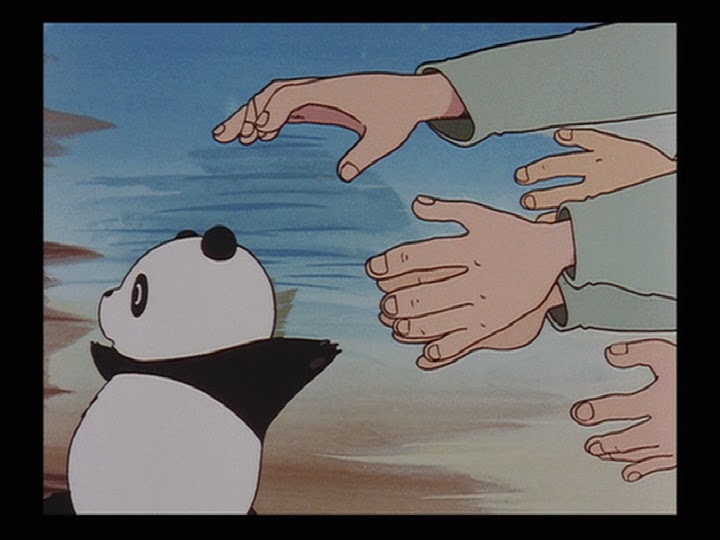
Little touches that I enjoy: the sight of a rural town massively flooded, a precursor to Miyazaki's own Ponyo; the shot of Baby Panda being chased by a sea of hands, again a precursor to the flashback scene in Nausicaa; a bumbling burglar voiced by Yasuo Yamada (Lupin); a runaway circus train, packed with animals, crashing through a town and stopping at the mayor's front gate. Everything is cheerful, everyone is having fun. What more can you ask for?

2015-04-20

Panda Kopanda, Chie, Gauche, Sherlock Blu-Ray and DVD in Japan July 17


Studio Ghibli is scheduled to release Panda Kopanda, Jarinko Chie, Gauche the Cellist, and Sherlock Hound on Blu-Ray and DVD in Japan this July 17. What a surprise! It appears that Ghibli is turning some attention to the "pre-Ghibli" eras of Hayao Miyazaki and Isao Takahata's long and storied careers.

None of these titles will feature the "silhouette" design reserved for the Ghibli catalog titles, since all pre-date the studio's founding by a number of years. But the cover designs do feature the original movie posters, in keeping with the remastered Ghibli DVDs.

Jarinko Chie is Isao Takahata's 1981 viciously funny comedy, rooted in the Kansei-region city of Kobe, and featuring the voice talents of one of Japan's popular comedy troupes (somebody out there, please help me with the names!). It's episodic structure is similar to My Neighbors the Yamadas, but more tightly wound around a central plot of a young girl (Chie) her struggles to fit within her dysfunctional family. The comedy leans heavily towards the slapstick and the gross-out, which is highly unusual for Takahata, and helps this movie stand out. Longtime friends and Toei Doga alums Yasuo Otsuka and Yoichi Kotabe served as the film's animation directors. It's a personal favorite of mine, and it remains criminally overlooked.

Gauche the Cellist is Takahata's 1982 feature, one of his true masterpieces. Lovingly crafted over the span of six years, this movie is pure poetry, masterfully blending historic melodrama, beautiful music, and a nostalgic longing for Japan's long-lost agrarian past. I want to live in Gauche's world (which is really Ludwig Van Beethoven's world), the fields and the forests, the gardens, the rainstorms and fiery sunsets, and the small yet tightly knit community, where modernity has yet to destroy nature.

Sherlock Hound was Hayao Miyazaki's 1981 TV series, which was created in collaboration with Italy. The production was scuttled after only six episodes were created, owing to copyrights issues with the Conan Doyle estate. Several episodes were shown alongside Miyazaki's Nausicaa of the Valley of Wind and Laputa: Castle in the Sky, and finally arrived on TV several years later...unfortunately, with a completely different animation team that was nowhere near as talented as Miyazaki's crew. This Blu-Ray features the "theatrical" version of the Sherlock episodes (meaning, we don't have the wonderful music from the TV show).

Finally, Panda Kopanda was created by Isao Takahata, Hayao Miyazaki and Yoichi Kotabe at the A Productions studio in 1972, hot on the heels of the infamous scuttling of their much-anticipated Pipi Longstockings animated project. Many of Pipi's ideas quickly found their way into this short movie, which played the opening slot for one of Toho's Godzilla pictures. The movie became a hit, and a sequel, Panda Kopanda and the Rainy Day Circus, was quickly commissioned and produced. They're both terrific little movies, and I often enjoy the second one a little more. I do wish more Panda cartoons had been made, and future animators seeking to continue Miyazaki's legacy may find inspiration here. And, as everyone knows, Panda could easily pass for Totoro's uncle, complete with a pipe and hat and that big, silly grin.

These Blu-Rays will retail for 5,800Yen, and the DVD will sell for 4,700. I don't yet know which, if any, will include English subtitles. Both Panda Kopanda and Gauche the Cellist previously had quality subtitles, so that's good. Jarinko Chie's prior BD/DVD releases did not include subtitles, which is too bad; a fansub translation has been available for a few years, and I really wish somebody had the sense to send copies of the script to Ghibli HQ. I don't think the previous Sherlock Hound BD included English subtitles.

Finally, will there be a US release for any of these titles? Discotek Media has released Panda Go Panda (the Westernized title) and Sherlock Hound on DVD. A Blu-Ray release isn't beyond the realm of possible. I know I would be thrilled to work on any of these projects. If you'd like that to happen, please send an email or letter directly to Discotek.

Outside of the United States, I would think that these movies would arrive in the usual territories sooner or later. As the Studio Ghibli catalog winds down, publishers will look to the earlier Takahata/Miyazaki films and find a host of hidden gems. It has to happen. It's only a matter of time.

2012-11-15

Panda Go Panda US Discotek DVD


Earlier this year, Discotek reissued Isao Takahata and Hayao Miyazaki's two Panda Kopanda short films on DVD, under the common Western title, "Panda Go Panda."  The previous home video release was handled by Geneon, which featured a butchered title sequence and no extras.  This 2012 version is much better by all counts.

The two short films - Panda Kopanda (1972), Panda Kopanda and the Rainy Day Circus (1973) - are included complete and uncut, which is nice if you're a fan of Animal Treasure Island and My Neighbor Totoro and enjoy their opening credit sequences.  For picture quality, I cannot speak from first-hand experience, but it does appear that Japan's Studio Ghibli DVD has a higher bitrate, which means a sharper, cleaner picture.  The US disc trades a lower bitrate in exchange for a 40-minute interview with director Takahata, and a 13-minute bonus feature.  All of these extras include English language subtitles.

Panda Go Panda deserves to be a part of your movie library.  For every fan of My Neighbor Totoro, it's an obvious must-have.  For everyone else, young and old alike, these two short animated films are a delight, free of cynicism or insincerity or shameless marketing.  These are the sort of cartoons I grew up watching, and I would very much like to see that tradition continue.

Discotek has been on an absolute tear this year.  Panda Go Panda and Lupin III: The Complete First TV Series are only the tip of the iceberg.  It's easy for anime fans to bemoan the state of the industry, but these gentlemen are working their tails off, day and night.  They deserve your support.

2012-01-25

Panda Go Panda DVD Coming April 17


Discotek has announced that April 17 will be the release date for Panda Go Panda on DVD in North America.  This is a very welcome return for the pair of Isao Takahata-directed short films, which have been out of print and out of circulation here for a number of years.  The new cover design is the same one that's been used overseas, and I've always enjoyed it.  Studio Ghibli's DVD release, naturally, remains the best.

I really do hope we get the uncut credit sequences.  I don't want to see that title hack-job that appeared on the Pioneer DVD release.  We will be watching closely, and hoping for the best.

Update: On their Facebook page, Discotek confirms that the original, uncut title sequences will be on the DVD.  Excellent news!

2011-12-11

Discotek Acquires Panda Kopanda DVD in 2012


Hot on the heels of scoring the original 1971-72 Lupin III television series, indie publisher Discotek has scored the DVD rights to Panda Kopanda.  The disc will be released sometime in 2012.  I don't know what extras, if any, are planned for inclusion, but I'd be more than happy to help out on the project.

As always, I highly recommend anime scholar Ben Ettinger for a commentary track.  If anyone at Discotek manages to read this, feel free to contact me and we'll get to work.

2011-11-02

Panda Kopanda Gets a Video Game, Sorta


We can always count on the videogames industry for innovation and original ideas.  Right?  Here's a shameless ripoff of Carnival Games (Nintendo Wii) for Sony's failed Move platform.  And starring the Papa Panda from Panda Kopanda, heh.

Speaking of which, the North American rights to Isao Takahata's two Panda Kopanda films have long since expired. Will any distributors pick up the rights and bring back the DVD?  These were great movies, and not just in that "I am Totoro's grandfather" sense.

2011-04-06

Miyazaki's Image Boards Book - Panda Kopanda


Let's take a look at some of the terrific image boards Hayao Miyazaki drew for Panda Kopanda, back in 1972.  Like the Totoro image boards, these appear in in the 1983 art book, Hayao Miyazaki Image Boards, and now they appear here in all their pencil-and-watercolor glory.

Panda Kopanda emerged in the wake of the Pipi Longstockings project, which was planned and developed by Isao Takahata and Miyazaki for a considerable time, only to be dashed to pieces once Astrid Lindgren, the author of the series of Pipi children's books, refused to grant the rights.  In many ways, it's a slighting that Miyazaki never forgave, and you can see similar red-haired, pigtailed females throughout his career.

The frustration and pent-up energy was poured into Panda Kopanda, as much of the old Toei Doga crew (Otsuka, Takahata, Miyazaki, Kotabe) were reunited at A Pro.  The result is a charming and amusing pair of short films.  I think the concept deserved more attention, perhaps a weekly TV series.  The two short episodes are not nearly enough.  Mimi and the pandas and the tiger, they're terrific fun, and it's over much too soon.

Older shows and movies are revived all the time; why not Panda Kopanda?  It has a great cast of characters.  It has a famous history and pedigree.  And it has almost limitless potential, at least in the right hands.  A team of clever writers and animators could really create something special.  Of course, the overwhelming odds are that any new Panda series would become a hideous train-wreck of Poochie proportions.  What I'm asking for is a classic cartoon, not a stupid and cynical toy commercial aimed at the stupidest and slowest kids in the room.  Nah, it'll never happen.  Maybe if you add futuristic robots and Tron light-cycles...Hmm, I wonder if Jesse Ventura would sign onto the project?

I better not tempt the fates.

2011-03-31

Riffs: For My Sister, Panda Kopanda

Riffs: For My Sister, Panda Kopanda

Riffs: For My Sister, Panda Kopanda

Hayao Miyazaki's 1983 picture book, For My Sister (Imoto He) is a short story, but does feature a couple of riffs on other works.  In this early panel, we see a stuffed panda in the sister's room - a nice reference to the two Panda Kopanda films from the early '70s.  Nice.

Speaking of which, now that I've finally figured out how jump breaks work, I'll be adding more Miyazaki comics to the blog.  That should be fun.

2010-06-05

Poster - Panda Kopanda (Ghibli Museum Library)


This is the 2008 movie poster for Panda Kopanda, as part of the Ghibli Museum Library series. This is Ghibli's showcase for international animation that is beloved by the studio, especially the founding directors. In addition to other's works, Isao Takahata and Hayao Miyazaki's earlier films are included. Panda Kopanda was the first, followed by Lupin III: Series One in 2009. Anne of Green Gables is the newest inclusion, and will be released on July 17, 2010.

These films are given a very limited release - a single theatre screen, in fact. DVD and Blu-Ray releases soon follow, except for Lupin III, which is available in Japan on DVD and Blu-Ray.

Panda Kopanda was once available in the US by Pioneer under the title, "Panda Go Panda." The DVD has been out of print for a number of years, and there doesn't seem to be much interest in bringing it back. Not sexy or violent or modern enough for today's anime crowd, I suppose. Sigh. Here is another no-brainer for Disney and Pixar.

I really dig this poster. It's taken from Miyazaki's original layout drawings for the movie, which were, in turn, based heavily on the doomed Pipi Longstockings project.

2009-08-02

Movie Review: Panda Kopanda (1972-73)

Review: Panda Kopanda
March 1, 2005

Panda go Panda is a charming, entertaining pair of 35-minute cartoon film shorts that appeared in Japan at the end of 1972 and the beginning of 1973. To most Americans, this will be a nice gift for the kiddies, and it may even win over adults with its irrepressible good charm and grace.

There will be a smaller group of folks, dedicated animation freaks, who will immediately recognize the show's creators: Hayao Miyazaki and Isao Takahata, the founders of the great Studio Ghibli and masterminds behind the finest animated films of the past two decades.

Even a creative genius must pay their dues, and for Miyazaki and Takahata, it's Panda go Panda. It was Miyazaki's first opportunity to create his own project, after a number of years as an animator for movies and television shows such as Lupin III, Gulliver's Space Travels, Puss in Boots, Animal Treasure Island, The Flying Ghost Ship, Ali Baba and the 40 Thieves, and Takahata's Hols, Prince of the Sun.

How many people know that Miyazaki's wife worked on these two Panda shorts? Or that later Ghibli stalwarts like Michiyo Yasuda and Yoshifumi Kondo contributed color, ideas and animation? Or that various moments and shots have reappeared in Grave of the Fireflies, Pom Poko, and My Neighbor Totoro (and possibly Spirited Away if you want to argue the case)? As you can see, Panda go Panda is a walking trivia book for the grown-ups, and it has remained a beloved memory for its creators.

The two Panda cartoons involve a young girl who lives in a country house while her grandmother is away. Two pandas, a small baby panda and a larger, strangely familiar papa panda, wander in and are immediately adopted by the little girl. The rest of the show involves a number of silly comic capers, laced with a gentle charm. This is a benign world, one without villains, really, or anything remotely harmful or scary.

It's interesting to see how early these notable Miyazaki traits have developed. This is very clearly Miyazaki's baby, and while Takahata directed, it's easy to see who was really calling the shots.

The most obvious comparison to make is to Totoro; quite a lot of Panda is later recycled into that later film, including characters, specific camera shots, and general plot points. Even the opening title sequence, featuring a dancing chorus line of pandas, was reimagined as dancing Totoros.

Dedicated Miyazaki fans will eventually discover that this is one of his most common traits. There are throwback bits and pieces of earlier works in all his later movies; most of them are references to Future Boy Conan or the Nausicaa books, but there are also riffs from his early animation work from Puss in Boots, Lupin III, and Panda go Panda.

There's one example I can think of that is absolutely, bloody brilliant, and as far as I know, nobody has pointed it out. In the first Panda cartoon, there's a scene where a policeman, riding on a bicycle, rides down a road and comes by the cottage the girl and panda family live in.

In Totoro's opening scene, we see an exact recreation of that shot. We see the same man on a bicycle riding down the road Now, this is the good part. The two girls see the man on the bike and hide inside the truck. After he passes, the older sister looks out, waves hello, and remarks, "Wow, that was lucky. I though he was a policeman!"

Now that's a great riff.

One can almost look at both movies and chart Miyazaki's growth and maturity over the 15 years between them, Each were the best children's story he could tell at the time. Panda go Panda is the work of a younger man eager to prove himself; My Neighbor Totoro is the work of a seasoned master. It should be an inspiration to all aspiring storytellers.

2009-07-30

Poster - Panda Kopanda (France)


Buta Connection has just reported that Panda Kopanda and Panda Kopanda & the Rainy-Day Circus will be released to theaters October 14 in France. Here is the new movie poster, which looks terrific.

Panda Kopanda was created in the wake of Isao Takahata and Hayao Miyazaki's Pipi Longstockings project was scuttled, and most of the old gang from Toei was on hand to contribute as well. The freewheeling atmosphere is clearly visable on the screen, and both Panda shorts have a peaceful, lighthearted feel that points back to Toei Doga, and forward to Heidi and, much later, My Neighbor Totoro.

Also included in the production team was a young 23-year-old Yoshifumi Kondo, who was discovered on Lupin III. He would become a crucial partner for both Miyazaki and Takahata, on Future Boy Conan, the second Lupin III series, Castle of Cagliostro, Anne of Green Gables, and Sherlock Hound. In 1984, Kondo directed the Nemo pilot, a true anime masterpiece, and later migrated to Studio Ghibli, where his success is well known.

2009-06-14

Panda Go Panda UK DVD


Manga UK has released Panda Kopanda recently, under the Western title, Panda Go Panda. The impressive cover design was first seen on the Australian release, and it also happens to be my favorite (certainly much better than the Pioneer disc that was released here in the US).

I haven't had time to contact Manga US to see if they plan on releasing the DVD here Stateside, but somebody should. They are the most likely candidate now that Pioneer's license has expired. Hopefully, the Panda films will remain uncut; the US version chopped out the opening sequence, replacing them with tepid still shots, ala Saturday morning cartoons. And let us not forget Manga US' similar mangling of the title sequence for Castle of Cagliostro (read about it here and here). Let's hope Panda Kopanda fares better.

2009-05-10

Panda Kopanda Japanese DVD


This is the Japanese DVD for Panda Kopanda. It was released just last year, following an exhibit at the Ghibli Museum, and it's placed under the "Ghibli Museum Library" label. This is the label the studio uses for various animation films from around the world that they've brough to Japan for theatrical releases.

This Panda DVD replaces an older release, which I happen to have in my collection. I haven't bought this newest version yet, so I don't know what improvements have been made. Hopefully the picture quality has been improved; the older version suffered from a slightly fuzzy look. These are all common problems with hand-drawn animation on the DVD format, and we've had to make our peace with them. Blu-Ray will look substantially better.

My older Panda Kopanda DVD included an hour's worth of interviews with Isao Takahata and Hayao Miyazaki, and I'm sure they are also included in the newer version. The major addition to the 2008 version are Miyazaki's image boards, which I'm sure look fantastic (that's one of his image boards on the cover). It's enough for me to shell out the money one more time.

I have a direct link for Panda Kopanda under the "Buy These DVDs" section. Why am I not getting paid for shilling this stuff? Somebody ought to be cutting me a check, or at least buying me lunch. My sesame chicken habit is getting expensive.

Photos - Panda Kopanda


This is one of my favorite shots from Panda Kopanda. Yeah, I know, it's a cheap little gag, having a big panda bear on the city bus. But it makes me chuckle. And I think that's me there on the left, snoozing away. I can't help it if the buses and the light-rail makes me sleepy.

2009-04-29

Photos - Panda Kopanda and the Rainy Day Circus


Someone asked me for some large-sized pics from Panda Kopanda, so I figured I'd oblige with some of these from Rainy Day Circus.

I especially love the shot of the baby panda being chased by the hands. It reminds me a lot of a similar shot in the Nausicaa flashback scene. Very stylish. This is the better Panda movie, I think. The rainstorm that floods the whole town feels so wonderfully inspired. Instead of becoming threatening, it's just an excuse for an impromptu picnic. This is a benevelent world, one you want to explore in. It's very peaceful and free of cheesy melodrama.

I've often wondered why Panda Kopanda was never spun off into a growing franchise, or why nobody else has taken a swing at another short film. No doubt the shadow of Takahata and Miyazaki and their peers is daunting, perhaps too daunting for anyone else to give it a go.

How about someone from the West? Or are we too trapped by convention and cliche to do justice to this peaceful little world? I think it would be a good challenge for an American studio to tackle, provided they could free themselves to many of the worst Disney cartoon cliches. If someone could deliver the right touch, that storybook feel, they'd really have something special on their hands.

Oh, and do I have to make a formal request for Disney to release Panda Kopanda on DVD and Blu-Ray? Or does Pioneer still have the rights?

Panda Kopanda Rama


Here's something I'm sure you'll enjoy: Panda Kopanda screenshots. Lots of 'em. Lots and lots of 'em. It's a Panda Kopanda-Rama! This is a very large collection of pics, so click on that pic above for the full-size view.

This collection of photos are from both Panda movies. I bought Ghibli's Japanese DVD a few years ago, and I see they have already updated with a newer version. I don't know if it's any better than the disc I already have, so I might just hold out for the inevitable Blu-Ray release.

Pioneer has the rights to Panda Kopanda in the West, but the North American DVD has been out of print for some time. Worse yet, they chopped up the movie's opening sequence, replacing some English text over still photos, and stitched the two short films together. In other words, Panda was turned into a Saturday morning cartoon. Oh, and the dub is just hideously bad. At least I think so.

So, in any event, you're better off importing your DVD from elsewhere.

So, now...is that large enough for ya?

2009-04-14

Miyazaki's Cameos


Last night, we took a look at Isao Takahata's cameo appearance in Grave of the Fireflies. Tonight, let's take a look at Miyazaki.

In a looser sense, you could point to many of Miyazaki's characters from his career as self-portraits, like Future Boy Conan or Porco Rosso or Howl. But that's not what I'm talking about now. I mean the good 'ol fashioned movie cameo. Roll the tape!

Miyazaki makes his first cameo here, in the final episode of the original 1971-72 series Lupin III. In fact, he appears twice, in successive shots during a crazed car chase. In this first shot, young Hayao-san is sitting in the car on the left. If you look to the right, you will also see Yasuo Otsuka, proudly showing off his jeep to a friend.

Here is the second appearance a few seconds later. The car crashes through the house, breaking through the Miyazaki clan, including wife and son. Hmm...I've wondered if that was meant to be the young Goro in this cut. Definitely one of the two boys.

It's pretty interesting, at that, seeing father and son together, not just because of their surrounding interactions and family dramas with Studio Ghibli so many years later. It's interesting because Miyazaki poses with his son at the end of Panda Kopanda. This is the long pan of the crowd at the zoo, and it appears that the entire production team appears scattered in the crowd. I've long wondered just how many cameos are packed into this scene, and maybe one of these days, somebody will be in a position to ask.

Note to Pixar employees: pass those Panda Kopanda pics along to John Lasseter and have him quiz Miyazaki-san the next time they meet. You'll have your chance later this year for the US Ponyo premier. Who's up to the challenge? Will no one rid me of this meddlesome priest?!

2007-01-06

Movie Posters - Panda Kopanda


Here's the movie poster for the first Panda Kopanda movie from 1972. I've seen a Japanese website by a person who claims to be selling these movie posters. I think I've mentioned him before in the past, only briefly, but I've never determined if the site was ever legitimate. Instead of any proper online merchant, you have to email the website owner, and apparantly send a Paypal check. So I'm really not sure if he's on the up-and-up, which is too bad, because he claims to have Studio Ghibli movie posters for sale, as well as earlier ones like Puss in Boots and Future Boy Conan and Panda Kopanda.

In any case, we get to look at this and admire. Would be nicer to have hanging from a wall.

2007-01-05

Who Are These People?!

Alright, here's a mystery that I have yet to solve. We've already seen the cameos of Yasuo Otsuka and Hayao Miyazaki (and family) from the final episode of Lupin III. There's one other major instance of cameos, and it comes at the end of the first Panda Kopanda cartoon.

At the end of the film, there's a leftward pan of a crowd waiting to see Papa Panda at the zoo, and it's packed with all the people who made Panda Kopanda. This was a beloved project, because it was the first reunion of the old gang from Toei Doga. Everyone had moved away, one after another, starting with Otsuka in 1969, after completing Puss in Boots. Eventually, everyone apart from Yasuji Mori - Takahata, Miyazaki, Otsuka, Akemi Ota, Yoichi Kotabe, Reiko Okuyama, Michiyo Yasuda, yadda yadda - had made the jump to A-Pro. After Lupin was finished, and the Pipi Longstockings project fell through, Panda Kopanda was churned out to vent all that frustration and pent-up energy.

Also, let's not forget a 22-year-old Yoshifumi Kondo, who joined the gang on Lupin. So you can see why the Panda cartoons, and especially the first one, have such a vibrant energy. The thing just pulses with life, like a pack of schoolkids let loose on a snow day.

So, here's the big question about this crowd shot at the end: who's who? You can pretty easily spot the real people, since most of the faces are simple, iconic cartoon faces. I managed to take three pictures, so everyone can take their best guesses.

This is something for John Lasseter to ask about the next time he travels to Japan. Or Ben Ettinger - maybe he knows who's who.

In the second photo, you can spot Lupin and Jigen, which is funny. Just below them, you can see the birthday boy - he's pretty easy to spot with the glasses and son hanging on him. In the third photo, at bottom right, it looks like Kotabe. He has that kind of long face, so that's my guess. Was that Okuyama at the end of the first photo? And who's the girl at the opposite end of the third picture? I see the hair and the blue outfit, so I'm thinking that's Ota, the wife. Again, I'm just guessing, and trying to plug my own Miyazaki Heroine theory into the mix.

I'm pretty stumped on this one, and I'm dying to know. Pass this among your so-called Ghibli friends and see if they can spot anyone. Use this as a benchmark to see how devoted a fan they really are. Get somebody at Pixar on the horn!

More Ghibli Blog Posts To Discover