Hustle Punch is a TV anime series created by Toei Doga and broadcast in 1965. It ran for only 26 episodes, but is an excellent cartoon with a very strong Hanna-Barbara groove. The series was masterminded by Yasuji Mori, Isao Takahata directed the opening sequence, Hayao Miyazaki and Yoichi Kotabe were key animators, and pretty much the whole gang of regulars that we all know and love worked on this series, which took place while Horus, Prince of the Sun was in pre-production.
Youtube user Felipe Jimenez has compiled all 26 episodes into this single video. It's a great discovery, although the video quality suffers from occasional glitching and there are no English subtitles. That's okay, since you're watching a lot of goofy slapstick cartoon gags that anyone can understand.
Beyond that, some of the animal characters from this series appeared in Animal Treasure Island, and the fox character also appeared as the villain in the third Puss in Boots movie from 1976. Finally, we can see that the junkyard and safe that appears in the opening was later riffed by Hayao Miyazaki in the final episode of Lupin the 3rd: Series One in 1972. Small world.
As always, be sure to watch this show before Toei gets wise and has it removed.

Showing posts with label toei doga. Show all posts
Showing posts with label toei doga. Show all posts
2020-05-11


Isao Takahata: GeGeGe no Kitaro (1971)
GeGeGe no Kitaro is a popular manga comic that has spawned a number of TV anime series over the years. The first series was produced by Toei Doga and ran from 1968-1969. A second series, this time in color, was created in 1971. Isao Takahata had a minor involvement on this show, directing episode 62 of the original series and episode 5 of the second.
Takahata also directed the opening and ending sequences for the 1971 series, making this his final work with Toei Doga before leaving with Hayao Miyazaki and Yoichi Kotabe to A Productions to join Yasuo Otsuka for Lupin the 3rd and Pippi Longstockings. A Youtube video of this has been posted below.
Currently, there are no complete episodes of the 1968/1971 GeGeGe series on Youtube, but complete box sets are available in Japan for the price of a kidney or any other major organ. One of these days, one of us will have to bite the bullet and purchase those, if only so that we can finally see the Paku-san episodes. Until then, we have his credit sequences to enjoy and share.
Takahata also directed the opening and ending sequences for the 1971 series, making this his final work with Toei Doga before leaving with Hayao Miyazaki and Yoichi Kotabe to A Productions to join Yasuo Otsuka for Lupin the 3rd and Pippi Longstockings. A Youtube video of this has been posted below.
Currently, there are no complete episodes of the 1968/1971 GeGeGe series on Youtube, but complete box sets are available in Japan for the price of a kidney or any other major organ. One of these days, one of us will have to bite the bullet and purchase those, if only so that we can finally see the Paku-san episodes. Until then, we have his credit sequences to enjoy and share.
Isao Takahata Episodes of Moretsu Ataro
Moretsu Ataro (Ataro the Workaholic) is a television anime series created by Toei Doga in 1969-70. Adapted from a gag comic that ran from 1967-1970 in Weekly Shonen Sunday, it's a purely zany and wacky kids cartoon. Isao Takahata directed episodes 10, 14, 36, 44, 51, 59, 71, 77 and 90 (the series finale).
Thanks to Youtube user Mr. Batsugoro, the entire series run has been posted online. There are no English subtitles, but as is the case with most vintage anime, you learn to live with it. What matters is that we are finally able to watch these episodes.
I am posting all of the Takahata-directed episodes here. As always, I strongly urge everyone to store these episodes for posterity. These things have a nasty habit of disappearing suddenly and without warning, and the chances of seeing a commercial release in the West is slightly less than zero. Remember all those fansub copies of the classic Toei Doga feature films that vanished off the face of the earth? Good luck finding those again.
It's always a thrill to discover more of Takahata's work, particularly the late post-Horus Toei period. Enjoy!
Thanks to Youtube user Mr. Batsugoro, the entire series run has been posted online. There are no English subtitles, but as is the case with most vintage anime, you learn to live with it. What matters is that we are finally able to watch these episodes.
I am posting all of the Takahata-directed episodes here. As always, I strongly urge everyone to store these episodes for posterity. These things have a nasty habit of disappearing suddenly and without warning, and the chances of seeing a commercial release in the West is slightly less than zero. Remember all those fansub copies of the classic Toei Doga feature films that vanished off the face of the earth? Good luck finding those again.
It's always a thrill to discover more of Takahata's work, particularly the late post-Horus Toei period. Enjoy!
2020-04-01
Toei Doga Movie Trailers: From Hakujaden to Sinbad
A YouTube member named Kenshiro Minami has posted a video compilation of trailers for the first six Toei Doga animated feature films. This is a terrific find that I am happy to share with you.
As we all know, Toei Doga was the leading animation studio in Japan's postwar years, growing into a powerhouse that trained, educated and inspired an entire generation of animators. Nearly every famous anime artist or director from the 1970s and 1980s got their start at "Toei University." And that includes Isao Takahata, Hayao Miyazaki and their many friends with whom they crafted so many classic films and television shows.
The movies featured in this compilation include: Hakujaden (1958), Shonen Sarutobe Sasuke (1959), Saiyuki (1960), Anju to Zuzhiomaru (1961), The Adventures of Sinbad (1962) and Wanpaku Oji no Orochi Taiji (1963).
All of these movies were given limited theatrical release in the US, usually with a change in title, all-star cast and the addition of new musical numbers. These are interesting historical curios that are worth checking out, and are available on VHS and LaserDisc. Alakazam the Great (aka Saiyuki) was even released on Netflix and Amazon Video.
Of course, none of these Westernized variants are anywhere as good as the Japanese originals, which stand as true animated classics of a bygone era, as good as animated classics from Russia, France and America. They remain almost entirely unknown, and only a small number of titles were released outside of Japan on DVD. In Japan, Toei is only now beginning to open the vaults for complete restorations on Blu-Ray, but only for a select few.
In the States, only three Toei Doga films were released on DVD, all by Discotek: Horus, Prince of the Sun, Puss in Boots and Animal Treasure Island. The latter two are now out-of-print and highly collectible, while Horus has also been released on Blu-Ray.
The first six Toei Doga features represent an era of complete creative freedom and dominance. In 1963, manga legend Osamu Tezuka, who collaborated on Saiyuki, Anju and Sinbad, founded his own animation studio called Mushi Productions and moved into television, sweeping in the TV anime era with Tetsuon Atom, aka Astro Boy. The winds of change were sweeping through the industry, and before long, nothing would ever be the same again.
2019-11-19
Poster: Gulliver's Space Travels


Here are two movie posters for the 1963 Toei Doga animated feature film Gulliver's Space Travels. Specifically, these belong to the US version, dubbed Gulliver's Travels Beyond the Moon. This is a terrific movie that's full of spark and adventure and color, a nice change from the usual Toei fare of Eastern myths and fairy tales. It has a very distinct Western flair in its visual design and story that helps set it apart from just about anything at the time.
Hayao Miyazaki fans know about this movie, of course. It was his second feature film as an in-between animator, and he famously drew attention by suggesting a vital change to the movie's ending, one that was embraced by the director and production team. The scene in question was later riffed in My Neighbor Totoro in one of those cool "blink and you'll miss it" moments.
The US version of Gulliver is very nice and benefits nicely from the source material. The voices are not too irritating and the songs are bearable. By anime dub standards, you could do a lot worse. These poster designs are also very nice, especially the second one which is washed in rich color tones and dynamic character poses.
It's very unfortunate that the Toei Doga classics are all but impossible to find today. A decade ago, a few dedicated fans created English fansubs for nearly all of their anime feature films, but the websites are gone and its creators vanished. Today, you might be able to track down the Japanese DVDs that were released around the turn of the century, but you'll have to live without subtitles. Hopefully, that situation will change one day.
P.S. Here's a great surprise: Gulliver's Space Travels is available on YouTube, in the original Japanese audio and English subtitles. Check this out before it gets pulled down.
2019-09-07
Toei Channel To Broadcast 4K Restorations of Toei Doga Classics


According to the official Toei website, this series will coincide with the hotly anticipated daytime drama series, "Natsuzora," a retelling of the animation studio's early days. All of the characters are based on real Toei alumni, including Reiko Okuyama, Yoichi Kotabe, Yasuo Otsuka, Akemi Ota, Michiyo Yasuda, Isao Takahata and Hayao Miyazaki. The drama will appear on the NHK network, which many Studio Ghibli fans will recognize.
In addition to their animated features, Toei will broadcast a 1959 documentary about the making of the studio's second feature, Shonen Sarutobe Sasuke. It should prove to be an invaluable document of the era, even though its portrayal of the making of an animated movie will most likely be itself carefully staged. Hopefully, we will catch a glimpse of a very young Isao Takahata, who worked on the film as assistant director.
Best of all (for me) will be the premier of a new documentary program on Horus, Prince of the Sun that features interviews with the artists and animators, a look at production artwork and more. I do hope the show's creators were able to speak to Paku-san while he was still alive. I would hope that there are some new discoveries to be made about this anime masterpiece. I shared pretty much everything I know for the BD audio commentary track, as well as the supplemental essays and production gallery (and, by the way, you're freaking welcome).
For those of us in the West, the most exciting prospect of these 4K restorations is the possibility of new home video releases on Blu-Ray or Ultra Blu-Ray. Of the classic Toei Doga library, only a handful of films have been released in Europe and America, and continuing rights issues over the domestic (dubbed) versions may complicate matters. As always, such matters can be solved by writing a lot of checks, but the limited appeal of classic Japanese animation may stop such plans cold.
In Japan, the only Toei Doga anime film to be released on Blu-Ray was Horus, Prince of the Sun (which was also released here). Everything else was released on DVD, but nearly all of those titles were simple transfers from LaserDisc. Most of the DVDs were given English fan translations some years ago, but it's nearly impossible to find any of those movies online today.
Needless to say, now would be a terrific time for Discotek or GKIDS to pick up these movies for a US release. Start your email and letter campaigns immediately, kids. Christmas is only three months away.
2018-04-15
Photos: Moretsu Ataro (1969-70)


The following screenshots come from episodes of Moretsu Ataro directed by Isao Takahata. The Toei Doga TV anime series ran from 1969-70 for 90 episodes. I found these screenshots from the Toei website while doing research.
One thing I really enjoy about these Toei anime programs from the 1960s is how they still embrace a Western cartoon style that will almost completely disappear in the 1970s and beyond. As much as I embrace anime's evolution away from the Disney paradigm and towards new horizons, I do hope they wouldn't forget the joys of a simple gag cartoon with really inspired animation and goofy humor.
Maybe I'm just feeling really nostalgic for Rocky & Bullwinkle and Hanna-Barbara these days. I'd really like to see this show. It looks really fun, the character designs are inspired in that classic-moderist fashion. And most importantly for this website, Paku-san directed these. What more do ya want?
The Films of Isao Takahata, Part I: Toei Doga
When Isao Takahata passed away last week, he left behind 50 years of many groundbreaking, visionary works in film and television, in animation and live-action. We're going to take a look at the director's complete career, including all of his directorial works. In this installment, we will look at Paku-san's early career with the Toei Animation studio.
Isao Takahata was born in 1935, and was recruited by the Toei Doga animation studio while still a university student in the late 1950s. After graduation in 1959, he was hired by the company and entered into their directors program. For the next several years, he would be trained in animation and filmmaking, learning the ropes, always hoping to apply his love of French and Japanese New Wave and Neo-Realist cinema, and join with the rising young generation of animators to forge the modern anime era.

Anju to Zushiomaru (1961)
Takahata served as assistant director on Toei Doga's fourth animated feature film, which is a major shift in tone from the studio's first three animated features. A loose retelling of the fable Sancho the Baliff, this movie focuses on character melodrama and tragedy than cartoon adventures, and its tone is comparatively dark and bleak. According to anime scholar Ben Ettinger, this film was not received well by the Toei animators, who believed that it endorsed passive acceptance of authority figures. All of these factors no doubt had a great impact on the young filmmaker. It is not known what role Takahata played in this film, beyond that of an apprenticeship.
I have watched this movie, and the tragic melodrama was very surprising to me, but the movie as a whole felt very sluggish and sloppy, more like a thematic experiment than anything else. The story is very uneven, particularly when the tone completely changes in the second half. That said, there is an interesting sword fight and a battle against a giant spider at the end because, well, every movie needs a big monster fight.
Anju is not one of my favorites, but I think it's worth seeing for diehard anime and cartoon fans, if only once.

Tanoshii Bunmeishi: Tetsu Monogatari (Interesting History of Civilization: The Story of Iron) (1962)
Here is an interesting and little-known entry. The Story of Iron is a 23-minute short film that premiered on April 22, 1962 in Japanese theaters. It was produced in tandem between Toei Doga and Iwanami Productions, a provider of sponsored educational and PR firms. Takahata again served as assistant director, and is also credited as a production assistant (according to the Japanese Wikipedia page) or script supervisor (according to US Wikipedia).
It appears that this short film was something of an educational film, an animated documentary. This screenshot is the only physical documentation that I could find. I could find, however, more material about Iwanami Eiga Seisakusho, including a 2015 book published by Yale University Press titled, "The Dawn of Cinematic Modernism: Iwanami Productions and Postwar Japanese Cinema", written by Takuya Tsunoda, PhD.
I could not find any evidence that this film was ever released on home video. There was at least one Iwanami compilation DVD, so it's possible that it was preserved. The above photo most likely came from a print source, either a book or newspaper.

Wanpaku Oji no Orochi Taiji (Little Prince and the Eight-Headed Dragon) (1963)
Here is a true classic, one of the all-time great Toei Doga animated features, a thrilling visual spectacle with amazing action scenes, wonderful characters, varied environments a fantastic climactic battle (a Toei staple) and even a good dance number. The animators are really show off their skills with confidence and grace, and the result is the studio's best movie yet.
Takahata served as assistant director on this movie, and while it's difficult to say what scenes were his, or what influence he had on the production, there is no doubt that the cinematic shots and more three-dimensional compositions made an impact on his career. There are moments in the battle against the eight-headed dragon that feel like Paku-san, and I noticed several brief shots that were "riffed" in Horus, Prince of the Sun. Of course, that might also be the influence of key animator Yasuo Otsuka, who was the animation director on Horus and animated the legendary fish battle.
I really love this movie, and wish a US distributor would pick it up for release. I'd also like to see Toei release this title on Blu-Ray; to date, Horus remains their only high-definiton release of their "classic era" feature films. That really ought to change.

Ankokukai Saidai no Ketto (The Biggest Duel in the Underworld) (1963)
This is a surprise, one that I had to search long and hard on Japanese websites to verify. The Biggest Duel in the Underworld is a live-action Yakuza gangster picture directed by Umetsugu Inoue, a prolific filmmaker who worked for all six major Japanese movie studios, and even worked for the Shaw Brothers in Hong Kong. Isao Takahata is listed as one of two assistant directors for this movie, which mostly involves tough, cool gangers looking tough and cool and shooting up the place.
The trailer is available on YouTube, which is where I snapped a few screenshots. A DVD is available in Japan but without English subtitles, and no fan translations currently exist. It's a pity that Discotek Media no longer imports pulpy live-action movies, as they did in their early days, because this movie would be perfect for cult movie fans.
Again, I have no idea what role Paku-san played in this production, but we can see the seeds to his unique filmmaking style, influenced greatly by New Wave and documentary films, and bringing those qualities to animation. I may have to buy the DVD just so check it out. Maybe I'll become hooked on Japanese gangster pictures.

Okami Shonen Ken (Wolf Boy Ken) (1963)
Now we come to Isao Takahata's directorial debut on Toei Doga's first TV cartoon show, Wolf Boy Ken, which followed on the heels of Osamu Tezuka's and Mushi Production's landmark Tetsuwan Atom, aka Astro Boy. The TV anime era had arrived, beginning a radical change away from lavish feature film productions. The series ran for 86 episodes over two years and remains a beloved staple. A pilot episode was even dubbed into English for a potential US release, but those plans were never realized.
Takahata directed twelve episodes of the series: 6, 14, 19, 24, 32, 38, 45, 51, 58, 66, 72, and 80. There are clips of several episodes on YouTube, but none of Paku-san's. The entire series was released on three DVD volumes in Japan, but without English subtitles. The prices are very affordable, however, so anime and cartoon fans should purchase a copy.

Hustle Punch (1965)
Hustle Punch should have been brought to America. It's a classic cartoon with animals, slapstick violence, and would have fit in nicely with Hanna-Barbara and Looney Tunes. What more do ya want? This show only ran for 26 episodes, but don't let that hold you back. The Jetsons only ran for 13 episodes, and it's an all-time classic. This series was created by founding Toei animator Yasuji Mori, and features key animation from Hayao Miyazaki, Yoichi Kotabe and most of the gang.
Isao Takahata did not direct any episodes, as pre-production for Horus, Prince of the Sun had already begun. He did direct the opening, however, which is terrific, and you can watch it on YouTube. Notice how the main characters pop out of a refrigerator in a junk yard? Takahata and Miyazaki paid tribute to this in the final episode of the "green jacket" Lupin the 3rd TV series. Some of the animal characters would also reappear in the Toei movies Animal Treasure Island (a classic) and Puss in Boots 3: Around the World in 80 Days (a stinker).

The Great Adventure of Horus, Prince of the Sun (1968)
Alright, the next person who uses the words "Little Norse Prince" will be smacked upside the head with a rolled up newspaper. Use the name "Horus, Prince of the Sun." That's the title on the DVD and Blu-Ray, not "Widdle Baby Schnooky Wookums." Got it? Good.
After years of preparation, planning, theorizing and growing, Isao Takahata and his band of merry rebels unleashed an anime masterpiece that took everything that was great about classic Toei Doga, added in a wealth of new animation theories and modes of expression, and transformed the medium.
We all know the story about this movie, that it was a troubled production, that Takahata had to fight the studio bosses over every scrap, being told "you can't do this" and "you can't do that," only to have him immediately turn around and do it anyway. The resulting movie is a towering masterpiece that liberated Japanese animation from the Western Disney archetype of children's fairy tales, opening the door for complex characters, adult themes, moral nuance, graphic violence, and visual stylization. This is where "manga eiga" became "anime."
Paku-san was the mastermind, but he relied upon his core team of animators, including Yasuo Otsuka, Hayao Miyazaki, Yoichi Kotabe, Reiko Okuyama, Yasuji Mori, etc. etc. This was a team effort, and one reason why this movie's influence was so wide was that those same artists would soon explode across the anime landscape, working on such diverse works as Lupin the 3rd, Belladonna of Sadness, Heidi, Future Boy Conan, and, of course, Studio Ghibli.
Simply put, if you don't have this movie in your Blu-Ray collection, you're not an anime fan. End of story.

Himitsu no Akko-Chan (The Secret of Akko-Chan) (1969-70)
Horus was far too experimental and radical for 1968 audiences, and it was pulled from Japanese theaters after only ten days, the studio's biggest box-office failure to that point. As punishment, he was demoted, sent back to television, and assigned as assistant director for this popular TV "magical girl" anime series, based on a popular girls comic book.
I actually found an episode on YouTube, and it's a pleasant surprise. It's definitely a "girl" cartoon with a fair mix of family drama and comedy, which, when you think about it, makes a lot of sense. You can see the seeds of inspiration for future Takahata films like Jarinko Chie, especially with a pair of childhood flashback scenes that are nearly identical to Omohide Poro Poro. So Paku-san wasn't merely punching in a time card. He was still actively creating.
Fun Fact: Hayao Miyazaki also worked as key animator on episodes 44 and 61.
This series was released on a DVD box set in Japan, but no English subtitles are included. Expect to spend...how much? What? $200?! Are you out of your damned minds?

GeGeGe no Kitaro (1968-69, 1971)
This Halloween monster-themed series, adapted from a popular manga comic, is very fascinating. I'm a big fan of classic monster movies and TV shows like The Munsters and The Addams Family, so GeGeGe no Kitaru could become a favorite if I ever get a chance to see some episodes.
According to research, Takahata directed only one episode of this late '60s TV series, number 62. A second TV series, this time in color, aired in 1971, and Takahata directed the opening and closing credit sequences, as well as episode 5. Those credit scenes are available on YouTube, and it's a very fascinating discovery for Ghibli fans. It shows the title character, a young boy with goth hair, running through a graveyard with an assortment of strange monsters. Several of them are also seen, many years later, in the "ghost parade" sequence in Pom Poko.
The 1971 opening is very visually sophisticated, with parallax scrolling, more complex backgrounds, and a greater use of 3D space. We even see the "camera" placed very low, practically at ground level. This is far superior to the original 1969 opening, which focuses squarely on simple character movements and 2D cartoon movements. It's another demonstration of Takahata's highly intelligent and cinematic approach to animation direction, and would prove to be his final work for Toei Doga before leaving to join Yasuo Otsuka at A Productions.
Black Hole Reviews has a great essay on the GeGeGe series, including all the TV and movie adaptations over the years. DVD box sets are also available, but frightfully expensive.
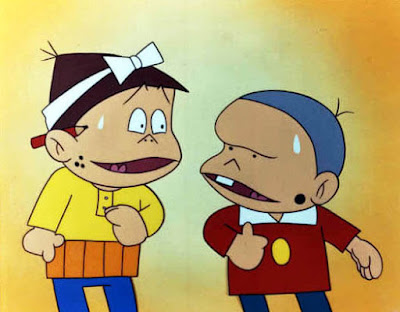
Moretsu Ataro (Ataro the Workaholic) (1969-70)
Finally, we have Moretsu Ataro, a comedy cartoon based on a weekly gag comic. With this series, Takahata returns to the director's chair for an extended period, directing episodes 10, 14, 36, 44, 51, 59, 71, 77, and 90. He also directed the opening and closing segments of the final 20 episodes, which I presume are the color episodes (the show began in black-and-white).
I have only seen the b/w and color opening and closing sequences, so I cannot comment on this series. You can read episode summaries (w/screenshots) on the Toei website. I can report that the color version is much more sophisticated and varied than the b/w version. It's not quite up to the level of GeGeGe, but very impressive. I do wish I could see some episodes. This looks to be a very funny cartoon.
The entire series was released on home video in Japan in 2007 and again in 2016, both as expensive DVD box sets. I do wish these prices could come down. Doesn't Toei want us to watch these shows? I think there could be a willing audience if the barriers to entry weren't so high.
That's the end of Part I, where we looked at Isao Takahata's early years at Toei Doga. Horus is the obvious standout, but there are other titles worth discovering. In the next part, we will discuss his work in the 1970s.
Isao Takahata was born in 1935, and was recruited by the Toei Doga animation studio while still a university student in the late 1950s. After graduation in 1959, he was hired by the company and entered into their directors program. For the next several years, he would be trained in animation and filmmaking, learning the ropes, always hoping to apply his love of French and Japanese New Wave and Neo-Realist cinema, and join with the rising young generation of animators to forge the modern anime era.

Anju to Zushiomaru (1961)
Takahata served as assistant director on Toei Doga's fourth animated feature film, which is a major shift in tone from the studio's first three animated features. A loose retelling of the fable Sancho the Baliff, this movie focuses on character melodrama and tragedy than cartoon adventures, and its tone is comparatively dark and bleak. According to anime scholar Ben Ettinger, this film was not received well by the Toei animators, who believed that it endorsed passive acceptance of authority figures. All of these factors no doubt had a great impact on the young filmmaker. It is not known what role Takahata played in this film, beyond that of an apprenticeship.
I have watched this movie, and the tragic melodrama was very surprising to me, but the movie as a whole felt very sluggish and sloppy, more like a thematic experiment than anything else. The story is very uneven, particularly when the tone completely changes in the second half. That said, there is an interesting sword fight and a battle against a giant spider at the end because, well, every movie needs a big monster fight.
Anju is not one of my favorites, but I think it's worth seeing for diehard anime and cartoon fans, if only once.

Tanoshii Bunmeishi: Tetsu Monogatari (Interesting History of Civilization: The Story of Iron) (1962)
Here is an interesting and little-known entry. The Story of Iron is a 23-minute short film that premiered on April 22, 1962 in Japanese theaters. It was produced in tandem between Toei Doga and Iwanami Productions, a provider of sponsored educational and PR firms. Takahata again served as assistant director, and is also credited as a production assistant (according to the Japanese Wikipedia page) or script supervisor (according to US Wikipedia).
It appears that this short film was something of an educational film, an animated documentary. This screenshot is the only physical documentation that I could find. I could find, however, more material about Iwanami Eiga Seisakusho, including a 2015 book published by Yale University Press titled, "The Dawn of Cinematic Modernism: Iwanami Productions and Postwar Japanese Cinema", written by Takuya Tsunoda, PhD.
I could not find any evidence that this film was ever released on home video. There was at least one Iwanami compilation DVD, so it's possible that it was preserved. The above photo most likely came from a print source, either a book or newspaper.

Wanpaku Oji no Orochi Taiji (Little Prince and the Eight-Headed Dragon) (1963)
Here is a true classic, one of the all-time great Toei Doga animated features, a thrilling visual spectacle with amazing action scenes, wonderful characters, varied environments a fantastic climactic battle (a Toei staple) and even a good dance number. The animators are really show off their skills with confidence and grace, and the result is the studio's best movie yet.
Takahata served as assistant director on this movie, and while it's difficult to say what scenes were his, or what influence he had on the production, there is no doubt that the cinematic shots and more three-dimensional compositions made an impact on his career. There are moments in the battle against the eight-headed dragon that feel like Paku-san, and I noticed several brief shots that were "riffed" in Horus, Prince of the Sun. Of course, that might also be the influence of key animator Yasuo Otsuka, who was the animation director on Horus and animated the legendary fish battle.
I really love this movie, and wish a US distributor would pick it up for release. I'd also like to see Toei release this title on Blu-Ray; to date, Horus remains their only high-definiton release of their "classic era" feature films. That really ought to change.

Ankokukai Saidai no Ketto (The Biggest Duel in the Underworld) (1963)
This is a surprise, one that I had to search long and hard on Japanese websites to verify. The Biggest Duel in the Underworld is a live-action Yakuza gangster picture directed by Umetsugu Inoue, a prolific filmmaker who worked for all six major Japanese movie studios, and even worked for the Shaw Brothers in Hong Kong. Isao Takahata is listed as one of two assistant directors for this movie, which mostly involves tough, cool gangers looking tough and cool and shooting up the place.
The trailer is available on YouTube, which is where I snapped a few screenshots. A DVD is available in Japan but without English subtitles, and no fan translations currently exist. It's a pity that Discotek Media no longer imports pulpy live-action movies, as they did in their early days, because this movie would be perfect for cult movie fans.
Again, I have no idea what role Paku-san played in this production, but we can see the seeds to his unique filmmaking style, influenced greatly by New Wave and documentary films, and bringing those qualities to animation. I may have to buy the DVD just so check it out. Maybe I'll become hooked on Japanese gangster pictures.

Okami Shonen Ken (Wolf Boy Ken) (1963)
Now we come to Isao Takahata's directorial debut on Toei Doga's first TV cartoon show, Wolf Boy Ken, which followed on the heels of Osamu Tezuka's and Mushi Production's landmark Tetsuwan Atom, aka Astro Boy. The TV anime era had arrived, beginning a radical change away from lavish feature film productions. The series ran for 86 episodes over two years and remains a beloved staple. A pilot episode was even dubbed into English for a potential US release, but those plans were never realized.
Takahata directed twelve episodes of the series: 6, 14, 19, 24, 32, 38, 45, 51, 58, 66, 72, and 80. There are clips of several episodes on YouTube, but none of Paku-san's. The entire series was released on three DVD volumes in Japan, but without English subtitles. The prices are very affordable, however, so anime and cartoon fans should purchase a copy.

Hustle Punch (1965)
Hustle Punch should have been brought to America. It's a classic cartoon with animals, slapstick violence, and would have fit in nicely with Hanna-Barbara and Looney Tunes. What more do ya want? This show only ran for 26 episodes, but don't let that hold you back. The Jetsons only ran for 13 episodes, and it's an all-time classic. This series was created by founding Toei animator Yasuji Mori, and features key animation from Hayao Miyazaki, Yoichi Kotabe and most of the gang.
Isao Takahata did not direct any episodes, as pre-production for Horus, Prince of the Sun had already begun. He did direct the opening, however, which is terrific, and you can watch it on YouTube. Notice how the main characters pop out of a refrigerator in a junk yard? Takahata and Miyazaki paid tribute to this in the final episode of the "green jacket" Lupin the 3rd TV series. Some of the animal characters would also reappear in the Toei movies Animal Treasure Island (a classic) and Puss in Boots 3: Around the World in 80 Days (a stinker).

The Great Adventure of Horus, Prince of the Sun (1968)
Alright, the next person who uses the words "Little Norse Prince" will be smacked upside the head with a rolled up newspaper. Use the name "Horus, Prince of the Sun." That's the title on the DVD and Blu-Ray, not "Widdle Baby Schnooky Wookums." Got it? Good.
After years of preparation, planning, theorizing and growing, Isao Takahata and his band of merry rebels unleashed an anime masterpiece that took everything that was great about classic Toei Doga, added in a wealth of new animation theories and modes of expression, and transformed the medium.
We all know the story about this movie, that it was a troubled production, that Takahata had to fight the studio bosses over every scrap, being told "you can't do this" and "you can't do that," only to have him immediately turn around and do it anyway. The resulting movie is a towering masterpiece that liberated Japanese animation from the Western Disney archetype of children's fairy tales, opening the door for complex characters, adult themes, moral nuance, graphic violence, and visual stylization. This is where "manga eiga" became "anime."
Paku-san was the mastermind, but he relied upon his core team of animators, including Yasuo Otsuka, Hayao Miyazaki, Yoichi Kotabe, Reiko Okuyama, Yasuji Mori, etc. etc. This was a team effort, and one reason why this movie's influence was so wide was that those same artists would soon explode across the anime landscape, working on such diverse works as Lupin the 3rd, Belladonna of Sadness, Heidi, Future Boy Conan, and, of course, Studio Ghibli.
Simply put, if you don't have this movie in your Blu-Ray collection, you're not an anime fan. End of story.

Himitsu no Akko-Chan (The Secret of Akko-Chan) (1969-70)
Horus was far too experimental and radical for 1968 audiences, and it was pulled from Japanese theaters after only ten days, the studio's biggest box-office failure to that point. As punishment, he was demoted, sent back to television, and assigned as assistant director for this popular TV "magical girl" anime series, based on a popular girls comic book.
I actually found an episode on YouTube, and it's a pleasant surprise. It's definitely a "girl" cartoon with a fair mix of family drama and comedy, which, when you think about it, makes a lot of sense. You can see the seeds of inspiration for future Takahata films like Jarinko Chie, especially with a pair of childhood flashback scenes that are nearly identical to Omohide Poro Poro. So Paku-san wasn't merely punching in a time card. He was still actively creating.
Fun Fact: Hayao Miyazaki also worked as key animator on episodes 44 and 61.
This series was released on a DVD box set in Japan, but no English subtitles are included. Expect to spend...how much? What? $200?! Are you out of your damned minds?

GeGeGe no Kitaro (1968-69, 1971)
This Halloween monster-themed series, adapted from a popular manga comic, is very fascinating. I'm a big fan of classic monster movies and TV shows like The Munsters and The Addams Family, so GeGeGe no Kitaru could become a favorite if I ever get a chance to see some episodes.
According to research, Takahata directed only one episode of this late '60s TV series, number 62. A second TV series, this time in color, aired in 1971, and Takahata directed the opening and closing credit sequences, as well as episode 5. Those credit scenes are available on YouTube, and it's a very fascinating discovery for Ghibli fans. It shows the title character, a young boy with goth hair, running through a graveyard with an assortment of strange monsters. Several of them are also seen, many years later, in the "ghost parade" sequence in Pom Poko.
The 1971 opening is very visually sophisticated, with parallax scrolling, more complex backgrounds, and a greater use of 3D space. We even see the "camera" placed very low, practically at ground level. This is far superior to the original 1969 opening, which focuses squarely on simple character movements and 2D cartoon movements. It's another demonstration of Takahata's highly intelligent and cinematic approach to animation direction, and would prove to be his final work for Toei Doga before leaving to join Yasuo Otsuka at A Productions.
Black Hole Reviews has a great essay on the GeGeGe series, including all the TV and movie adaptations over the years. DVD box sets are also available, but frightfully expensive.

Moretsu Ataro (Ataro the Workaholic) (1969-70)
Finally, we have Moretsu Ataro, a comedy cartoon based on a weekly gag comic. With this series, Takahata returns to the director's chair for an extended period, directing episodes 10, 14, 36, 44, 51, 59, 71, 77, and 90. He also directed the opening and closing segments of the final 20 episodes, which I presume are the color episodes (the show began in black-and-white).
I have only seen the b/w and color opening and closing sequences, so I cannot comment on this series. You can read episode summaries (w/screenshots) on the Toei website. I can report that the color version is much more sophisticated and varied than the b/w version. It's not quite up to the level of GeGeGe, but very impressive. I do wish I could see some episodes. This looks to be a very funny cartoon.
The entire series was released on home video in Japan in 2007 and again in 2016, both as expensive DVD box sets. I do wish these prices could come down. Doesn't Toei want us to watch these shows? I think there could be a willing audience if the barriers to entry weren't so high.
That's the end of Part I, where we looked at Isao Takahata's early years at Toei Doga. Horus is the obvious standout, but there are other titles worth discovering. In the next part, we will discuss his work in the 1970s.
2018-04-10
Himitsu no Akko-Chan (1969-70)
Himitsu no Akko-Chan ("The Secrets of Akko-Chan") was a "magical girl" anime based on a popular girls manga comic. The series was successful enough, running 94 episodes during its 1969-70 run. The series was later revived on television in 1988 and 1998, and also appeared in three theatrical film adaptations. The series currently exists as an ongoing web comic in Japan.
According to various Wikipedia pages, Takahata worked as assistant director for the original series. It is still unknown just how much creative freedom he was given at the time, but I would have to assume that he was kept on a very short leash, and probably focused on rebuilding his reputation with the studio bosses after fighting the epic war over Horus.
By 1971, Paku-san had had enough. He took Hayao Miyazaki and Yoichi Kotabe and escaped to join fellow alum (and "older brother") Yasuo Otsuka at the A Productions studio, where they began their pre-production work for the doomed Pipi Longstockings project. Takahata and Miyazaki would jointly direct episodes of the "Green Jacket" Lupin the 3rd series, and Takahata would work as director on other A Pro series while working on Pipi, Panda Kopanda, and eventually preparing for his epic triumph with Heidi, Girl of the Alps.
This is a very interesting period in Paku-san's career, and it remains a bit of a mystery to me. It would help tremendously if we had more of these anime series available to watch. But at least we have these bits and scraps to inspire us and keep us moving forward.
As for this video, it shows the opening to Himitsu no Akko-Chan. A DVD set was released in Japan, which is probably where this clip originated.
As for this video, it shows the opening to Himitsu no Akko-Chan. A DVD set was released in Japan, which is probably where this clip originated.
2018-04-09
Poster: Rock el Valiente (Wan Wan Chushingura)

Rock el Valiente is the Spanish title for Toei Doga's 1963 animated feature film, Wan Wan Chushingura. This movie is a loose retelling of the Japanese tale of The 47 Ronin, but presented with a cast of animal characters, including dogs, foxes, bunnies and a ferocious tiger. It's a very good movie, entertaining and colorful and featuring a great action-filled climax. Toei always knew how to end their pictures on a strong note.
Today, this movie is probably best remembered as Hayao Miyazaki's very first work in animation, where he began as a lowly in-betweener. In his memoirs, he famously grumbled that all of his drawings were corrected by the supervising animators, which made his initial drawings unrecognizable. This is what the old-timey folks called "paying your dues." In short order, the ambitious young animator was already working his way up the animation ladder, and famously offering a novel idea for the ending to the next Toei feature film, Gulliver's Space Travels. By 1965, he had advanced to the level of key animator on the television series Hustle Punch and Wolf Boy Ken, where he famously met another young director named Isao Takahata. One of cinema's all-time great partnerships had begun, and would last for the next 50 years.
Anyway, back to our movie poster, which looks terrific. I can only imagine how rare and expensive this is. Such finds are extremely rare on Ebay, so it's a special honor to anyone who was fortunate enough to grab one of these gems. I like the layout sense of color, and it's especially nice that this poster retains the classic Yasuji Mori character designs. He was one of the all-time great cartoon animators.
I have great affection for the "classic" Toei Doga movies of the 1950s and 1960s, which followed the Walt Disney formula while offering a very unique Asian spin, with a young generation of artists who were endlessly experimenting. It's beyond baffling that these films that were once so important to Japanese animation are all but forgotten. We need a renaissance for classic animation. There's so much beauty and art in the world to discover.
Toei Doga Animated Movie Links


After the sudden passing of Isao Takahata on Thursday, one of my first impulses was to share as many of his "undiscovered" (to American eyes) films and television shows, to showcase his vast talents and immeasurable range as an artist. I also did this because I wanted to preserve the past, to keep it from slipping away. This becomes more of an obsession as you grow older and watch the people and events of your life fade away.
My search to preserve the past has led me, once again, to Toei Doga, the pioneering Japanese animation studio where Takahata began his career alongside Hayao Miyazaki. Many of the studio's movies from the classic Hiroshi Okawa era, 1958-1972, were given American theatrical releases, but nearly all of those adaptations have become highly obscure and forgotten. Meanwhile, the original Japanese movies themselves have also faded and nearly disappeared. Only those titles directly connected to the Studio Ghibli founders seem to be remembered at all.
Currently, of the Toei Doga "classic era" films, only Horus, Prince of the Sun is currently available on home video (hint, hint). Puss in Boots, Animal Treasure Island and the 1979 Toei movie Taro the Dragon Boy were released to DVD a decade ago, but are now out of print. In France, Hakujaden, Japan's first all-color animated feature, was released on DVD (in an unfairly cropped "widescreen" framing), but is likewise out of print. Today, fan translations remain the only source for preservation.
And now it seems that even the fansubs are disappearing.
Anyway, I wanted to have one master list of where you could find the Toei Doga movies online. As always, such things are extremely fluid and may change at any time. Also, caveat emptor, as these websites may be less than ideal.
This is a purely academic exercise for me. Ideally, all of these films would be given a proper commercial release or reissue. We should do all that is possible to make that happen. Until then, as they used to say on MST3K, keep circulating the tapes.
Hakujaden (1958)
Shonen Sarutobe Sasuke (1959)
Saiyuki (1960)
Anju to Zushiomaru (1961)
Wan Wan Chushingura (1963)
Gulliver's Space Travels (1965)
Jack and the Witch (part 1) (part 2) (1967)
2017-11-12
Movie Review: The World of Hans Christian Andersen (1968)

The World of Hans Christian Andersen is the American title to the 1968 Toei Doga animated feature Andersen Monogatari ("The Story of Andersen"). It was released in the US in 1971 by United Artists, in partnership with the legendary Hal Roach Studios, who handled the English-language dub.
The movie tells the tale of a young Hans Christian Andersen, who meets a magical storyteller who arrives to Earth from Heaven in order to guide the boy and inspire his talents as a storyteller. As young Hans observes the lives of the villagers around him, we see the trappings of the fairy tales that would make him famous. There are cartoon mice, cats and dogs, as well as about a hundred song-and-dance numbers.
Personally, I am not a great fan of this movie. Of all the Hiroshi Okawa-era Toei Doga movies (1958-1972), The World of Hans Christian Andersen feels the most formulaic, the most cliched, the most, shall we say, Disney-esque. In every way, it is a stereotypical "family cartoon" with sing-along songs, simple characters, contrived plot points, and an overall atmosphere of suffocating niceness. The swelling strings of the orchestra are pure cheese. This is a movie very specifically made for very small children who would be easily distracted and amused.
What made the classic Toei movies so compelling is how they learned the lessons of Walt Disney without copying his movies. Instead, they learned to adapt their own folk tales and legends, learned how to incorporate a purely Asian flavor to their animated features. In time, the animators learned new ways of expression, and new paradigms emerged which eventually became "anime." This movie, however, represents a massive thrust backwards. It is nowhere near the level of Hakujaden, Saiyuki, or Little Prince and the Eight-Headed Dragon, Toei's best animated features up to that point.
Here's why I believe that happened. This movie was released in March of 1968, ahead of another Toei feature that was supposed to be completed and released earlier. It's name: The Great Adventure of Horus, Prince of the Sun, the revolutionary anime masterpiece directed by Isao Takahata and helmed by Hayao Miyazaki, Yasuo Otsuka, Yoichi Kotabe, Reiko Okuyama and Yasuji Mori. The battle to create Horus lasted the better part of three years, ran massively over-budget and severely damaged relations with the production staff and its labor union (of which Takahata, Miyazaki and Otsuka served leading roles).
To the studio bosses of the day, Horus was an albatross, a dark, brooding, violent mess that would almost certainly give children heart attacks. It might even scare them away from Toei forever, into the waiting arms of rival animation studios that were flooding television screens. Something needed to be done to keep that traditional audience in place, and to prevent them from fleeing.
I believe this is the reason why Andersen Monogatari was made. It is the safest and most "child-friendly" movie the studio had ever made. It was a purely defensive move against a feared backlash, to say nothing about recovering all that money that was being spent on Horus (which ended up being the studio's biggest box-office flop, but that was at least partly due to studio sabotage as anything).
Hans Christian Andersen is not a bad movie. It's just very uninspired and very, very "safe." It could have been assembled by committee, and very likely was. To be fair, all the studio's best talent was locked up with Horus, leaving very few skilled animators or artists available for anything else (Jack and the Witch, Toei's 1967 feature, suffered from the same problem). The animation is lacking any real spark or inventiveness, never straying from the instruction manual, it seems. The story lacks inspiration in its characters or setting.
In the movie's defense, I do enjoy the "Little Match Girl" story thread the weaves in and out and supplies the climax. Here, the movie seems to have found a proper balance, striking an emotional cue that is fitting to Andersen's stories. The movie ends on a strong note. It probably doesn't matter that before the year was out, Horus, Prince of the Sun would completely demolish it to rubble. The World of Hans Christian Andersen is like that act on The Ed Sullivan Show that came on stage just before The Beatles. Does anyone remember that guy? No, of course not. Which is precisely the point.
P.S. The World of Hans Christian Andersen was recently uploaded to YouTube, in the original Japanese, where one person noted that the movie's final 25 minutes syncs up perfectly with David Bowie's Low album. That gave me a chuckle. These are the sort of things that make me question if we're really living in The Matrix.
2017-10-06
Puss in Boots 1969 Trailer
Puss in Boots, the 1969 Toei Doga feature, is one of the all-time classic anime films. If you're a fan of old Tom and Jerry cartoons, then you'll have a blast. It's very funny and goofy, with a number of terrific action sequences, a few song-and-dance numbers, and some really inspired art design. This movie remains almost entirely unknown in the West, which is a damn shame. It deserves to find an audience, and it's a personal favorite.
The castle chase sequence in the final act is probably the most famous, and was animated jointly by Yasuo Otsuka and Hayao Miyazaki. This sequence would later be parodied in 1971's Ali Baba and the 40 Thieves, which Miyazaki also animated, and was his final film at Toei before jumping ship with Isao Takahata and Yoichi Kotabe to join their elder brother Otsuka at A Productions. Nearly the entire crew who created Horus, Prince of the Sun worked on this picture, and you can feel the sense of excitement and liberation as they created this classic. What a great movie!
2015-01-11
Movie Review: Arabian Nights: The Adventures of Sinbad (1962)

Arabian Nights: The Adventures of Sinbad (1962) is Toei Doga's fifth animated feature film, and second of three films to include the collaboration of the great Osamu Tezuka, the "God of Japanese Manga Comics." It's a rollicking spectacle that includes legendary treasures, heaving seas, great whales, and a cast of characters who will be familiar to anyone who's a fan of The Thief of Baghdad or Disney's Aladdin.
While I wouldn't rate this movie as highly as the aforementioned others, The Adventures of Sinbad is a very entertaining ride. There is an impressive amount of effects animation, a couple of very nice song numbers, and a third act that is exciting to watch. The Toei Doga films often excel in their third acts. Being a movie set largely at sea, there is a lot of terrific water animation, and I'm impressed at how the animators drew upon Asian art, and their own intuitive sense of timing, to create their art.
I also enjoy how these Toei Doga animators continued to innovate and push their limits with each film. They weren't content to recycle the same formula again and again. There's a clear distinction between Hakujaden, Sosuke Shonen Sarutobe, Saiyuki, Anju to Zushiomaru, and Sinbad. That's because, to a great extent, these people are making up the rules as they go. They're learning and experimenting and developing animation theory on their own. Eventually, all of the little experiments lead to major breakthroughs, seen in Saiyuki and Eight Headed Dragon, and finally leading to the complete paradigm break/shift in Horus, Prince of the Sun.
Why do these Toei Doga movies remain so completely unknown to animation lovers? It's true that many of these movies were translated and adapted to US theatrical releases in the 1960s, but most of those are extremely obscure, and many titles such as "Panda and the Magic Serpent" and "Gulliver's Travels Beyond the Moon" appear to have drifted onto the public domain. Fan translations have, once again, delivered the goods, making it possible for this "lost era" in animation history to be discovered.
As always, we are deeply indebted to the fan translators and fansub community, for opening the door to needlessly obscure animated features. I would hope that a fan community emerges around the classic Toei Doga movies. They're uniquely Japanese, not yet "anime," strongly influenced by the West, but seeking their own identity.
A quick note about the Sinbad poster. I'm a big fan of Toei Doga's movie posters, that uniquely Japanese approach to poster designs. Finding an image of this one was harder than usual; finding a physical poster will be especially difficult. Toei really ought to sell poster prints online. I'd buy up everything I could get my hands on...wouldn't you do the same? Of course you would.
2014-02-25
Trailer - Ali Baba and the 40 Thieves (Toei Doga, 1971)
Yes! I finally found the trailer to the 1971 Toei Doga movie, Ali Baba and the 40 Thieves. I also see that I haven't written about this picture in a long while, so we're overdue for another shout-out.
I really do like this Ali Baba. It doesn't really look like anyone's expectations of an "anime" movie, more like a Rocky & Bullwinkle cartoon mashed up with Dr. Seuss. It doesn't aim to be anything more than a zany kids' cartoon, and it's a lot of fun.
Hayao Miyazaki, of course, contributes arguably the movie's best scene, the crazy castle chase between Ali Baba and the goofy, cat-phobic genie. It's probably a little too similar to the castle chase from the 1969 Puss in Boots, which was one of the all-time anime classics, but there's a lot to enjoy and every moment is inspired. His mastery of comic timing and three-dimensional visual perspective, the slapstick gags, the funny cartoon poses, it's all so perfect. For those who are fans of Miyazaki's early period, Ali Baba is a standout, alongside Puss in Boots and Animal Treasure Island.
Of course, there's more to this movie than Hayao Miyazaki, a point few Westerns seem to grok sometimes. Most of Toei Doga's star talent worked on this picture: Akira Daikubara, Yasuji Mori, Reiko Okuyama, Yoichi Kotabe, Akemi Ota. Yasuo Otsuka, by this point, had already moved on to the A Productions studio to create the Lupin III anime series, and Isao Takahata had been demoted back down to directing television as revenge for the "Horus Rebellion." I'd really love to know who was responsible for which scenes. Calling Ben Ettinger!
Unfortunately, the days of Toei Doga's lavishly-produced animated features was over; cheap TV had taken over, and that meant much lower budgets for film productions. Ali Baba suffers notably because of this; the visuals are clearly "limited" animation, and Ali Baba was not successful at the box office. It was released around the world, and later released in the US under the title, "Ali Baba's Revenge," but remains stubbornly overlooked.
Shortly after Ali Baba and the 40 Thieves, Toei Doga founder and visionary Hiroshi Okawa died, marking this the end of an important era in ths history of Japanese animation. He established a standard for quality, and spawned a generation of artists who would revolutionize and define the art form for the next 50 years. Studio Ghibli is the direct heir to the Toei tradition.
Discotek really ought to release Ali Baba in the US, but since hardly anybody bothered to buy their other Toei Doga DVDs, that's not likely to happen. This is what happens when ya steal everything off the internet, kids! We gots ta pay the rent around here!
2013-03-31
Apache Yakyuugun (Baseball Academy) Ep.2 - Isao Takahata Directs
"What, exactly, did Isao Takahata do between 1968 and 1971?" This has long been one of my great questions on the life of the great director. After Horus, Prince of the Sun failed at the Japanese box office in 1968, Takahata was sacked from the director's chair at Toei Doga, never to helm another feature at the studio. His period of exile wouldn't end until the early 1970s, with Lupin III and Panda Kopanda and, ultimately, to Heidi, Girl of the Alps. So what happened to him at Toei?
Now we have an answer: Takahata was moved back to television. His directorial career began as an assistant director on a few Toei features, but he really cut his teeth on the early TV anime series, Hustle Punch and Ken the Wolf Boy. After Horus, he was sent back to the small screen, as a "director-for-hire" on a number of series. Some work here, a little work there, nothing really steady, and no real creative input. One can understand why Paku-san would quickly grow tired, and begin to plot his revenge with his friends Hayao Miyazaki and Yoichi Kotabe.
One such television show was 1971's Apache Yakyuugun, or Apache Baseball Academy. This short-lived series (it ran for 26 episodes), about an athlete who rejects a professional baseball career to become a high school coach in a small village, has plenty of comic book action and melodrama to go around. In 2002, a DVD set was released in Japan, and it's currently out of print.
By sheer luck, I found a copy of Apache's second episode, which was directed by Isao Takahata. Subtitles are not included in these videos, but Japanese transcripts are included, so a fan translation is easily doable. I will admit that I haven't yet watched this episode, so I'll be enjoying it along with you. This may be a good opportunity to study the young Takahata's directorial style, his sense of timing and compositional skill. It's always thrilling to see a master at work, even if it's just a work-for-hire. Admit it, you'd pay good money to watch Martin Scorcese make sandwiches. So would I. Enjoy.
2011-04-02
Trailer - Anju to Zushio-Maru (Toei Doga, 1961)
Here's the trailer for Toei Doga's fourth feature film, Anju to Zushio-Maru. This is an adaptation of the famous 1957 movie by Kenji Mizoguchi, albeit with a few changes that try to simplify the story and put a happy face on things. That said, this is a really tragic movie, almost shockingly so. An aristocrat is framed for a crime he didn't commit and dies in prison; his family is sold into slavery; two daughters drown (their "rebirth" into cartoon animals was a bit confusing); and the mother disappears. Only the son escapes, and returns as a young adult with power and influence to enact revenge...oh, and fight this big monster spider which shows up suddenly for no reason.
I finally managed to track down a couple copies of this movie on the internet; one is the original version (dubbed into some European dialect), and the other is the American release, retitled, "The Littlest Warrior." The US version has over a dozen minutes cut out of the original running length, and the dubbing and scripting are neither faithful to the source material, nor witty and clever like Alakazam the Great. It's probably a nice addition to your library if you're into collecting old anime VHS tapes, I guess.
It's a good trailer, and I'm thankful for being able to track it down. I'm not too sold on the movie, however. I think it's the weakest of Toei Doga's first four features, and clearly a step down from Saiyuki. The studio's staff, however, absolutely hated this movie, particularly for the way it seems to endorse a submissive, the-rulers-know-best message. It's no coincidence that a union is formed around this time; the back-and-forth struggle between labor and management would only intensify throughout this new decade. Like it or not, the '60s had come to Toei, and the seeds of future revolution were about to be sown.
2011-03-20
Riffs: The Wan Wan Chushingura and Ponyo Connection
Toei Doga's 1963 animated feature, Wan Wan Chushingura, is a terrific cartoon adaptation of the fabled Japanese tale of the 47 Ronin, told with dogs and cartoon animals and one really mean tiger. Sadly enough, this film is only known in the West as the first movie that Hayao Miyazaki worked on, after being hired to the studio in 1963.
Miyazaki began as an in-betweener, and at this point in his career, he's basically working in the mail room. He only gives Wan Wan Chushingura a passing mention in his memoirs, Starting Point, lamenting how his superiors would correct his drawings so much, that they were completely unrecognizable from what he drew. So while this is another entertaining classic from the Toei stable, it's more of a footnote for the Miyazaki biology.
Or, that's what I thought. I sat down to watch the film this evening, a terribly worn-out VHS copy of the Spanish-dubbed version, Rock el Valiente. One key scene managed to leap out at me, and it completely took me by surprise. I've snapped some screenshots as best I could - you can see how lousy the picture quality is on this old tape - so you can judge for yourself.
In this scene, the dog hero, Rocky, has been knocked into a barrel and thrown into the open sea. Caught in a storm, he struggles to hold onto the barrel as he approaches shore. As the waters strike the cliffs, Rocky's barrel is broken into smaller pieces, Rocky hangs on for dear life.
A young girl stands at the top of the cliff. She sees something in the water and carefully climbs down the rocks. She reaches the shoreline, and seeing the helpless puppy in the water, she tries to rescue him. Resisting the crashing waves, the girl successfully grabs the puppy and drags him onto the shore, and to safety. The scene ends in a warm embrace.
This scene just leapt out at me. Ponyo! This is almost identical to the early scene in Ponyo where Sosuke rescues Ponyo from the ocean, trapped in the glass jar. Even the cliffs look quite similar. It's not an exact shot-by-shot remake, so I don't know if I'd place it into the "riffs" category. But this does appear to me that Ponyo used the similar scene from Wan Wan Chuushingura as an inspiration. And when we remember this was also Miyazaki's first animation film all those years ago, the realization strikes. It makes a lot of sense.
I'll leave it for you to decide if these two "on a cliff by the sea" scenes match, or if I'm just reading into things. It would help tremendously if we had a DVD fansub to watch; this Rock el Valiente VHS was damned near impossible to find. And the picture quality is just dreadful...Ah, just like the good old days of anime fandom.
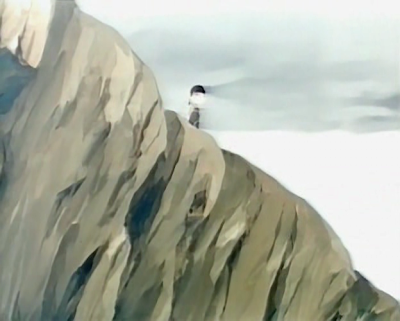


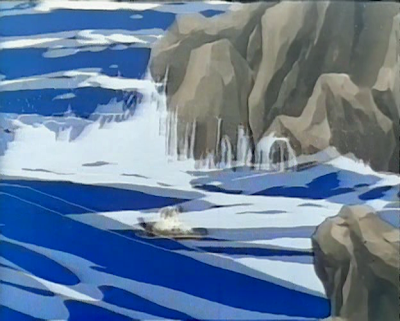


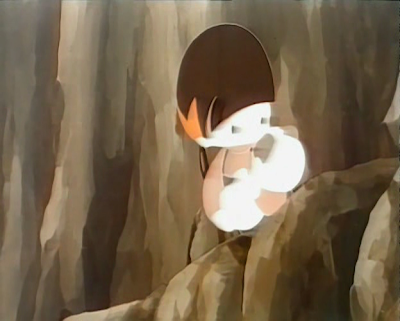
Miyazaki began as an in-betweener, and at this point in his career, he's basically working in the mail room. He only gives Wan Wan Chushingura a passing mention in his memoirs, Starting Point, lamenting how his superiors would correct his drawings so much, that they were completely unrecognizable from what he drew. So while this is another entertaining classic from the Toei stable, it's more of a footnote for the Miyazaki biology.
Or, that's what I thought. I sat down to watch the film this evening, a terribly worn-out VHS copy of the Spanish-dubbed version, Rock el Valiente. One key scene managed to leap out at me, and it completely took me by surprise. I've snapped some screenshots as best I could - you can see how lousy the picture quality is on this old tape - so you can judge for yourself.
In this scene, the dog hero, Rocky, has been knocked into a barrel and thrown into the open sea. Caught in a storm, he struggles to hold onto the barrel as he approaches shore. As the waters strike the cliffs, Rocky's barrel is broken into smaller pieces, Rocky hangs on for dear life.
A young girl stands at the top of the cliff. She sees something in the water and carefully climbs down the rocks. She reaches the shoreline, and seeing the helpless puppy in the water, she tries to rescue him. Resisting the crashing waves, the girl successfully grabs the puppy and drags him onto the shore, and to safety. The scene ends in a warm embrace.
This scene just leapt out at me. Ponyo! This is almost identical to the early scene in Ponyo where Sosuke rescues Ponyo from the ocean, trapped in the glass jar. Even the cliffs look quite similar. It's not an exact shot-by-shot remake, so I don't know if I'd place it into the "riffs" category. But this does appear to me that Ponyo used the similar scene from Wan Wan Chuushingura as an inspiration. And when we remember this was also Miyazaki's first animation film all those years ago, the realization strikes. It makes a lot of sense.
I'll leave it for you to decide if these two "on a cliff by the sea" scenes match, or if I'm just reading into things. It would help tremendously if we had a DVD fansub to watch; this Rock el Valiente VHS was damned near impossible to find. And the picture quality is just dreadful...Ah, just like the good old days of anime fandom.


2010-12-07
Downloads Updated and Expanded!
Hello, everyone! I just spent the morning and early afternoon revising and expanding the Downloads section on Ghibli Blog. The number of fansub downloads have steadily increased over the years, and I wanted to keep everything simple and easily accessible. Now the downloads are separated into four categories: Toei Animation, Television, Pre-Ghibli & Misc., and Studio Ghibli.
In doing so, I've also searched around and found more movies and television series for you to enjoy. I'm especially happy to find new fansubs for two Toei Doga classics, 1963's Little Prince and the Eight-Headed Dragon, and 1972's Ali Baba and the Forty Thieves. I've also added the downloads for Puss in Boots and Animal Treasure Island because, frankly, the DVDs may no longer be commercially available. I certainly can't find them anywhere, and I've been looking around ever since I lost my discs on a plane trip last year.
Our goal should be to translate and release all of the movies from Toei Animation's "classic" era, 1958-1972. There are still a number of movies we need, all of them from the pre-Horus years. I'm hopeful that this crucial era of anime history will be preserved. All Ghibli Freaks owe it to themselves to become immersed in the classic Toei films.
As always, my deepest thanks and gratitude to all those individuals who bring us these translated fansubs. None of these works would ever be seen in the West otherwise, as there simply isn't enough commercial demand. That's really too bad, because these are the defining classics of Japanese anime. And you cannot consider yourself a true anime fan unless you've been exposed to the classics.
(EDIT: I removed Puss in Boots and Animal Treasure Island from the Download links since they are still readily available on Amazon. Of course, I'm sure every one of you already own these DVDs, right? Right.)
In doing so, I've also searched around and found more movies and television series for you to enjoy. I'm especially happy to find new fansubs for two Toei Doga classics, 1963's Little Prince and the Eight-Headed Dragon, and 1972's Ali Baba and the Forty Thieves. I've also added the downloads for Puss in Boots and Animal Treasure Island because, frankly, the DVDs may no longer be commercially available. I certainly can't find them anywhere, and I've been looking around ever since I lost my discs on a plane trip last year.
Our goal should be to translate and release all of the movies from Toei Animation's "classic" era, 1958-1972. There are still a number of movies we need, all of them from the pre-Horus years. I'm hopeful that this crucial era of anime history will be preserved. All Ghibli Freaks owe it to themselves to become immersed in the classic Toei films.
As always, my deepest thanks and gratitude to all those individuals who bring us these translated fansubs. None of these works would ever be seen in the West otherwise, as there simply isn't enough commercial demand. That's really too bad, because these are the defining classics of Japanese anime. And you cannot consider yourself a true anime fan unless you've been exposed to the classics.
(EDIT: I removed Puss in Boots and Animal Treasure Island from the Download links since they are still readily available on Amazon. Of course, I'm sure every one of you already own these DVDs, right? Right.)
2010-08-16
Poster - Puss in Boots 3: Around the World in 80 Days (1976)

Here is another addition to the always-impressive lineup of Toei Animation movie posters: Puss in Boots 3: Around the World in 80 Days, from 1976.
I'm a great fan of the original 1969 Puss in Boots. In fact, I think it's an anime masterpiece and one of Toei Doga's crowning achievements. It benefited greatly from the immense talent at the studio, including Hayao Miyazaki, Yasuo Otsuka, Yoichi Kotabe, Reiko Okuyama, and Yasuji Mori. Within a couple years, however, they would begin the migration away to other studios and projects like Lupin III and Heidi, and the quality of Toei's movies deteriorated as a result.
Puss in Boots 2, made in 1972, was a weaker sequel, but it still had some charms, thanks to Mori and Okuyama. At least, the Wild West theme was a bold change of pace. Most sequels aim to repeat the exact formula, so you have to admire the willingness to take risks. I think it's an alright movie and is worth watching at least once.
Puss in Boots 3, however, is a disaster. If there was ever an example of Toei's decimation as a great movie studio, it's this picture. It's amazing that this was even considered a feature release at all. It has the look and feel of crude television, some low-budget mess that was probably green-lighted as a result of some executive losing a poker match.
I will say this in the movie's defense: I really like the setting. "Around the World in 80 Days" is a terrific idea for a movie; in fact, it happens to be a terrific movie. That's a movie you watch with the grandparents at holiday gatherings. So it makes sense to give it a try with Pero the Cat. It's a pity the whole thing is such an unimaginative mess.
I found it a bit weird that Puss in Boots 3 completely rips off the 1968 anime masterpiece Horus, Prince of the Sun. How did that come about? Was Toei finally feeling remorse over letting the movie tank at the box office, sacking the director, Isao Takahata, only to see him steal the studio's best talent and revolutionize anime with Heidi and Marco? Strange. Personally, I chalk it up to a lack of ideas. The filmmakers who made this picture couldn't find a decent idea if it bit 'em on the....ehh, whatever. You get the point.
I also wonder if Hayao Miyazaki had seen this movie? How strange is it that a movie that steals from Horus features a climactic chase through a clock tower, one that Miyazaki seems to steal for Lupin III: Castle of Cagliostro? Yes, it's true that the clock tower motif first appeared in an episode of Lupin III: Series One, but, still. I came away with the impression that Miyazaki ripped this scene out. You can't blame him for being cranky, in any event.
Let's see, what else is there? The animation is stiff and crude, barely television quality, as I've mentioned before. Pero is certainly likable, but dull and witless. You can tell this isn't the same whipsmart anti-hero from the original 1969 classic. The villains are likewise boring. Just why are we seeing that fox character yet again? He was first a character on the television show Hustle Punch, and then a pirate in Animal Treasure Island (another of my all-time favorites). Why is he in this lousy picture? And why can't he get to do anything interesting or fun?
An animated movie version of Around the World in 80 Days should be wildly funny, colorful, full of life. This should be a movie for Pixar, not the creatively bankrupt Toei. This is an absolute clunker. I can't think of any redeeming qualities for this movie....except for the movie poster. That's a really terrific poster.
Subscribe to:
Posts (Atom)