
Showing posts with label ali baba and the 40 thieves. Show all posts
Showing posts with label ali baba and the 40 thieves. Show all posts
2014-02-25
Trailer - Ali Baba and the 40 Thieves (Toei Doga, 1971)
Yes! I finally found the trailer to the 1971 Toei Doga movie, Ali Baba and the 40 Thieves. I also see that I haven't written about this picture in a long while, so we're overdue for another shout-out.
I really do like this Ali Baba. It doesn't really look like anyone's expectations of an "anime" movie, more like a Rocky & Bullwinkle cartoon mashed up with Dr. Seuss. It doesn't aim to be anything more than a zany kids' cartoon, and it's a lot of fun.
Hayao Miyazaki, of course, contributes arguably the movie's best scene, the crazy castle chase between Ali Baba and the goofy, cat-phobic genie. It's probably a little too similar to the castle chase from the 1969 Puss in Boots, which was one of the all-time anime classics, but there's a lot to enjoy and every moment is inspired. His mastery of comic timing and three-dimensional visual perspective, the slapstick gags, the funny cartoon poses, it's all so perfect. For those who are fans of Miyazaki's early period, Ali Baba is a standout, alongside Puss in Boots and Animal Treasure Island.
Of course, there's more to this movie than Hayao Miyazaki, a point few Westerns seem to grok sometimes. Most of Toei Doga's star talent worked on this picture: Akira Daikubara, Yasuji Mori, Reiko Okuyama, Yoichi Kotabe, Akemi Ota. Yasuo Otsuka, by this point, had already moved on to the A Productions studio to create the Lupin III anime series, and Isao Takahata had been demoted back down to directing television as revenge for the "Horus Rebellion." I'd really love to know who was responsible for which scenes. Calling Ben Ettinger!
Unfortunately, the days of Toei Doga's lavishly-produced animated features was over; cheap TV had taken over, and that meant much lower budgets for film productions. Ali Baba suffers notably because of this; the visuals are clearly "limited" animation, and Ali Baba was not successful at the box office. It was released around the world, and later released in the US under the title, "Ali Baba's Revenge," but remains stubbornly overlooked.
Shortly after Ali Baba and the 40 Thieves, Toei Doga founder and visionary Hiroshi Okawa died, marking this the end of an important era in ths history of Japanese animation. He established a standard for quality, and spawned a generation of artists who would revolutionize and define the art form for the next 50 years. Studio Ghibli is the direct heir to the Toei tradition.
Discotek really ought to release Ali Baba in the US, but since hardly anybody bothered to buy their other Toei Doga DVDs, that's not likely to happen. This is what happens when ya steal everything off the internet, kids! We gots ta pay the rent around here!


2011-03-18
Is This the First Miyazaki Flying Machine?

This airplane makes its appearance during the closing credits of Ali Baba and the 40 Thieves, Toei Doga's feature film from 1971. There's really no doubt who conceived it; even the most casual fan of Hayao Miyazaki knows of his love of flying machines.
Is this the first flying machine to appear in a Miyazaki anime? I think so. The previous films in which he played a key creative role - Horus, Prince of the Sun; Puss in Boots; Animal Treasure Island - had no flying scenes, unless you count that scene where Horus is kidnapped by a giant bird and dropped off a mountain. His early comics during the Toei period - newspaper comics adaptations of Puss in Boots and Animal Treasure Island; the epic drama People of the Desert - likewise included no flying.
Miyazaki's passion for vintage aircraft would emerge in the 1970s and 1980s, with Lupin the 3rd, Future Boy Conan and Sherlock Hound, and his many short-form comics for magazines like Model Grafix. And, of course, there is Nausicaa and Studio Ghibli.
It's fascinating to see such a crucial element to Hayao Miyazaki's art emerge in 1971, when he was 30 years old. He was already a veteran of the business, but he was still just barely beginning.
Photos - Ali Baba and the 40 Thieves (1971)
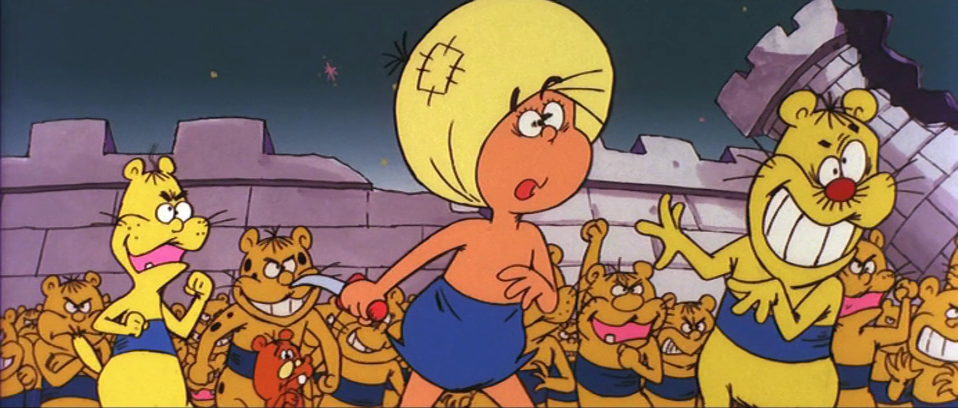


Some nice screenshots of Toei Animation's 1971 movie, Ali Baba and the 40 Thieves. I'm happy that we finally have a fansub of the movie, with the correct widescreen ratio. Previously, the only available version of this movie was the VHS of the old MGM dubbed Ali Baba's Revenge. That dub is actually very good, since this is basically a Western-style chase cartoon. It may as well be an episode of Tom and Jerry, or Rocky and Bullwinkle.
Ali Baba came and went without much fanfare in 1971. A short time later, Hiroshi Okawa, the founder of Toei, the man who dreamed of creating a "Disney of the East," died. Soon Isao Takahata and Hayao Miyazaki would leave the studio to rejoin Yasuo Otsuka at A Productions, and the rest of the crew began their migration in earnest. There would be one more good movie from Toei, 1972's Puss in Boots 2, and after that, everyone would be gone. The era of Toei Doga's Golden Age was over.
At least they went out on a good note. It's amazing to me that the classic Toei films are so obscure today. Animation fans owe it to themselves to discover these great, pioneering cartoons.


2009-08-23
Poster - Ali Baba and the 40 Thieves

Ali Baba and the 40 Thieves must be the next anime film that is tackled by the fansub community. If someone would just put the raw video online, that would be a terrific improvement over the US dubbed version we have, an old VHS of Ali Baba's Revenge. At least the dub is pretty good.
Hayao Miyazaki's memoirs, Starting Point, includes an interview from 1984 where he discusses his career to that point. He said the following about his involvement with Ali Baba and the 40 Thieves and the state of Toei Doga in 1971:
Ali Baba and the Forty Thieves was hopeless; I changed the entire storyboard thinking that I'd make my part interesting. I made it too interesting, and it seemed like the whole movie was over when my scene ended.
In those days, Toei Animation's feature-length movies were divided into A-films and B-films. The length and budget were different. Robin and Cyborg 009, if I remember correctly, were B-films. Ali Baba and Flying Ghost Ship were also B-films. A-films consisted of 50,000 pages or so, at two frames. Puss in Boots, Animal Treasure Island, and Horus, Prince of the Sun were A-films. We had high expectations for Animal Treasure Island, but in box office terms it lost out to Ultraman or some such film [laughs]. So A-films died off. That was the end of the era of two-frame animation.
...When Animal Treasure Island didn't do so well and we realized A-films were doomed, our hopes were shattered. So I thought, "Eh, what the hell," when doing Ali Baba. The story was terrible. I was able to work on it without a single hour of overtime.
2009-07-29
Poster - Ali Baba and the 40 Thieves

I just love the Czech movie posters. They have such a terrific sense of abstract style about them. I discovered this poster for Toei Doga's 1971 film, Ali Baba and the 40 Thieves. It was directed by founding studio animator Akira Daikuhara, who, alongside Yasuji Mori, built the studio into an animation powerhouse. As best as I can tell, this was his final film.
After Ali Baba, Hayao Miyazaki and Isao Takahata finally made the jump to A Pro, joining the rest of the old gang on a new television show called Lupin III. This is a terrific farewell, loaded with wild colors and goofy fun. This may be the zaniest movie in Miyazaki's long career, the final hurrah to his thrilling comedy trilogy, which began with 1969's Puss in Boots and 1971's Animal Treasure Island.
I found this poster on this site. It's not for sale, but you can browse through the very large and impressive catalog.
2009-06-11
Photos - Ali Baba and the 40 Thieves


Can you believe I forgot that I downloaded this movie? Fortunately, I snapped a lot of screenshots to share, since it's such a rare movie. It's really wonderfully funny and goofy, and Miyazaki fans everywhere should watch it at least once or twice. And, of course, it's impossible to look at this big pink Genie without thinking of Dr, Suess.
I don't really have any agenda or method for these shots. I'm just showing a variety from across the movie. Don't forget that you can download it ("Ali Baba's Revenge," the old dubbed version) from the Download section.
2009-05-12
Download These Fansubs - Ali Baba's Revenge
Just so you know, I've added Ali Baba and the 40 Thieves to the "Download These Fansubs" section. This is actually an old VHS copy of the US dubbed version, "Ali Baba's Revenge." The running time is about an hour, and you'll have a great time. Try it out on your kids and see what they think. If they love Looney Tunes, you'll have yourself a winner. Enjoy.
Riffs- Ali Baba and the 40 Thieves


Finally got it! Now we can start tearing apart Ali Baba and the 40 Thieves. What did I think of it? I thought it was great. It's one of those movies that gets better as it goes along, and features some very stylish scenes. Essentially, the whole movie is a slapstick cartoon, certainly leaner than Puss in Boots and Animal Treasure Island, but no less fun. It's just so laughably zany.
Anyway, I spotted a few riffs. Here is a cut from Ali Baba, near the end. This shot of one character leaving the other dangling on the edge is quoting the same shot from (surprise!) Horus, Prince of the Sun. I have to admit, this one was a real surprise, so it was nice to spot.
The first photo is from Ali Baba and the 40 Thieves, and the second is from Horus. But you could figure that out pretty easily, right?
2009-05-10
DVD - Ali Baba and the 40 Thieves

While this movie has been released in various territories on VHS (here in the US under the title, "Ali Baba's Revenge"), Japan remains the only place where Ali Baba and the 40 Thieves has been released on DVD. Why is that?
The other regions around the globe - Australia, UK, Europe, the Americas - need to get their hands on the Toei movies. Digital distribution and exploiting the internet - I'd strongly recommend posting these movies on YouTube for free - would help immensely. And put these films on Blu-Ray, already!
Here is the Japanese DVD, which was released about a million years ago. It's a single-layer disc, with no extras or subtitles of any kind, just like the other Toei DVD's. They really do a poor job of preserving their own history, and that's something I hope can change very soon.
In any case, enjoy the DVD cover. I'd love to find a vintage movie poster. Good luck on that.
Ali Baba and the 40 Thieves - Toei's Abbey Road

Toei Doga's 1971 feature, Ali Baba and the 40 Thieves, marked the end of an era for Toei. The company's founding president, Hiroshi Okawa, died after its completion. Okawa created the studio for the purpose of creating feature animation, and Toei's many classics were enormously successful. They created movies that were influenced, but never overwhelmed, by Walt Disney's legacy. These movies were very uniquely Japanese to the core, and they serve as a model for creating feature animation that follows a different path than the Disney model.
Unfortunately, the arrival of tv animation, and the steady exodus of the studio's top talent marked the end of Toei's golden age. Ali Baba and the 40 Thieves is the final hurrah, the one last lap around the track that reminds moviegoers what made the studio great.
This would be the final project Hayao Miyazaki worked on at Toei. Both he and Isao Takahata would follow Yasuo Otsuka and the others to A Pro, first to work on the Lupin III television show, and then to work on their Pipi Longstockings project.
This movie is extremely hard to find any information on the internet. Ali Baba is definitely more easily overlooked, for whatever reasons these films become overlooked. Perhaps it's the goofy designs, which looks a lot more like Chuck Jones or Dr. Seuss than Japanese anime. Perhaps it's the short length or the title or...who knows? I was disappointed that Discotek passed this movie up when they brought Puss in Boots, Animal Treasure Island, and Taro the Dragon Boy to the US on DVD. Hopefully, they'll eventually pick this movie up one of these days.
Ali Baba finishes off with a crazy climax through a giant castle - a throwback to the castle seige in Puss in Boots. Miyazaki animated this final bit, and it's fantastic, goofy fun. At least, the parts I've been able to see were fun. It shows the young Hayao Miyazaki at his goofiest. If you loved Puss in Boots and Animal Treasure Island, you know exactly what to expect.
Now that I think about it, this does mark the end of an era for Miyazaki as well. The later Toei years marked a high point for his zany slapstick comedy, and most of his work in the 1970s would be far more serious fare. By the time he returned to his adventure roots in Future Boy Conan in 1978, his style, and his worldview, had become far more complex and nuanced. And his work no longer had the light, carefree feel of his youth. The burdens of the real world and the questions of humanity had taken over.
So there really is a bittersweet quality to be had in Ali Baba and the 40 Thieves. It's an Abbey Road movie, of sorts. It's a celebration of an era that has finally passed.
Subscribe to:
Posts (Atom)