Search

Showing posts with label posters. Show all posts

2020-04-17

Studio Ghibli Video Call Backgrounds


This week, Studio Ghibli provided a series of background images from their movies that can be used in online conference calls or podcasts. Eight backgrounds are currently available with more to follow in the coming weeks. I have posted four, and the others can be found by clicking on the above link.
Ghibli also posted the following notes (courtesy of Google Translate):

It is provided for the purpose of being used by individuals as a background for Web / TV conference applications such as telecommuting, teleworking, and distance learning. It cannot be used for commercial purposes or for advertising of companies or products. 
If you would like to introduce us, please use the information and links on this site. Please refrain from redistributing the image data yourself. 
When using it, you can change the image size and adjust the trimming to fit the Web / TV conference application.

2019-12-06

Poster: My Neighbor Totoro (China)


This charming and artistic poster design for My Neighbor Totoro was created for the film's theatrical release in China on December 2018. It marked Studio Ghibli's long-awaited foray into mainland China and has already been followed by Spirited Away in June of this year. Four more Ghibli features are planned for release as well: Castle in the Sky, Princess Mononoke, Howl's Moving Castle and The Wind Rises.

I enjoy the spaciousness of this poster design, very much in a classical Asian style of utilizing negative space. You can almost feel the fur of the giant Totoro as the two girls wade through, like walking through boundless fields of grass. The text simply describes the title, Hayao Miyazaki's name and the voice cast. No need for any tag line or description as this is a well-known children's classic.

Chinese movie lovers, of course, have long been able to watch My Neighbor Totoro on home video formats, to say nothing of pirated bootlegs. But this theatrical release was a first and marks a new development in the growth of Ghibli across the globe. Whatever becomes of the studio, its catalog titles are guaranteed a long and bright future.


2019-11-19

Poster: Gulliver's Space Travels


Here are two movie posters for the 1963 Toei Doga animated feature film Gulliver's Space Travels. Specifically, these belong to the US version, dubbed Gulliver's Travels Beyond the Moon. This is a terrific movie that's full of spark and adventure and color, a nice change from the usual Toei fare of Eastern myths and fairy tales. It has a very distinct Western flair in its visual design and story that helps set it apart from just about anything at the time.

Hayao Miyazaki fans know about this movie, of course. It was his second feature film as an in-between animator, and he famously drew attention by suggesting a vital change to the movie's ending, one that was embraced by the director and production team. The scene in question was later riffed in My Neighbor Totoro in one of those cool "blink and you'll miss it" moments.

The US version of Gulliver is very nice and benefits nicely from the source material. The voices are not too irritating and the songs are bearable. By anime dub standards, you could do a lot worse. These poster designs are also very nice, especially the second one which is washed in rich color tones and dynamic character poses.

It's very unfortunate that the Toei Doga classics are all but impossible to find today. A decade ago, a few dedicated fans created English fansubs for nearly all of their anime feature films, but the websites are gone and its creators vanished. Today, you might be able to track down the Japanese DVDs that were released around the turn of the century, but you'll have to live without subtitles. Hopefully, that situation will change one day.

P.S. Here's a great surprise: Gulliver's Space Travels is available on YouTube, in the original Japanese audio and English subtitles. Check this out before it gets pulled down.


2018-04-09

Poster: Rock el Valiente (Wan Wan Chushingura)

Poster: Rock el Valiente (Wan Wan Chushingura)

Rock el Valiente is the Spanish title for Toei Doga's 1963 animated feature film, Wan Wan Chushingura. This movie is a loose retelling of the Japanese tale of The 47 Ronin, but presented with a cast of animal characters, including dogs, foxes, bunnies and a ferocious tiger. It's a very good movie, entertaining and colorful and featuring a great action-filled climax. Toei always knew how to end their pictures on a strong note.

Today, this movie is probably best remembered as Hayao Miyazaki's very first work in animation, where he began as a lowly in-betweener. In his memoirs, he famously grumbled that all of his drawings were corrected by the supervising animators, which made his initial drawings unrecognizable. This is what the old-timey folks called "paying your dues." In short order, the ambitious young animator was already working his way up the animation ladder, and famously offering a novel idea for the ending to the next Toei feature film, Gulliver's Space Travels. By 1965, he had advanced to the level of key animator on the television series Hustle Punch and Wolf Boy Ken, where he famously met another young director named Isao Takahata. One of cinema's all-time great partnerships had begun, and would last for the next 50 years.

Anyway, back to our movie poster, which looks terrific. I can only imagine how rare and expensive this is. Such finds are extremely rare on Ebay, so it's a special honor to anyone who was fortunate enough to grab one of these gems. I like the layout sense of color, and it's especially nice that this poster retains the classic Yasuji Mori character designs. He was one of the all-time great cartoon animators.

I have great affection for the "classic" Toei Doga movies of the 1950s and 1960s, which followed the Walt Disney formula while offering a very unique Asian spin, with a young generation of artists who were endlessly experimenting. It's beyond baffling that these films that were once so important to Japanese animation are all but forgotten. We need a renaissance for classic animation. There's so much beauty and art in the world to discover.

2017-11-17

Ghibli Fan Posters: Nausicaa of the Valley of Wind, Porco Rosso

Ghibli Fan Posters: Nausicaa of the Valley of Wind, Porco Rosso


Here are a pair of excellent fan-designed movie posters for two of my favorite Hayao Miyazaki movies, Nausicaa of the Valley of Wind and Porco Rosso. I really enjoy these designs, which incorporate an indie comic book style. Nausicaa evokes the surreal images of the Ohmu shell, with the title character seated near the eye and the toxic fungus. Porco Rosso evokes the myth and mystery of its central character, a legendary pilot who has renounced his humanity.

Poster designs like these always remind me of the way movie posters were made long, long ago. It was an established art form all its own, as movie collectors and fans will tell you. Once the conglomerates took over the major Hollywood studios, however, everything became subsumed by marketing hacks. Everything just became another crummy commercial. The age of Photoshop has been especially cruel. Movies can still be magical. Most of the time, however, they're nothing more than plastic, a disposable product designed for immediate consumption, discarded three days after opening. Meh.

I want classic movie posters again. Don't you? Of course, you do.

2017-11-12

Movie Review: The World of Hans Christian Andersen (1968)

Movie Review: The World of Hans Christian Andersen

The World of Hans Christian Andersen is the American title to the 1968 Toei Doga animated feature Andersen Monogatari ("The Story of Andersen"). It was released in the US in 1971 by United Artists, in partnership with the legendary Hal Roach Studios, who handled the English-language dub.

The movie tells the tale of a young Hans Christian Andersen, who meets a magical storyteller who arrives to Earth from Heaven in order to guide the boy and inspire his talents as a storyteller. As young Hans observes the lives of the villagers around him, we see the trappings of the fairy tales that would make him famous. There are cartoon mice, cats and dogs, as well as about a hundred song-and-dance numbers.

Personally, I am not a great fan of this movie. Of all the Hiroshi Okawa-era Toei Doga movies (1958-1972), The World of Hans Christian Andersen feels the most formulaic, the most cliched, the most, shall we say, Disney-esque. In every way, it is a stereotypical "family cartoon" with sing-along songs, simple characters, contrived plot points, and an overall atmosphere of suffocating niceness. The swelling strings of the orchestra are pure cheese. This is a movie very specifically made for very small children who would be easily distracted and amused.

What made the classic Toei movies so compelling is how they learned the lessons of Walt Disney without copying his movies. Instead, they learned to adapt their own folk tales and legends, learned how to incorporate a purely Asian flavor to their animated features. In time, the animators learned new ways of expression, and new paradigms emerged which eventually became "anime." This movie, however, represents a massive thrust backwards. It is nowhere near the level of Hakujaden, Saiyuki, or Little Prince and the Eight-Headed Dragon, Toei's best animated features up to that point.

Here's why I believe that happened. This movie was released in March of 1968, ahead of another Toei feature that was supposed to be completed and released earlier. It's name: The Great Adventure of Horus, Prince of the Sun, the revolutionary anime masterpiece directed by Isao Takahata and helmed by Hayao Miyazaki, Yasuo Otsuka, Yoichi Kotabe, Reiko Okuyama and Yasuji Mori. The battle to create Horus lasted the better part of three years, ran massively over-budget and severely damaged relations with the production staff and its labor union (of which Takahata, Miyazaki and Otsuka served leading roles).

To the studio bosses of the day, Horus was an albatross, a dark, brooding, violent mess that would almost certainly give children heart attacks. It might even scare them away from Toei forever, into the waiting arms of rival animation studios that were flooding television screens. Something needed to be done to keep that traditional audience in place, and to prevent them from fleeing.

I believe this is the reason why Andersen Monogatari was made. It is the safest and most "child-friendly" movie the studio had ever made. It was a purely defensive move against a feared backlash, to say nothing about recovering all that money that was being spent on Horus (which ended up being the studio's biggest box-office flop, but that was at least partly due to studio sabotage as anything).

Hans Christian Andersen is not a bad movie. It's just very uninspired and very, very "safe." It could have been assembled by committee, and very likely was. To be fair, all the studio's best talent was locked up with Horus, leaving very few skilled animators or artists available for anything else (Jack and the Witch, Toei's 1967 feature, suffered from the same problem). The animation is lacking any real spark or inventiveness, never straying from the instruction manual, it seems. The story lacks inspiration in its characters or setting.

In the movie's defense, I do enjoy the "Little Match Girl" story thread the weaves in and out and supplies the climax. Here, the movie seems to have found a proper balance, striking an emotional cue that is fitting to Andersen's stories. The movie ends on a strong note. It probably doesn't matter that before the year was out, Horus, Prince of the Sun would completely demolish it to rubble. The World of Hans Christian Andersen is like that act on The Ed Sullivan Show that came on stage just before The Beatles. Does anyone remember that guy? No, of course not. Which is precisely the point.

P.S. The World of Hans Christian Andersen was recently uploaded to YouTube, in the original Japanese, where one person noted that the movie's final 25 minutes syncs up perfectly with David Bowie's Low album. That gave me a chuckle. These are the sort of things that make me question if we're really living in The Matrix.

2017-10-23

Mary and the Witch's Flower US Premier Announced

Poster: Mary and the Witch's Flower

Animation movie distributor GKIDS has today announced the US date for Hiromasa Yonebayashi's Mary and the Witch's Flower. The film will play a special one-night premier on January 18, 2018 in select theaters. The screenings will be presented by Fathom Events, and you can purchase advance tickets directly from their website.

In addition, GKIDS has revealed the official US poster for the film, which looks terrific. It's different from the Japanese poster designs, but very similar. Studio Ponoc and "Academy Award Nominated" director Yonebayashi are given the top space, which is very generous.

Studio Ponoc is a new animation studio staffed by Studio Ghibli alumni, and Mary can be seen as a direct descendent to the films of Hayao Miyazaki. We see the obvious parallels to Kiki's Delivery Service and Spirited Away. What Yonebayashi brings to the table is a gentle sensitivity, an ability to get into the depths of his heroines. When Marnie Was There, his previous movie (and Studio Ghibli's final feature before their "retirement"), is an exceptional portrait of teenage alienation and loneliness, wrapped in the blankets of a nostalgic ghost story. He is a storyteller with great potential, and he is a rising star to watch in the coming years.

I have not seen Mary and the Witch's Flower yet, and I have consciously avoided learning too much, apart from the Japanese movie trailers. I always enjoy walking into a theater with as few expectations as possible. I know the former Ghibli crew will bring their "A" game. What more do you need to know?

2017-10-13

Ghibli Fest Continues: Spirited Away in Theaters 10/29, 10/30, 11/1

Spirited Away in Theaters October 30 - November 1

Ghibli Fest, sponsored by film distributor GKIDS, continues with Hayao Miyazaki's Academy Award-winning masterpiece Spirited Away in theaters October 29, 30 and November 1. The events are presented in conjunction with Fathom Events, and will feature screenings in both English (dub) and Japanese (sub) language soundtracks.

Spirited Away will be given a fairly wide release, which is a big plus for Ghibli Freaks everywhere. Here in Chicago, there are 24 theaters participating, not including the outer suburbs (which, frankly, are like visiting another state). No doubt, conditions will be the same in your area.

Tickets can be purchased in advance by visiting the GKIDS website.

2016-12-15

Poster: Mary and the Witch's Flower


Here are the first movie posters to Hiromasa Yonebayashi's upcoming feature film, Mary and the Witch's Flower. Its design is pure Ghibli, which is no doubt the filmmakers' intention. They seek to continue the legacy of the world's greatest animation studio, to continue the rich legacy of Miyazaki and Takahata into the new century. And I'm sure there will be many surprises along the way. I can't wait!

Much thanks to Buta Connection for the poster photos.

2016-12-14

Poster - Ocean Waves (Umi ga Kikoeru)


Here is the newly-released movie poster for GKIDS' theatrical release of Studio Ghibli's 1993 film, Ocean Waves (Umi ga Kikoeru). Looks great, very restrained and tasteful and clean. I do hope we will be able to purchase one of these. When is Ghibli going to start selling their movie posters? I always ask this question. One of these days, it's going to happen, trust me.

A big thanks to GKIDS for their support of Studio Ghibli, as always. Next item on the menu: the Studio Ghibli short films, including Hayao Miyazaki's On Your Mark and Yoshiyuki Momose's Ghiblies Episode 2. Stay tuned.

2016-10-21

Poster: Miss Hokusai


Poster: Miss Hokusai

Miss Hokusai, the latest anime masterwork by esteemed veteran director Keiichi Hara (Doraemon, Crayon Shin-Chan, Colorful) and animation studio Production I.G. (Ghost in the Shell), is currently enjoying a theatrical run across the US, courtesy of GKids Films.

This movie tells the story of O-Ei, a fiercely independent-minded artist who creates portraits under the name of her famous father, the Japanese painter Hokusai. This family melodrama promises comparisons to the great films of Yasujiro Ozu, as well as the emotional dramas of our favorite director, Isao Takahata. The art and visual design looks fantastic, filled with the many details, great and small, that make anime so uniquely inspired.

This film will open in Minneapolis next week, October 28. Marcee and I are planning to see it and expect to have a terrific time. I'm greatly looking forward to this movie, and strongly urge all anime fans and Ghibli Freaks to attend if it is playing in your city. Let's show our support for hand-drawn animation!

2016-03-13

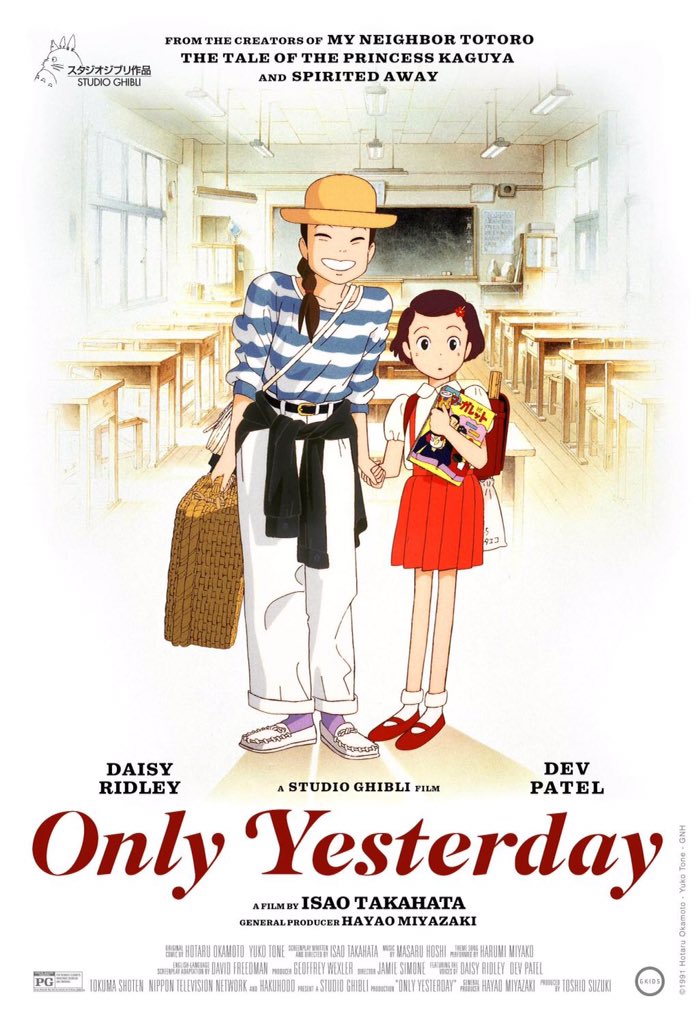
Omohide Poro Poro (Only Yesterday) in US Theaters


The seemingly impossible has happened. Isao Takahata's 1991 masterpiece, Omohide Poro Poro (Only Yesterday is the US title) is now playing in US theaters, courtesy of distributor GKIDS Films. Both Japanese language (with English subtitles) and all-new English language soundtracks will be shown. Be sure to check your local theaters for screenings.

The film opened in Minneapolis, MN this weekend, four screening of the dub and one show with subtitles. We watched the new dub, and if time and money permits, I'll go back again for the subtitles.

Here is the US poster, which is exactly the same as the Japanese original. It's very respectful, and for that, we should all be thankful. Studio Ghibli and GKIDS will release a Blu-Ray later this year, although details and specifics have yet to be announced. Expect the same level of quality seen in From Up on Poppy Hill and The Tale of the Princess Kaguya.

2015-02-18

My Neighbor Totoro Poster For Sale: "Near the Camphor Tree"


Artist AJ Frena's "Near the Camphor Tree," is an excellent painting inspired by the characters of My Neighbor Totoro. Created with giclee print on velvet fine art paper (16"x20"), a limited run of 75 prints are available for sale. Each print will cost $40.

You can purchase this piece at Bottleneck Art Gallery. Fresna previously created an illustrated print inspired by Princess Mononoke.

I really like this painting. There's a strong graffiti influence in the lines and movements. I could see this on the side of any building in any major city. And there's just a hint of danger in Catbus' eyes, just a hint of things not seen. The ruins of an old bicycle in the foreground offers a contrast against the eternally dominant forces of nature. Cities rise and fall, and the trees reclaim the land. It's a very Miyazaki-esque theme.

If you're interested, be sure to pick up your print while it's still available.

2015-02-16

Night on the Galactic Railroad Coming to DVD and Blu-Ray

Night on the Galactic Railroad Blu-Ray and DVD

Earlier this month, Discotek Media announced that they have acquired the rights to Gisaburo Suugi's 1985 anime masterpiece, Night on the Galactic Railroad, and will be releasing the film on DVD later this year. A Blu-Ray is also planned for future release, but no firm date has been set. Cover design and bonus features have yet to be determined.

This is one of my favorite animated movies, a deeply religious meditation on life and death. Imagine The Polar Express if it were created by Thomas Merton, C.S. Lewis or Thich Nhat Hanh. The story is adapted from the famous story by Japanese poet Kenji Miyazawa, who struggled deeply with the death of his younger sister, incorporating elements of his Christian and Buddhist faith. His death at age 37 from pneumonia left his story unfinished.

Gisaburo Suugi is one of a handful of the greatest Japanese animator/directors. His credits include the 1958 Toei Doga animated feature, Hakujaden; the 1967 TV series Goku no Daibouken (episode #4 is a classic); the 1969 Lupin III pilot film; and the 1973 adult art-film, Belladonna of Sadness (which is also coming to home video this year).

Ghibli Blog has previous discussed Night on the Galactic Railroad here, here and here.

2015-02-13

Poster - Warriors of the Wind


Here's a copy of the US movie poster for Warriors of the Wind, the notorious 1985 New Line Cinema hack of Hayao Miyazaki's 1984 Nausicaa of the Valley of Wind. The film was released in theaters and VHS in the 1980s, but has disappeared since that time. If you're curious and have never seen this, copies are available online, and is probably on YouTube as well.

Miyazaki, needless to say, was furious when he discovered what had happened to his masterpiece. It's a hack job that almost qualifies as graffiti art, it's so bad. One quarter of the running time was cut, the characters names were changed ("Princess Zandra?" Really?!), and crucial plot points were just dropped. Oh, and the voice actors sound a lot like Rocky & Bullwinkle (the legendary June Foray denied any involvement). What a mess. But it has a certain campy, MST3K value that we can laugh at and enjoy, especially now that we have a proper Nausicaa on DVD and Blu-Ray.

And this poster? Priceless. I want a copy of this movie poster. Don't you? Of course, you do.

(I wish I could remember who sent this to me. If the author steps forward, I'll update this post to give the proper credit. He had an exhibition of classic anime posters that played at anime conventions, including descriptions on the history of these movies. It was quite impressive, and although he informed me that he was retiring his exhibit, I would like to see it again. Perhaps a short video could be made?)

2015-01-14

When Marnie Was There - GKids Scores US Rights, Spring 2015 Release


GKids Films today announced that they have acquired the US distribution rights to Studio Ghibli's 2014 feature film, When Marnie Was There, directed by Hiromasa Yonebayashi (Arrietty). The movie is currently planned for a Spring 2015 release, with the eventual migration to home video.

Here is one of the Japanese movie posters for Marnie. It's a terrific design a masterpiece of pop art, bold lines and vibrant color, as all the Studio Ghibli posters are. I still haven't seen this film, but I have watched the final trailer, and what I saw was sublime. I don't believe this will be the final Ghibli feature film, but if it was, then they're going out on a very high note.

I'm really looking forward to this one. Will this be your final chance to see a "new" Ghibli movie on the big screen? Better score your tickets ASAP for the last ride.

2015-01-11

Movie Review: Arabian Nights: The Adventures of Sinbad (1962)

Review: Arabian Nights: The Adventures of Sinbad

Arabian Nights: The Adventures of Sinbad (1962) is Toei Doga's fifth animated feature film, and second of three films to include the collaboration of the great Osamu Tezuka, the "God of Japanese Manga Comics." It's a rollicking spectacle that includes legendary treasures, heaving seas, great whales, and a cast of characters who will be familiar to anyone who's a fan of The Thief of Baghdad or Disney's Aladdin.

While I wouldn't rate this movie as highly as the aforementioned others, The Adventures of Sinbad is a very entertaining ride. There is an impressive amount of effects animation, a couple of very nice song numbers, and a third act that is exciting to watch. The Toei Doga films often excel in their third acts. Being a movie set largely at sea, there is a lot of terrific water animation, and I'm impressed at how the animators drew upon Asian art, and their own intuitive sense of timing, to create their art.

I also enjoy how these Toei Doga animators continued to innovate and push their limits with each film. They weren't content to recycle the same formula again and again. There's a clear distinction between Hakujaden, Sosuke Shonen Sarutobe, Saiyuki, Anju to Zushiomaru, and Sinbad. That's because, to a great extent, these people are making up the rules as they go. They're learning and experimenting and developing animation theory on their own. Eventually, all of the little experiments lead to major breakthroughs, seen in Saiyuki and Eight Headed Dragon, and finally leading to the complete paradigm break/shift in Horus, Prince of the Sun.

Why do these Toei Doga movies remain so completely unknown to animation lovers? It's true that many of these movies were translated and adapted to US theatrical releases in the 1960s, but most of those are extremely obscure, and many titles such as "Panda and the Magic Serpent" and "Gulliver's Travels Beyond the Moon" appear to have drifted onto the public domain.  Fan translations have, once again, delivered the goods, making it possible for this "lost era" in animation history to be discovered.

As always, we are deeply indebted to the fan translators and fansub community, for opening the door to needlessly obscure animated features. I would hope that a fan community emerges around the classic Toei Doga movies. They're uniquely Japanese, not yet "anime," strongly influenced by the West, but seeking their own identity.

A quick note about the Sinbad poster. I'm a big fan of Toei Doga's movie posters, that uniquely Japanese approach to poster designs. Finding an image of this one was harder than usual; finding a physical poster will be especially difficult. Toei really ought to sell poster prints online. I'd buy up everything I could get my hands on...wouldn't you do the same? Of course you would.

2014-03-19

Poster: The Tale of Princess Kaguya

Poster: The Tale of Princess Kaguya

And now we come to the other Studio Ghibli masterpiece of 2013, Isao Takahata's The Tale of Princess Kaguya.  This film was in production since 2008, and was a painstaking and long process to completion.  The result is a true labor of love by a film master who continues to push the medium of animated film.  This movie was modestly successful in Japan ($22 million, in the range of pre-Mononoke Ghibli releases), which is a welcome return for Takahata, whose 1999 feature My Neighbors the Yamadas crashed and burned in its native country.

Kaguya's art style is purely expressionist, continuing the watercolor style begun by Yamadas, and continued by a number of Studio Ghibli short films.  It remains a very unique style, and with this picture, Takahata pushes the art style to its absolute limits.  The $50 million budget - the same as Hayao Miyazaki's The Wind Rises - is monstrously expensive for a Japanese animated feature, so we're promised a spectacle to remember.  If you're hungry for something different and unique, then stay tuned for Kaguya's fall US release.

This is a great movie poster.  Keen observers will notice that this illustration riffs a famous scene from Horus, Prince of the Sun, where the conflicted anti-heroine Hilda battles winter wolves and collapses in the snow.  This suggests common themes in the story, which is based on a famous Japanese myth about a supernatural woman who is born inside a tree, grows to adulthood, and escapes from her troubled life to the moon.  No doubt Takahata will examine the psychology of this character.

Will Princess Kaguya be Isao Takahata's final feature film?  At age 78, one can never take the future for granted.  And given the enormous expense of the film's production (Studio Ghibli actually lost money for 2013), it would be challenging to secure financing for any future film projects.  Heaven knows how long it took Paku-san to find the money to pay for this one.  It's quite audacious of him to be so bold, so risky, at this stage in his career.  I am reminded that Ingmar Bergman reemerged from retirement to direct one final movie.  We should treat this as a miracle, and be thankful for the moment.  The moment may never pass our way again.

The Tale of Princess Kaguya will be released in American theaters this fall, courtesy of GKids.  Dubbed and Subtitled versions will be available.

2014-02-23

Art Nouveau Studio Ghibli Poster Designs


These spectacular poster designs recreate our favorite Studio Ghibli movies in the early 20th Century Art Nouveau style.  An artist named "Marlboro" posted these artworks on Pixiv, a Japanese art-sharing site.  Unfortunately, Marlboro's page is no longer available, but the art lives on.

What makes these illustrations so effective is how perfectly the art style matches the original material.  Nausicaa, Sheeta, Kiki, Totoro, Howl...these characters do have an Art Nouveau appeal.  They fit into this style perfectly.  Indeed, it makes me wonder why comics and animation cannot use this visual style, instead of merely retreading the same old paradigms.

Excellent job, Marlboro, wherever you are.

Poster - Totorwho?


This terrific mashup of My Neighbor Totoro and the revived Doctor Who comes to us from artist James Hance.  He created this piece and sold a limited number of prints in 2012, but it just happened to arrive on my Facebook this weekend.  And now we're sharing this super cool poster with you.  Enjoy!

More Ghibli Blog Posts To Discover