Search

Showing posts with label omohide poro poro. Show all posts

2019-11-17

Photos: Omohide Poro Poro

Photos: Omohide Poro Poro (Only Yesterday)

Photos: Omohide Poro Poro (Only Yesterday)

Photos: Omohide Poro Poro (Only Yesterday)

Photos: Omohide Poro Poro (Only Yesterday)

Isao Takahata's 1991 Studio Ghibl masterwork Omohide Poro Poro remains my all-time favorite animated feature film. This is a movie that I have championed for many years and remains, for me, the gold standard for the untapped potential for dramatic, naturalist animation, one inspired by Ozu and Fellini and Bergman and Renoir.

Miraculously, this movie is now available on Blu-Ray format in the States, thanks to the efforts of GKIDS, the American film distributor that has become a champion for global animation.

These screenshots were taken from the Japanese DVD, which I purchased way back in 2005, along with a stack of other Ghibli films. This was at a time when hardly anybody knew these gems existed, and it felt like a true treasure, a true secret left untold. I feel much happier today that this secret can now be shared with everyone.

For me, the genius of Omohide Poro Poro is its ability to weave multiple narratives between past and present, detailing key events in the childhood of a quiet office worker who yearns for direction and purpose. It is a commentary on (then) contemporary Japan, whose "bubble economy" created in pursuit of Western materialism had burst, offering the opportunity to reconnect with a Japan of the past. It is a film about those post-war generations, raised on television and movies, versed in the language of American Pop, learning to rediscover the cultural language of their homeland.

2017-12-09

Riffs: When Marnie Was There, My Neighbor Totoro, Omohide Poro Poro


Hiromasa Yonebayashi pays tribute to the Studio Ghibli movies in all of his work, and When Marnie Was There is chock full of them. Here is one easy riff for fans: Anna is wearing the same hat as Mei in My Neighbor Totoro. However, I was also reminded of Taeko's hat in Omohide Poro Poro. Maybe that's just me, or maybe it's intentional. You be the judge.

2017-12-01

Riffs: Heidi, Girl of the Alps, Omohide Poro Poro


Riffs: Heidi, Girl of the Alps, Omohide Poro Poro

Riffs: Heidi, Girl of the Alps, Omohide Poro Poro

Of all the great works in the Hayao Miyazaki-Isao Takahata canon, it is Heidi that stands tallest. At least where the riffs stand. Nearly every one of the 52 episodes from the groundbreaking anime series has been quoted in the directors' later works. For those of you playing the "Ghibli Riff Game", you will never truly become a champion until you've spotted all those Heidi moments.

Here is but one terrific example. This shot from Omohide Poro Poro (Only Yesterday) of children running down the aisle of a train passenger car is directly quoting a shot from a later episode of Heidi, one in which the title character, her "Alm-Uncle" and her friends spend a vacation at the ruins of a great castle. Notice how characters wink back at the camera as they skirt on by. That's a very sly shot.

One extra riff tidbit: the Heidi episodes set at the castle (a completely original plot line that was never in the original Johanna Spyri novel) were later riffed in Lupin the 3rd: The Castle of Cagliostro, when Lupin and Jigen encounter the ruins of the Cagliostro family castle. And the elderly groundskeeper who speaks to them? He is voiced by the same Japanese actor who voiced the Grandfather in Heidi.

Better learn your Ghibli Riffs, kids.

P.S. I've been holding onto that Heidi screenshot on my computers since 2005, when I bought a Taiwan DVD Heidi box set and watched the whole series. No, there were no English subtitles, which was unfortunate, but I was able to follow pretty easily in my crummy toddler-level Japanese grammar skills. I'm still not any better.

2016-03-29

Omohide Poro Poro (Only Yesteday) US Box Office

Omohide Poro Poro (Only Yesterday)

Isao Takahata's 1991 masterpiece, Omohide Poro Poro (Only Yesterday), is closing out its limited theatrical run in the US. This is a good time to take stock of its performance.

According to Box Office Mojo, the movie has earned $415,941 as of March 27, 2016, playing on a total of 44 screens. A dozen theaters await their releases in April (our master list will be updated to reflect this), which will add to the total. I personally remain hopeful that we can break $500,000, which would be a very good achievement for a movie of this nature, and its very limited run.

I used to get worked up whenever a Studio Ghibli film failed to gain any mainstream momentum in US theaters, but not much anymore. Animation in this country remains stuck in the ghetto of "electric babysitter," suitable only for pacifying small children and getting them out of their parents' hair. That paradigm is unlikely to change in the foreseeable future. And it's pretty obvious that Isao Takahata doesn't fit into that paradigm at all, unless we were to consider the 1974 Heidi TV series.

Omohide Poro Poro is an Ozu film set to watercolors. It's very unique and unlike anything seen in the West. Even diehard film buffs will require multiple viewings, and a knowledge of Japanese history and culture, to appreciate its depths. It's far easier to run to the multiplex and watch Batman v Superman, and sit back and have a fun time.

This film, like all of Studio Ghibli's works, will find its audience on home video, and its reputation will grow in time. Even then, these will always remain off the mainstream path, in the thickets. But that's alright. Many of the best discoveries in life lie off the beaten path. If you want "mainstream," you'll end up with shopping malls, fast food chains and reality shows. The gormet food requires some effort to discover, but the rewards are there.

I'm definitely looking forward to GKIDS' inevitable Blu-Ray release, which should include both English and Japanese language soundtracks and some nice extras. If you have the chance, definitely go see the movie. You'll never know when you'll get a chance to see Ghibli on the big screen again.

2016-03-16

Omohide Poro Poro (Only Yesterday) Cities and Theaters

Omohide Poro Poro (Only Yesterday)

The following is the complete list of cities and theaters playing Omohide Poro Poro (Only Yesterday) in the US, courtesy of distributor GKIDS. Each link takes you directly to the theater's respective website, please go there for specifics on times and choice of soundtrack (US or Japan). More cities and theaters may be added in the future, and we'll be sure to update the list if and when that happens.

(Last Updated: March 29, 2016)


January 1New York - IFC Center  

February 26
Los Angeles, CA - Landmark Nuart Theater
Irvine, CA - Regal University Town Center 
Washington DC - Landmark E Street Cinema
Boston, MA - Landmark Kendall Square
San Diego, CA - Landmark Ken Cinema
Denver, CO - Landmark Esquire Theater
Austin, TX - Regal Arbor 8 @ Great Hills
Austin, TX- Alamo Drafthouse Slaughter Lane
Philadelphia, PA - Landmark Ritz at the Bourse
Charlotte, NC - Regal Ballantyne Theater
Toronto, ON - TIFF Bell Lightbox
Columbus, OH - Gateway Film Center (2/26 only)
Seattle, WA - SIFF Uptown Cinema
Buffalo, NY - North Park Theatre (2/27-28) 
San Antonio, TX - Alamo Drafthouse Westlakes (2/29 only)
Winchester, VA - Alamo Drafthouse Winchester (3/2)


March 4
Los Angeles, CA - ArcLight HollywoodP
asadena, CA -Laemmle Playhouse
Santa Monica, CA - Laemmle Monica Film Center
San Diego, CA - Landmark Hillcrest Cinemas
Kalamazoo, MI - Alamo Drafthouse Kalamazoo
San Francisco, CA - Landmark Embarcadero
Rochester, NY - Little Theater (3/5)
Berkeley, CA - Landmark California

Akron, OH - Nightlight Cinema
Victoria, BC - The Vic Theatre
Saskatoon, SK - The Roxy
Littleton, CO - Alamo Drafthouse Littleton (3/7)
Palo Alto, CA - Landmark Theatres
San Jose, CA - Camera 3 Cinemas
Houston, TX - Landmark River Oaks
Littleton, CO - Alamo Drafthouse (3/7)
Providence, RI - Cable Car Cinema (3/5)


March 11
Beverly Hills, CA - Laemmle Music Hall
North Hollywood, CA - Laemmle NoHo
Berkeley, CA - Landmark Shattuck Cinemas
Baltimore, MD - The Charles
Asheville, NC - Carolina Asheville
Camarillo, CA - Regency Paseo Camarillo Cinemas
Cleveland, OH - Cedar Lee Theatre
Honolulu, HI - Consolidated Kahala 8
Portland, OR - Regal Fox Tower
Cincinatti, OH - Esquire Theater
Milwaukee, WI - Landmark Oriental Theatre
Minneapolis, MN - Landmark Uptown Theatre
Atlanta, GA - Landmark Midtown Art
Tempe, AZ - Harkins Valley Art
Waterloo, ON - Princess Cinema
Ithaca, NY - Cornell Cinema (3/12-13)
Houston, TX - Alamo Drafthouse Vintage Park
Katy, TX - Alamo Drafthouse Cinema
Vancouver, BC - Vancity Theatre (3/14)
Notre Dame, IN - DeBartolo Performing Arts Center (3/13-16)
Knoxville, TN - Regal Downtown West
Albuquerque, NM - United Artists High Ridge 8
Grand Rapids, MI - Celebration Cinemas Woodland
Vancouver, WA - Kiggins Theatre

Santa Cruz, CA - The Nick
Dallas, TX - Angelika Film Center and Cafe
Plano, TX - Angelika Film Center and Cafe
Chicago, IL - Music Box Theatre
Santa Rosa, CA - Summerfield Cinemas
St. Louis, MO - Landmark Tivoli Theatre
Lubbock, TX - Alamo Drafthouse Cinema


March 18
Minneapolis, MN - Landmark Edina Theatre
Seattle, WA - SIFF Film Center (3/18-21)
Washington, DC - Angelika Pop-Up Cinema

Tampa, FL - Tampa Theatre (3/21-22)
Montreal, QC - CinĆ©ma du Parc

Hartford, CT - Real Art Ways
Salt Lake City, UT - Broadway Centre Cinemas
Jacksonville, FL - Sun-Ray Cinemas
Indianapolis, IN - Landmark Keystone Art
Albany, NY - Landmark Spectrum 8
Lowell, MA - The Luna Theatre
Iowa City, IA - FilmScene
Lambertsville, NJ - ACME Screening Room (3/18-3/20)
Santa Fe, NM - CCA Cinematheque

Pittsburgh, PA - Row House
Tuscon, AZ - The Loft Cinema
Lancaster, PA - Zoetropolis
Salem, MA - CinemaSalem
Camas, WA - Liberty Theatre
Olympia, WA - Capitol Theater (3/19)
Memphis, TN - Wolfchase Galleria Cinemas
Hilo, HI - The Palace Theater
Jefferson City, MO - Capitol City Cinema
Oklahoma City, OK - Oklahoma City Museum of Art


March 25
Eugene, OR - Bijou Art Cinemas
Montpelier, VT - Savoy Theatre (3/26)
Howell, MI - Historic Howell Theater (3/26-4/3)
Keene, NH - Putnam Theater

Miami, FL - O Cinema Wynwood
Winston-Salem, NC - Aperture Cinema (3/26-27)
Fort Worth, TX - Modern Art Museum of Ft Worth
Edmonton, AB - Metro Cinema


April 1
Halifax, NS - Carbon Arc CinemaVancouver, BC - Rio Theater (4/6)
Omaha, NE - Film StreamsWilmington, DE - Theatre NGainesville, FL - The Hippodrome 


April 8
Oakland, CA - The New ParkwaySan Francisco, CA - The Roxie
St. Johnsbury, VT - Catamount Arts Center


April 15
Gloucester, MA - Cape Ann Community Cinema


April 22
Potsdam, NY - The Roxy Theatre
Athens, GA - Athens Cine


April 29
Lincoln, NE - Mary Riepma Ross Arts Center

2016-03-13

Geoffrey Wexler (Studio Ghibli Int'l) Talks About "Only Yesterday"

Geoffrey Wexler, Studio Ghibli's International Distribution Chief, recently wrote an open letter to the faithful fans eagerly awaiting the arrival of Omohide Poro Poro (Only Yesterday) in the United States.

You can read the letter here. It's a PDF file, so you can save it for later. I did try to copy the text so I could reprint here, but no luck. My new HP desktop wouldn't cooperate.  The moral lesson, of course: I should've bought a Dell.

Omohide Poro Poro (Only Yesterday) in US Theaters


The seemingly impossible has happened. Isao Takahata's 1991 masterpiece, Omohide Poro Poro (Only Yesterday is the US title) is now playing in US theaters, courtesy of distributor GKIDS Films. Both Japanese language (with English subtitles) and all-new English language soundtracks will be shown. Be sure to check your local theaters for screenings.

The film opened in Minneapolis, MN this weekend, four screening of the dub and one show with subtitles. We watched the new dub, and if time and money permits, I'll go back again for the subtitles.

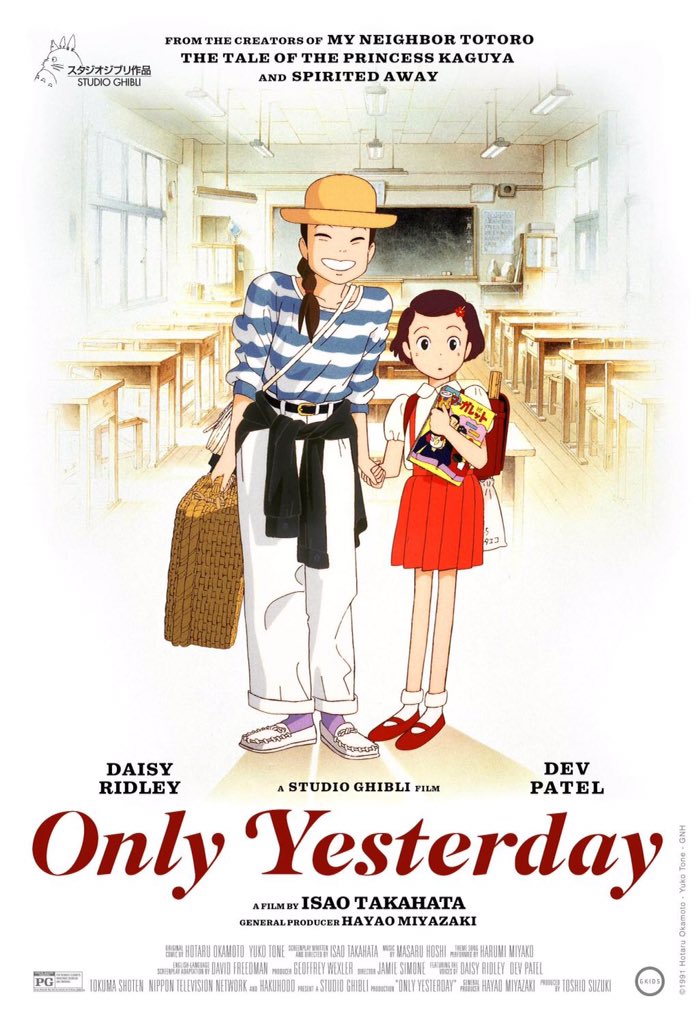
Here is the US poster, which is exactly the same as the Japanese original. It's very respectful, and for that, we should all be thankful. Studio Ghibli and GKIDS will release a Blu-Ray later this year, although details and specifics have yet to be announced. Expect the same level of quality seen in From Up on Poppy Hill and The Tale of the Princess Kaguya.

2015-03-31

Overnight Thread ("Omohide Poro Poro Trailers")


For the overnight video, we have the Japanese trailers to Takahata's 1991 masterpiece, Omohide Poro Poro. It is easily my favorite of all the Studio Ghibli movies, and one of my all-time favorite movies. I've often described this film as "Ozu painted with watercolors," but Poro Poro has a modern pop-centric sensibility that gleefully steals from Western mass media in the service of cultural satire, it flows between a "modern" 1991 and "nostalgic" 1966 to question Japan's postwar values, its Western influences, its very identity in the face of economic collapse. The "bubble" economy is the unspoken elephant in the room, as the personal and the cultural melt together.

What does it mean to be Japanese in the post-war world? Horus begs his dying father, "Who? Who are my people?" These questions of personal and national identity are one of the dominant themes of Takahata's films. And he does so by telling deeply humane, emotional stories. I always find myself completely verklempt after watching one of his movies, and I need a good five minutes after to bring myself back down. I can think of a number of moments where Poro Poro does this: the baseball game that doubles as a childhood courtship; a sunrise over the mountains where the flowers sing in a beautiful chorus; a father's frustration at his daughter erupting in sudden (and shocking) violence; a daughter trapped by society's strict rules; consoling herself by singing the theme song to her favorite television show; and, of course, the final ending during the credits. Yes, it's a schmaltzy ending. Willy hears ya, Willy don't care.

Of course, you don't need to understand Japanese culture circa 1991 to connect to Poro Poro. Anyone who has ever felt lost, drifting in a life that seems to carry you away, can connect to Taiko-chan's crisis of identity, and her journey of the self. Who am I? Who have I become? What became of the child I once was? Where do I go from here? These are universal themes.

Why can's such movies be made in the West? Is it really so impossible to comprehend the idea of animation that doesn't sell to five-year-olds? Can we really imagine any future for the medium beyond "the electric babysitter?" I don't see any reason why animation cannot tell stories for all audiences, covering all topics, incorporating all of the history of cinema. In the West, Walt Disney is the Black Hole of Animation. Nothing escapes his gravitational pull. That's unfortunate. It's like Dorothy is trapped for eternity in boring ol' black-and-white Kansas, completely unaware that Technicolor even exists. Dorothy is being deprived and it's a damned shame.

2012-11-27

Minneapolis Studio Ghibli Film Festival - Closing Days


The two-week Studio Ghibli Film Festival in Minneapolis closes out this Thursday, and we are playing the final four films: The Cat Returns and Mimi wo Sumaseba on Monday and Tuesday, Princess Mononoke and Omohide Poro Poro on Wednesday and Thursday.  It's a terrific lineup and we wish we could be there every day this week.  Sadly, we're down to our final two free passes, and we have to save our money for the move to a new apartment this weekend.

Marcee and I will be there on Thursday for the final showing of Omohide Poro Poro, Isao Takahata's 1991 masterpiece.  I thought it would be right for Ghibli Blog to be there at the very end.

Of the final four movies, The Cat Returns is the weakest of the bunch, and it's a good example of Ghibli's struggles to find new directors to follow Hayao Miyazaki and Isao Takahata.  It does have its charms, but when you can also watch Yoshifumi Kondo's Mimi, why bother?  One is a decent movie best served by home video (and best paired with the short film, Ghiblies Episode 2); the other is an animation masterpiece by a skilled veteran who built a long career with the Miya-san and Paku-san.  I really wish I had money hidden under my couch cushions!

Princess Mononoke was Miyazaki's blockbuster smash that toppled E.T. from the Japanese all-time box office and brought international acclaim to Studio Ghibli.  It also sparked a notorious battle between Miya-san and Disney, and especially the Weinsteins at Miramax.  Now Lionsgate owns the home video rights, and it's questionable that we'll see Mononoke on US home video again.  If you get a chance to see this movie in a theater...run.  Don't walk, run.  You may not get another chance for a long time.

Omohide Poro Poro is the perfect closer, a style and genre of filmmaking that literally does not exist in the West.  Feature animation in the service of a weepy character melodrama?  With a pop culture nostalgia that rivals Quentin Tarantino?  And one that addresses contemporary Japan (ca.1991) as its vaunted bubble economy burst?  Somewhere in the mix lies a popular Japanese manga about a woman's childhood in the 1960s, and a modern quasi-documentary about organic farming and cultivation of safflowers for dyes and cosmetics.  Yes, this is a very deep movie.  Yasujiro Ozu would have been amazed.

Much thanks to everyone who attended GKids' Studio Ghibli Film Festival here in Minneapolis.  It's been terrific, and I really do wish it could have lasted longer.  I needed more time to save up more money!  Please come back!

2012-08-09

The Next Studio Ghibli Blu-Rays - Kiki's Delivery Service, Omohide Poro Poro


The next Studio Ghibli Blu-Ray movies have been announced - Kiki's Delivery Service and Omohide Poro Poro.  Both films will be released on December 5, 2012 in Japan.

Omohide Poro Poro, as you know, is my favorite animation film, ranked #11 on my 50 Greatest Movies list.  The HD format is going to do wonders for Isao Takahata's masterpiece; its rich colors and visual splendor will be a sight to behold.  This is a visually spectacular movie, endlessly varied and nuanced, perfectly weaving Tarantino-pop with Ozu melodrama.

Kiki's Delivery Service is a sweet and charming movie, a perfect follow-up to My Neighbor Totoro, and Ghibli's first box-office hit.  Miyazaki doesn't get nearly enough credit for this film, but it's a wonderful story about the end of childhood and the transition into adulthood, and it's very funny.  I do hope we finally get true subtitles at last, instead of the now-ancient "dub-titles."  That would be a very welcome change.

Poro Poro, of course, will never be released here in North America, unless someone like Sentai Filmworks or Criterion steps up, but it should be released in all other territories.  Disney will happily pick up Kiki, and I wouldn't be at all surprised if they released it alongside Totoro sometime next year.  Those were the movies Disney wanted when they first courted Miyazaki, which is good news for us.

2011-07-03

Omohide Poro Poro Manga Available on iTunes


From the Studio Ghibli Weblog in Spain, we discover that Omohide Poro Poro, the original manga series masterfully adapted to animation by Isao Takahata, is now available on iTunes.  It does not appear that the text has been translated from Japanese, however.  It would be nice if original and translated editions were made available.  But in any case, it's great that this comic can now be seen by a wider audience.

Omohide Poro Poro, the manga, was written by Hotaru Okamoto and drawn by Yuuko Tone.  It was a largely auto-biographical story of the author's childhood in 1960s Japan.  Takahata expanded the original story to include the character as an adult, coming to grips with her identity and her place in the world.  Also, there's music by Zamfir, Master of the Pan Flute. Remember that guy?  I'll bet that's the real reason Disney won't allow this movie to be seen in the US.  They're jealous of the Zamfir.

Omohide Poro Poro (manga) - Vol 1
Omohide Poro Poro (manga) - Vol 2

2011-03-21

Omohide Poro Poro - The Musical?


First Grave of the Fireflies gets spun off into two live-action movies.  Now Isao Takahata's Omohide Poro Poro has been turned into a stage musical in Japan.  Uh....yeah.  Cueing up Troy McClure: "I hate every ape I see, from chim-pan-a to chim-pan-z..."*

It's interesting to see that people are finally making due on that old threat against Takahata's films: "These might as well be live-action!"  Unfortunately, when Grave of the Fireflies was filmed with live actors, the results were terrible.  Paku-san's belief that animation is the stronger medium was vindicated.  Will it be vindicated again with this stage adaptation?  It's a fun experiment, if nothing else.

Thanks to The Studio Ghibli Weblog (from Spain) for the news tip.


(*Note: Hey, since I brought up the Troy McClure "Planet of the Apes" spoof, doesn't that song steal a melody from the Castle in the Sky theme? "Oh, no, I was wrong, it was Earth all along..."  That part.)

2010-12-30

New Years Resolutions for 2011

In the new year, could Disney please, kindly, sorta, maybe, finally release Omohide Poro Poro and Umi ga Kikoeru in North America?  It's been how long by now?  Heck, give those movies to Criterion if you're afraid of a backlash from the fundamentalist set.

I've said it a thousand times, and I'll probably say it a tousand times more, but Isao Takahata's Omohide Poro Poro is the greatest animation film ever created.  It is poetry painted in watercolors.  And you won't get your Ghibli Freak merit badge until you've watched it twice.

And Umi ga Kikoeru/I Can Hear the Sea remains criminally underrated.  The fact that it was the work of the studio's younger staff shouldn't deter you.  There is far more to Studio Ghibli than Miyazaki, and sooner or later, everybody is going to have to realize that.

2009-09-06

Riffs - Omohide Poro Poro


This fanciful shot from Omohide Poro Poro is quoted again humorously in Pom Poko.  It's nothing more than a quick sight gag, but Pom Poko is loaded to the rafters with these sort of riffs.  Take a drink!

2009-09-03

Omohide Poro Poro: Production Artwork

Omohide Poro Poro: Production Artwork

Omohide Poro Poro: Production Artwork

Omohide Poro Poro: Production Artwork

Omohide Poro Poro: Production Artwork

Omohide Poro Poro: Production Artwork

Omohide Poro Poro: Production Artwork

Omohide Poro Poro: Production Artwork

Omohide Poro Poro: Production Artwork


Thanks to the magic of the intertubes, we have a look at the fantastic production artwork for Omohide Poro Poro.  I think I'll split the "present" and "past" styles into seperate posts.  Let's take a look at the painting for the 1960s scenes.

The art design in these scenes is a masterstroke.  Isao Takahata strikes at the very heart of nostalgia; he understands just how we process and retain memories.  The backgrounds fade at the edges, and some scenes are nothing more than bare sketches.  Others, like the great scene of the market at sunset, are vivid and saturated with lush colors.

The baseball sequence is almost barely drawn, and the players themselves are painted white, which makes them to appear almost as ghosts.  The game flashes by in a blur, which is precisely how Taeko-chan remembers her childhood crush.

This is one of the many reasons why I hold Omohide Poro Poro as Takahata's film masterpiece.  It is so masterfully constructed, so skillfully thought out, and then so wonderfully realized by the Ghibli artists and animators.  They have the willingness to take great risks and the skills to bring them to life.  I would kill to see the Americans try something as inspired as this movie.

Poster - Omohide Poro Poro


Oh, no.  I'm stuck in a post-Ponyo slump.  I have a large stack of artwork from the Ghibli films, so this is as good a time as any to devote some attention to my favorite Isao Takahata film, Omohide Poro Poro.

Here is the second poster for the film.  It's an excellent, if economic, design.  This design matches the zen art style of the movie's flashback scenes, and the sole focus on Taeko-chan informs us that this will be a character-driven story.  This poster also informs us of the movie's major deviation from the manga on which it was based.  Hmm...now that I think about it, this poster is quite daring. The title is familiar, but the setting is very different; the original Japanese comic focused on the author's childhood in the 1960s.

I'm also reminded of the art design for My Neighbors the Yamadas, which really ran with this art design and created something truly special.  If you expect to see wall-to-wall details in your animated movies, you're bound to be disappointed.  But there's something to be said for the zen approach.  Another gutsy move.

2009-08-14

Got to Get Ourselves Back to the Garden

As often happens, I read an excellent comment from one of the readers and become inspired. Toongirl commented on my Omohide Poro Poro essay review here, and once I started scribbling a short response, my brain took over. Since environmental themes are paramount to Studio Ghibli, and since Ponyo is opening today, I think you'll be inspired by her insights:

The two things I appreciate most about both Miyazaki & Takahata are
their (almost?) religiously inspired earth-centered themes and strong, sensitive
portrayals of female characters.

Since Takahata [in Omohide Poro Poro] infuses the spiritual singing of Bulgarian women's dainas with Toshio's rural world and the scene you mention where the farmers pray at sunrise makes me think that Ghibli's "environmental" stance goes beyond the merely political. To them, it is a religious necessity & survival issue for humanity to "go back to the land."

I couldn't agree more.

...and we got to get ourselves back to the garden...
Crosby, Stills, Nash, & Young

Toongirl, you rock. And a shout-out to Joni Mitchell, too, for her classic Woodstock song.

The relation between man and nature has a long and rich history in Japan, and this is one of the benefits of having a culture that stretches back 2,000 years. For Americans like us, 1969 was ancient history - Woodstock, Janis and Jimi, Apollo 11.

Much of Takahata and Miyazaki's work addresses the vast transformation of Japanese society after the Second World War. The nation, completely destroyed, rebuilt itself as a Western industrialized nation. With that came unparalled peace and prosperity. But look at what was lost. The history was sacrificed. The mythology was denied, thrown away. The environment was left to ruin and devestation.

You're very right; getting back to the garden isn't simply a political issue. It's a matter of defining a people and embracing that long, lost past. And thanks to the consequences of pollution and insatiable consumption, it's becoming a matter of life and death.

In The Story of Yanagawa Waterways, the 1987 live-action documentary directed by Takahata and produced by Miyazaki, the theme of environmental apocalypse is played out in shocking detail. We are shown wondrously vivid footage of Yanagawa's vast network of canals, rivers, gates, and images of people living their daily lives in the river - drinking, fishing, swimming. Then we are shown what happened to these canals during Japan's economic boom of the 1960s - and the images are appalling. Where water once stood, now lay trash, garbage, sewage. People had turned the lifeblood of their community into a dumping ground.

If you see these shots of Yanagawa's destruction, you are immediately reminded of that great scene from Spirited Away, where a bulbous stink spirit is revealed to be the spirit of the polluted river. When freed, the trash explodes out of his body in an avalanche. Bicycles, tires, everyday garbage, food waste, everything you can think of, splattered across the floor of the bath house.

Everyone around the world got the message, I'm sure, but I don't think Westerners realize that Miyazaki isn't displaying flights of fancy. He is depicting real life in all its ugliness.

This conflict, between the modern industrialized Japan and its deep past, with its union of man and nature and spirit, is the central theme to the Studio Ghibli movies. Above all else, this is the topic on Takahata and Miyazaki's minds. And as they grow older, you can sense the worry they feel towards future generations. What does it mean for a child to grow up in this place? How will a five-year-old adapt to such a world? And will the people realize their true value and turn back?

In Omohide Poro Poro, Takahata uses the collapse of the economic bubble - the film was released in 1991, just as Japan slid into a decade-long period of stagnation - to ask the audience to reconsider, to stand back, to reconnect with the lost world. It's very clear that his vision for Japan is a return to the agricultural past, of a balance between humanity and nature. What's refreshing is that he does not sugarcoat this rural life. This is not an idyllic paradise; getting back to this garden means struggle, hard work, and sacrifice. But within that struggle lies the joys of life. There's a certain triumph of the spirit that only emerges from hard work, a deeper satisfaction that you will never find from a life of ease and comfort. The challenge lies in reconciling these two worlds.

Hayao Miyazaki's visions, of course, are often more passionate an spirited. He is the prophet of doom, the storyteller of the apocalypse. He shares Takahata's belief in the strength of Japan's past, of the balance with nature, of the religions and folklore and mythology that the modern world has discarded. We don't believe in such things in our so-called, "modern, enlighted" world. That lost realm, the realm of the imagination, has given way to cold science, materialism and greed. What's in it for me. What you see is what you get. He who dies with the most toys wind. And on and on and on.

When we look at our modern culture through these eyes, is it any wonder that Miyazaki wishes to see it smashed to pieces? His dream of the giant tsunami that sweeps away the modern world...how do we make our peace with this? How do we reconcile such belief?

Miyazaki has become the prophet of rage, the humanist who prays for destruction, and it's astonishing to see his apocalyptic revenge fantasies play out in children's movies. The mood from one film to the next changes, and that's probably due to its intended audience. Princess Mononoke's devestation is far bleaker than the tidal waves in Ponyo. Same with the war in Howl's Moving Castle, or the raging Ohmu stampedes in Nausicaa. I have no idea how he does it, but it works. His diverse and conflicting themes always manage to gel together in a big, beautiful mess, like that giant, lurching castle, stalking the countryside on enormous chicken legs.

This is why I believe it is so crucial to study and absorb all of Miyazaki and Takahata's films. Their visions compliment one another, like one giant, ongoing conversation between the two. Captain Kirk and Mr. Spock discussing the fate of the universe and the wisdom of Joni Mitchell folk songs. Tickets on sale now.

2009-07-29

Movie Review: Omohide Poro Poro (Only Yesterday) (1991)

Omohide Poro Poro (Only Yesterday)
February 28, 2005

Isao Takahata is not a name most Americans will recognize. Mention his name, and more often than not, you will be greeted with shrugs. But make no mistake: Takahata is a poet who has revolutionized animation as an art form. If you see his Grave of the Fireflies, you will be tempted to call it his masterpiece. I felt the same way myself, but I was wrong. Omohide Poro Poro is his masterpiece.

I'll be even bolder and declare this to be the finest animated picture ever made; a grand achievement of animation as art form. It proves to be deeply moving, at many times overwhelming; yet is also close, small, intimate. This is one of the great movies of our lives.

Takahata only made one fantasy adventure picture, his first, The Adventure of Hols, Prince of the Sun, in 1968 with Hayao Miyazaki. Miyazaki fell in love with adventure movies; Takahata moved in the opposite direction, towards realism. He strove to create animation influenced by neo-realism, a naturalism in the style of Jean Renoir and Yasujiro Ozu.

Omohide Poro Poro best incorporates the traits and skills Takahata developed during the 1970's, when he revolutionized animation in Japan with World Masterpiece Theatre, presenting television renditions of Heidi and Anne of Green Gables, and then in 1982 with his great Goshu the Cellist.

His style is reflective and deeply personal, very much like Ozu, but Takahata's greatest gift, for me at least, is his ability to take us inside the heads of his characters as their imaginations take flight. That trait is what made his version of Anne so memorable; here, he takes one story and molds an entirely different story from within.

Omohide Poro Poro is the story of a Tokyo office worker named Taeko. At age 27, she feels dissatisfied, unhappy with her life. She slowly begins to question some of her life decisions, her choice in careers. When we first see her, she has decided to spend a week with her sister's in-laws who live out in the country.

Taeko puts on a happy face and gets along well with others, but we discover that much of this is a shell, a cover. Over the course of the movie, she wonders out loud if her whole life has been a front to pacify the outside world. Perhaps she is entering another moment of growth in her life, and she begins to reflect upon another similar time, her childhood and early adolescence.

The movie dances about, from the present day (1982) to Taeko-chan's tenth year (1966), and back again. For almost anyone's first viewing, it's the flashbacks in Poro Poro that leap out in our minds. These scenes are drawn in a style I've never seen before in an animated film. The screen is drawn very sparsly, with colors and details fading away at the edges of the screen. The amount of visual detail is striking, almost like sketches from a beloved children's book, painted with spring-tone watercolors.

The 1966 episodes capture that painterly sense of nostalgia better than just about any other movie I've seen. One obvious comparison I could make is Wild Strawberries; imagine Bergman's classic, drowned in Warhol pop, echoing song lyrics like Bob Dylan in his prime. It's a thing of beauty to watch the past and present intertwine, commenting on one another, dancing in grand celebration of the joys and sorrows of life.

How can I describe this to someone in America who only knows animation in the language of Walt Disney and Chuck Jones? Our first time watching Grave of the Fireflies is a lot like being hit in the chest with a cinder block. It's impossible not to be deeply moved, and I've discovered that Takahata achieves that feat in all his work. Fireflies, of course, has its poetic tragedy; this film affects me far more with its beauty and grace.

Looking at the life of this woman, we identify with her awkwordness and tragedies. Taeko-chan's life is a series of setbacks, losses great and small. Granted, she is on a path to her self-discovery, but it isn't until the very end that you realize the great unspoken conflict in the movie. Namely, how did this precocious, curious child become the polite woman in a stale desk job? Her story is much like the Japanese saying that the upright nail gets the hammer; it's Takahata's thinly-disguised stab at his country's conformist culture.

There are so many brilliant moments in the 1966 scenes that describing them would mean reciting the entire plot. I love the episode involving Taeko's crush on another boy in school; a baseball game is skillfully played as duel, chase, and showdown that captures all the magic and fear of first loves. I love the sequence involving the girls' emerging puberty and emergence into womanhood; it's both endearingly funny and sobering from a boy's point-of-view. I'm endlessly enamored with Taeko's short stab at acting, which leads to interest by the local college theatre group; it's a masterpiece of editing and pop montage, it turns horribly tragic, all set against the backdrop of a popular children's show called Hyokkori Hyoutan Jima. The final moment is a redemptive triumph that beautifully sums up Taeko's whole life, and maybe Takahata's, too. It may be the best scene he's ever filmed.

By contrast, Poro Poro's other half - the story set in the present - exchanges the faded pop nostalgia for luminous, bold colors, family drama, and an almost documentary realism. Taeko's arrival in the country brings her in the company of Toshio, a young man who walked away from the punishing city life for the simple life of a farmer. "Do you like this music?" he asks Taeko as he walks her to his car. "It's music for peasants. I like it because I'm a peasant, too." His cheery demenor and thoughtful disposition begin a series of conversations between the two, very often in that tiny car.

Toshio's conversion to a more traditional rural life fits in with much of the nostalgia in Studio Ghibli's films; I strongly suspect this may also be a direct conversation with the audience. By 1991, Japan's bubble economy had burst, plunging the nation into a cycle of endless recession that only now is ending. Takahata (who doesn't quite share Hayao Miyazaki's legendary work ethic) has little respect for the unrelenting corporate culture. His world resides in the quieter, rural Japan of the past.

This life is neither shown to be light or trivial; it is hard work at long hours and little pay. A brilliantly moving sequence goes into great detail showing the process of picking safflowers to make cosmetic dyes, and then brings us to the fields at dawn as Taeko and her relatives pick flowers. Now maybe I was mistaken before; maybe this is the greatest scene Takahata has ever filmed.

This moment is so sparse, so perfectly zen, that we almost think we're watching nothing at all. But watch them pick flowers. Listen to that majestic Hungarian folk and choir music - such marvelous music! - and just wait, enjoy the moment. Gradually, slowly, almost in real-time, we see the sun peak behind the mountains, and it dawns on us: we're watching the sunrise. It's just about the most beautiful scene I've ever witnessed.

When you look at Isao Takahata's greatest works, you find a crucial common denominator: Yoshifumi Kondo. Kondo served as the charcter designer and animation director on Anne of Green Gables, a role he reprised faithfully for years at Studio Ghibli. His drawing style is superb, absolutely perfect for a naturalist style. His sensibility is also close to Takahata's, who later remarked that both Grave of the Firefles and Poro Poro could never be made without him. I say Kondo was the best character artist in the business, and his death in 1998 remains a terrible loss.

The official western title to this film is "Only Yesterday," although I confess I much prefer the original Japanese title, "Omohide Poro Poro"  It can be (loosely) translated as "Memories of Falling Teardrops," which appeals to me because of its Yasujiro Ozu influence. It seems fitting to me that both Japanese filmmakers should be mentioned in the same breath. This film is a work of genius - Ozu painted with watercolors.

---------------------------------
(Update 11/24/12: I've been asked to clarify on the movie's title.  "Omohide Poro Poro" doesn't have a direct English translation.  "Omohide" means "memories," and "Poro Poro" is a Japanese onomatopoeia that, in this instance, carries a double meaning: "raindrops" and "teardrops."  This is similar to the double meaning in Takahata's Grave of the Fireflies - "Hotaru no Haka" doubly suggests fireflies and firebombs.  In any event, "Memories of Falling Teardrops" is a slightly poetic translation of the Japanese title, and it's suggestive of Yasujiro Ozu's movies.  You may prefer a slightly different translation.  In any case, I always refer to this movie in its original Japanese title, Omohide Poro Poro.  And, no, I've never been a fan of Ghibli's "international" titles; the original titles are much more poetic.  Don't you agree?)

2009-06-14

Photos - Omohide Poro Poro


Time once again for a series of photos from Isao Takahata's Studio Ghibli masterpiece, 1991, Omohide Poro Poro. The DVD continues to be censored from the North American market, but it has become available in most regions across the world. My Japanese Region-2 copy is a prized possession in my library; the rest of you here in the States can download the fansub copy (which has slightly better subtitles).

Most of these shots come from the flashback segments of Taeko-chan's childhood. I tried to post these in chronological order, but ended up doing the exact reverse. Ah, it's just as well. The juxtoposition between the present day and childhood give the movie a non-linear feel. Its structure is not unlike Citizen Kane, a movie whose influence Takahata acknowledged in Heidi and Anne.

The third screenshot, of the family dining room inside the barn, is a direct homage to Igmar Bergman's Wild Strawberries. Bergman's film dealt with similar issues of memory the role our past plays in our present lives, and I'm sure it was a great influence to Takahata.

For Americans who demand something more from their animation - stronger roles for women, less violence and explosions, less cynical commercialism, more complex and emotionally honest storytelling - Omohide Poro Poro is the answer to their prayers. I have no doubt it could become a success and find a broad fanbase, given the proper time and exposure. But first it must be allowed to be seen at all. Disney's studio bosses must lose their squeamishness and their fear of retribution from the fundamentalist right.

I continue to insist that this is the greatest animation movie ever made. And it is your responsibility to discover that for yourself.

2009-04-30

Cels - Omohide Poro Poro

Cels - Omohide Poro Poro
A wonderful production cel from Omohide Poro Poro. This comes from my favorite scenes in the film, Taeko's picking safflowers at dawn. As she is collecting the flowers, she explains its history in Japan, its use in the making of cosmetics, and she marvels at the thought of poor farm girls laboring away for the benefit of rich girls in the city. The hard struggles of traditional rural life is depicted honestly, not airbrushed or turned into some romantic fantasy.

This, I think, is one of Isao Takahata's great strengths, as it gets to the heart of his traditionalist views. He makes many of the same observations in his 1987 live-action documentary, The Story of Yanagawa Waterways, appealing to Japan's rural past, yet also embracing the hardship of that existence. No doubt he appreciates and benefits from our modern conveniences, and I'm sure he doesn't wish for people to return purely to a medieval existence. But Takahata is a firm critic of the modern, post-industrial world, and in Yanagawa and Omohide Poro Poro, he asks us to question these modern values.

Is Jello Biafra right? Is our national motto, "Give me convenience or give me death"? Perhaps we should examine that notion, and question just what it was human beings were chasing after modernity. And perhaps we should contemplate just what we have lost. This is probably the central theme of all of the Studio Ghibli films.

Oh, and if you're curious, this production cell from Omohide Poro Poro would set you back $500 easy. Ouch!

More Ghibli Blog Posts To Discover