Search

Showing posts with label ghibli shorts. Show all posts

2018-04-06

Boro the Caterpillar: A Review From Japan

Boro the Caterpillar

Boro the Caterpillar

Boro the Caterpillar

Boro the Caterpillar

Boro the Caterpillar

Boro the Caterpillar

SoraNews24 has recently published a review of Hayao Miyazaki's newest movie, the Ghibli Museum short Boro the Caterpillar. The review is very favorable and runs through the overall story, which is about a young caterpillar making his way in the world. Judging from the photos from the official art book, this movie is visually spectacular.

There doesn't appear to be any CG animation in this movie. I wonder what happened to that idea? Perhaps it was considered at one point and then abandoned? Or perhaps it was another case of a mistranslation being heard around the world. That happens a lot where Miyazaki-san is concerned.

As always, Boro will be shown only at the Ghibli Museum in Mitaka, Japan. Don't expect this or any other of the Ghibli Museum short films to be screened outside of Japan, certainly not while Miyazaki is still alive. And I'm sure you don't wanna think about that subject right now.

These photos come from the article and show pages from the official art book, which can be purchased online. For Western Ghibli Freaks, this is the only way we can enjoy these great movies. It's like the days before VHS, when you had to read through giant picture books to relive your favorite movies. The Marx Brothers movie book, Why a Duck?, is sitting next to me on the shelf as I write this. We never see books like it anymore, now that we can watch nearly any movie on demand. But we still have to wait for the Ghibli Museum shorts, including Boro the Caterpillar.

Enjoy the screenshots.

2018-03-29

Hayao Miyazaki's Boro the Caterpillar Released in Japan

Hayao Miyazaki's Boro the Caterpilla

Hayao Miyazaki's Boro the Caterpilla

Hayao Miyazaki's Boro the Caterpilla

On March 21, Hayao Miyazaki's newest short film premiered at the Ghibli Museum in Mitaka, Japan. Boro the Caterpillar. With a running time of 14 minutes, Boro tells the adventures of a small caterpillar making his way in the world. Once again, the director has created a character with spark and personality, with large cartoon eyes and prickly hair that reminds me a little of Pigpen.

Early reports indicated that this would be a CG animated short, which turned many heads in the West, as the famously stubborn Miyazaki clings to traditional hand-drawn animation, resisting the modern obsession with computer animation. Any expectations that Ghibli would turn into "the Pixar of the East" (to coin a phrase) has been dashed, as this movie was, thankfully, created in the classical style (presumably with CG in a Ghibli-standard supporting role). Thank Heavens for that. There is an expressiveness to hand-drawn art that computer software tools cannot match.

Obviously, as this is a Ghibli Museum short film, there are no plans to show this movie outside of Japan. Miyazaki has always insisted that movies created specifically for the museum shall stay there, and be free of overt commercialism. I would like to imagine a touring collection of these shorts in children's museums around the world, much like the traveling Totoro exhibition over a decade ago. It's not likely to ever happen, but it would be very nice.

It's great to see Miyazaki back in the director's chair after his latest "retirement" in 2013. Age has no doubt slowed him down, but his talents and his mind remain as sharp as ever. Let's hope that he is able to complete his upcoming feature film, which is expected to be completed in two to three years.

2017-10-11

Hayao Miyazaki Short Films: Mei and the Kittenbus (2003)

Hayao Miyazaki Short Films: Mei and the Kittenbus

Hayao Miyazaki Short Films: Mei and the Kittenbus

Hayao Miyazaki Short Films: Mei and the Kittenbus

Hayao Miyazaki Short Films: Mei and the Kittenbus

Here are some photos from the 2003 Ghibli Museum short film Mei and the Kittenbus. Directed by Hayao Miyazaki, this is a sequel of sorts to the beloved children's classic My Neighbor Totoro.

Mei and the Kittenbus is fairly short, roughly ten minutes. In the first sequence, young Mei playing around her family house until she discovers a new friend, the "kittenbus," who is a pint-sized version of Catbus. The two play and frolic around and have a good time.

In the second sequence, Mei is awakened at night by Kittenbus, who takes her on a journey, where they discover dozens of "cat buses" of all shapes and sizes, and populated by hundreds of large Totoros. Everyone is joining together to meet the elder Catbus, the oldest and largest of them all (and voiced by Miyazaki himself). Here, Mei is reunited with Totoro, who is still carrying his umbrella.

Everyone is happy and cheerful. Mei is returned to her home, and the story ends.

While this film, like all the Ghibli Museum short films, remain exclusively in Japan, Westerners can purchase the official art books, which include large screenshots detailing the stories. These are nice collectibles and very valuable for scholars who wish to discover this little-known aspect of Studio Ghibli.

Will Mei and the Kittenbus ever be shown outside of Japan? Not likely, at least not while Miyazaki is still alive. The museum was created with a decidedly non-commercial approach, deliberately avoiding the mass consumerism of a Disneyland. Because of this, the museum's short films are intended to be seen only there, with no possibility of a home video release.

Even after Miyazaki passes (hopefully not for many more years), Toshio Suzuki will likely still honor his friend's wishes. Whoever ends up controlling Studio Ghibli after the original founders are gone will likely decide the fate of these movies. But that's not a conversation we're ready to have, for obvious reasons. I'll gladly prefer to keep these movies in the vault in exchange for keeping Miyazaki around a little longer.

2017-05-01

Hayao Miyazaki's Boro the Caterpillar Arrives in July


Hayao Miyazaki's latest short film, Boro the Caterpillar (Kemushi no Boro) will debut this July at the Ghibli Museum in Japan. The eagerly-awaited movie marks the celebrated director's return to animation after The Wind Rises and his much-publicized retirement from feature film directing. The news was announced by Ghibli co-founder Toshio Suzuki, spoke at the Niconico Chokaigi 2017 convention this Saturday.

Boro is also known to feature computer graphics animation, although what form this shall take remains a mystery. On The Never-Ending Man, NHK's recent documentary program, Miyazaki was shown creating his drawings the old fashioned way, with pencil and paper. A modern tablet was the only nod given to today's technology, which Miyazaki-san famously and stubbornly resists.

Many people are not aware that Studio Ghibli has long experimented with computer animation, albeit in a supporting role, while hand-drawn animation remained dominant. As CG animation has become the overwhelming favorite of moviegoers around the world, Japan remains a fierce holdout for the old artform. Any future evolution of anime will likely continue to combine pencils and computers in their wholly unique way.

So where does that leave Hayao Miyazaki? My own personal gut feeling -- and this really is nothing more than that -- is that Boro the Caterpillar will feature elements of both traditional and computer animation. Anyone expecting Studio Ghibli to suddenly morph into Pixar will likely be disappointed. Perhaps this will be closer to Yoshiyuki Momose's celebrated Capsule music videos, or the experimental styles of Ghiblies Episode 2? Or will this movie resemble Goro Miyazaki's Ronja the Robber's Daughter?

July approaches, and expectations are high. Anything could happen. Let us hope Boro marks the renaissance of Studio Ghibli, not its swan song.

2016-11-14

Photos - Boro the Caterpiller


Details of Hayao Miyazaki's upcoming CG short film, Boro the Caterpiller, are few and far between. We still have yet to see any storyboards or production artwork or screenshots. The only detail yet shown is this illustration of the main character, who Miyazaki describes as "a tiny, hairy caterpillar, so tiny that it may be easily squished between your fingers."

Planned for a 2017 release, hopefully some new details will emerge soon. And perhaps we will also learn new details of the proposed Miyazaki feature film which may or may not happen. And you thought Studio Ghibli was finished!

2016-03-15

New Studio Ghibli Short Film: Choju Giga


Just when you thought Studio Ghibli was out, they pull you back in.

Today, the studio unveiled the first of three planned animated short films for Marubeni Power. This campaign promotes Japan's "Plan G," a new electric power option that Marubeni Power is offering to homes as an alternative to nuclear power. Studio Ghibli, and especially Hayao Miyazaki, are strong opponents of nuclear ever since the devastating earthquake and tsunami that led to the Daiichi power crisis in 2011.

This film is based on Japan's oldest art scroll, Chōjū-Jinbutsu-Giga Emaki, or "Scrolls of Cartoons of Birds, Animals, and People." These scrolls are among Japan's most famous and influential artworks; Isao Takahata wrote a book about this very subject, 12th Century Animation, in 1999. Needless to say, I would love to score the US publishing rights for that book.

This first short will begin airing in Japan on April 1; two more are promised and will follow in short order. Longtime Ghibli veteran Katsuya Kondo directed and animated this piece. Pianist Nobuyuki Tsujii provided the music, and Toshio Suzuki provides his own voice at the very end.

The short film plays below. Enjoy:


2015-03-24

Overnight Thread ("The Sky-Colored Seed")


"The Sky-Colored Seed" (Sora Iro no Tane) was a 1992 short film created by Yoshifumi Kondo for Studio Ghibli, broadcast on Japanese network NHK to commemorate their 40th anniversary. This film, the second directed by Kondo (the first being Telecom's 1984 Nemo pilot).

This short film is composed of two segments, and run roughly 90 seconds in all. It's based on a children's book by Reiko Nakagawa and Yuriko Omura. In the story, a boy with a toy airplane meets a fox carrying a seed. The two agree to exchange, and the boy plants the seed into the ground, which grows into a large house that draws together all the animals of the neighborhood. The fox returns, and in his jealousy, demands the return of his seed for the boy's toy plane, and expels all the animals from the house. The house continues to balloon in size, until it pops against the sun, evaporating instantly. The fox is left alone, bewildered.

It's a great little film, cheerfully animated and rendered in that "children's storybook" style. Here is a good example of Studio Ghibli demonstrating their skills, moving beyond the typical "anime" look. Their strong Western influence and willingness to experiment visually has always been the studio's greatest strengths. You never quite knew what to expect from Studio Ghibli. They were always coming up with surprises.

It's hard to realize that we've been without Yoshifumi Kondo for almost 20 years. His loss, in my opinion, proved crippling to Studio Ghibli. I can't say whether he could have crafted an endless supply of blockbuster hits, ala Hayao Miyazaki's blockbuster period, but any new Kondo film would be wonderful, unique, peaceful, humane. The world needs more artists like that, and more charming little movies like The Sky-Colored Seed.

2015-02-19

Hayao Miyazaki Short Films: Imaginary Flying Machines (2002)

Hayao Miyazaki Short Films: Imaginary Flying Machines

Imaginary Flying Machines (Kuusou no Sora Tobu Kikaitachi) is a 2002 short film directed by Hayao Miyazaki, and created exclusively for the Ghibli Museum in Mitaka, Japan. It is devoted to Miyazaki's favorite subject, aircraft. The visual imagery evokes Jules Verne, Fritz Lang, Albert Robida, and what is known as "steampunk." The many flying machines, real and very imagined, are some of the most dazzling of the director's career.

This film was a companion piece to a Ghibli Museum exhibit titled, "Castle in the Sky and Imaginary Science Fiction Machines." This exhibit used Studio Ghibli's inaugural film as starting point for examining, and romanticizing, the early years of flight.  One animated sequence actually shows Pazu putting the finishing touches to his aircraft that we saw in the 1986 movie. And to a great extent, Imaginary Flying Machines plays out like an extension of Laputa's title sequence (the theme song plays in my head when I look at these images).

The extravagent painterly style, the use of pig characters, including Miyazaki's voice-over narration, all evoke the feel of Miyazaki's manga comics. There is usually a dividing line between his comics and his animated movies; in terms of complex compositions, framing and layouts, detailed cross-sections of machines, more evident use of pencil and brushstrokes. One can easily see the comics form as Miyazaki's true vision, the goal his animations aspire to reach. And here is a rare opportunity where the two forms meet; perhaps this is only attainable in short-form animation? Time and budgetary pressures for feature-length animation would probably make this visual style impossible.

It's important to remember just how recent an invention aircraft are, and how old the dream of flight lived in the human imagination. Miyazaki's visions aim back to those older romanticisms, those lofty dreams of what it must be like to fly like birds, and dance among the clouds. The reality of commercial flight, by contrast, feels mundane, almost ordinary. A flight from Minneapolis to New York is no different than a ride on the light rail train to the Mall of America, or a bus trip to Dinkytown. It's all so damned boring and soulless, the product of a boring and soulless civilization. I would much rather take a ride on Miyazaki's imaginary flying machines, thank you very much.

I have no doubt that, one day, we will have a home video collection of all the Ghibli Museum short films. On that day, Imaginary Flying Machines will achive its much-deserved fame. This movie deserves to be seen.

More screenshots (taken from the Ghibli Museum book) appear after the jump break:

2011-03-31

Ghibli Short Films at Carnegie Hall - A Report


Reader and Ghibli Freak Otto chimes attended the screenings of two Ghibli Museum short films at Carnegie Hall on March 26.  Many thanks to him for writing a detailed report on the experience.  His report from New York continues after the jump:


2011-03-15

Ghibli Museum Short Films at Carnegie Hall March 26


On March 26, Carnegie Hall will be screening two of Hayao Miyazaki's short films from the Ghibli Museum.  Yadosagashi (House Hunting) and Mizugumo Mon Mon (Mon Mon the Water Spider), both from 2006, will be shown outside Japan for the first time.  This is an extremely rare chance for Americans to see these magnificent films without traveling to the Ghibli Museum.

Unfortunately, I won't be able to attend, so if anyone is planning to go and wants to file a news report, please contact me.  If only there were any professional animators living in New York...

Tickets are still available for $15, and the films will be shown at 6:30pm and 8:30pm.  You can order tickets online here.

2011-01-06

Hayao Miyazaki Short Films: Mr. Dough and the Egg Princess (2010)

Hayao Miyazaki Short Films: Mr. Dough and the Egg Princess

Ladies and gentlemen, the newest animated film by Hayao Miyazaki, Mr. Dough and the Egg Princess (Pan-Dane to Tamago-Hime).  This short film was released to the Ghibli Museum on November 20, 2010, and is also paired with an accompanying exhibit.

What we are looking at is the official art book that serves as a companion piece to the film. It all looks so spectacular; of course, we already expect this. It's Miyazaki. I'm thrilled to see him continue his surrealist streak; you can see how happily he has settled into his grandfather role.

At its core, Mr. Dough and the Egg Princess asks the question, "How is bread made?" The idea is examined through the wild, imaginitive eyes of a small child. Cooking becomes magic. Ingredients become alchemy. Leavened bread becomes alive. The miracle of creation is on display, weaving through waking eyes and the imagination. Miyazaki has a way of making the natural world seem magical that is wholly unique. Perhaps it's because I hail from Minnesota that I can identify with this quality so much. American animators should aspire to this.

Little details are to be found everywhere in these photographs. I'm sure the animation is a joy to watch. The shot of the breadman crawling out of the oven is a riff from the giant robot in Castle in the Sky. The animal farmers remind me a lot of Richard Scarry's animals, which I loved as a small child. On the final photo, you can spot Miyazaki-the-Pig, and is that Heidi seated at a table with some bread? Yes, it is! And I marvel at the brilliant contrast between the large witch - a surreal, messy cousin to the witchy women in Spirited Away and Howl's Moving Castle - and the Egg Princess, who is a textbook example of simplicity in action. This 10-minute cartoon is amazing in its diversity. Am I right to suspect that some of Miyazaki's greatest anime resides in these Ghibli Museum short films?

You'll have to click on the photos to seem them in the proper size. The color and detail is exquisite; our thanks go out to the forums at Buta Connection in France. No doubt copies of the art book will be sold on Ebay; like every dedicated Miyazaki fan, I am determined to collect all of them. What an amazing movie.


Hayao Miyazaki Short Films: Mr. Dough and the Egg Princess

Hayao Miyazaki Short Films: Mr. Dough and the Egg Princess

Hayao Miyazaki Short Films: Mr. Dough and the Egg Princess

Hayao Miyazaki Short Films: Mr. Dough and the Egg Princess

Hayao Miyazaki Short Films: Mr. Dough and the Egg Princess

Hayao Miyazaki Short Films: Mr. Dough and the Egg Princess

2010-06-04

Ghibli Museum Short Films - Mei and the Kittenbus (2003)


Behold, the most beloved Miyazaki anime that you will never see. This is Mei and the Kittenbus, created in 2003 exclusively for the Ghibli Museum. I think it's safe to say this is by far the most popular and beloved of all the Museum's short films.

Mei and the Kittenbus runs 15 minutes, and pairs younger sister Mei (voiced by the original actress, Sakamoto Chinatsu) with a pint-sized Kitten Bus, as they run and fly around the house and surrounding woods. Totoro, naturally, appears once again, but this time he is joined by massive crowds of fellow Totoros, and Cat Buses of all sizes and stripes. The biggest surprise is the arrival of a giant, old Catbus, carrying dozens of Totoros. Hayao Miyazaki himself provides the voice.

This film, like all of the other Ghibli Museum short films, is not available outside of Japan. Miyazaki intends these movies solely for the children of the Museum, free from consumer capitalism and commercialism. Fortunately, it is screened regularly, including this summer, so if you are planning a trip to Japan to see Arrietty, be sure to make your pilgrimmage. Fortunately, for the rest of us, Ghibli does sell art books of all their shorts, which means we can enjoy Mei and the Kittenbus from a distance.

2010-03-20

Photos - Goro Miyazaki's Nisshin Cat Commercial


I captured a few screenshots of Goro Miyazaki's new Studio Ghibli short.  Thank God for the "print screen" button, and reflexes sharpened by a week of playing Street Fighter 2.  I hope you enjoy these, and feel free to steal and share.

I really love this hand-painted and hand-drawn style.  It's very Japanese and very old fashioned.  The red butterfly is an especially attractive touch.  Another blow for traditional 2D animation!

Goro Miyazaki's New Animation Short


Goro Miyazaki is back with a new animation short.  This television commercial is a celebration of Nisshin Seifun Group's 110th birthday.  Nisshin and Ghibli began working together in 2008, as co-sponsors of the Ghibli Museum Library, which has brought many beloved and influential animated films from around the world to Japan.

This 30-second commercial, presented in a hand-drawn calligraphy style, is available online.  The website has few links, but, naturally, everything is in Japanese.  I've included the above screenshot so you know what page to look for.  I think you'll be able to find your way.

There is also an interview page with Toshio Suzuki.  I'd really appreciate it if we could translate the text into English.  My Japanese is just barely at the level of a three-year-old.  If anyone in the community could help out, that would be wonderful.

Goro Miyazaki directed this short and drew the storyboards.  Katsuya Kondo handled the animation, and his five-year-old daughter sang the song.  It's a cute, charming little moment of bliss, nothing major.  It's just a lazy cat yawning and chasing a butterfly around - a joyful moment of zen.

Goro continues to be carefully cultivated at Ghibli.  He's being put through film school and he's paying his dues.  Father Miyazaki insisted last summer that his son must work his way up the chain like everybody else, but there's no denying that Goro-san remains the studio's heir apparent.  His second directorial feature will be the ultimate test, and a critical moment for Ghibli's future as well.  No pressure at all.

2010-01-26

Hayao Miyazaki's New Short Film, The Borrowers, and Ghibli Museum Shorts on Youtube

(Thanks to T. Ishikawa and GhibliWiki for all their hard work and dedication.)

Toshio Suzuki surprised the world on his radio show Ghibli Asemamire: Hayao Miyazaki was busy at work on his latest film. The unnamed project is a 10-minute short film for the Ghibli Museum. There is no word yet on the title or its contents, but we should expect a release this year.

According to Suzuki-san, most of Ghibli's staff is busy working on Arrietty (The Borrowers), leaving Miyazaki free to draw the key animations personally. This is a thrilling development for the workaholic director; after Mononoke, where he touched up and revised as much as a third of the animation cels, he "retired" those duties and settled squarely in the director's chair. This is the heart of all the "Miyazaki is retiring" rumors that have followed him ever since (at least, that's my understanding).

Given Miyazaki's hunger to rush in and take over every situation - it's how he made his name since the beginning - I wonder if Suzuki offered this short film project as a way to get the director out of the way, and leave The Borrowers' first-time director Hiromasa Yonebayashi alone.

GhibliWiki has this following exchange regarding Miyazaki's role in shaping The Borrowers:


According to Toshio Suzuki, Miyazaki wrote the project paper and the script for Arrietty then asked Suzuki "Who directs it?" Suzuki answered, "Maro" (Hiromasa Yonebayashi's nickname) immediately. Miyazaki was surprised and asked "Why?" It was a snap decision at the time as Suzuki recalls, "I had not spoken with Maro about being the director. I said his name as the question was asked Miya-san." They called Yonebayashi to the Miyazaki's sub-studio (Nibariki) and Miyazaki said, "You do the direction!" Yonebayashi was stunned, but he accepted after a few minutes. Yonebayashi decided to do the storyboards work without Miyazaki's assistance and when informed Miyazaki replied, "You are right, You are a man!" However, Miyazaki is very much interested in the film, and Suzuki worries about when Miyazaki will break into the project.

This, of course, is meant to be tongue-in-cheek, but there's also a lot of truth behind the smiles. Even in his late '60s, Hayao Miyazaki is still champing at the bit, eager to prove himself, eager to dive into another project. You will remember that Kiki's Delivery Service and Howl's Moving Castle began with different directors, before Miyazaki rushed in and took over. He's been like this ever since Gulliver's Space Travels.

He does recognize, naturally, the importance of letting the young Yonebayashi have free reign over his film. It's important for the future of the studio. But the temptation in insert oneself, nudging, offering advice, suggesting edits...it's very strong. But before you know it, Miyazaki has muscled the animators aside, and he's blazing away once again.

Whoever came up with the idea of having Miyazaki animate and direct a new Ghibli Museum short was very smart.

----------

There was one new major development on Toshio Suzuki's radio show. Ghibli President Kouichiro Tsujino (Suzuki's groomed successor) has been a guest on the show the past two weeks. Tsujino has recommended that Miyazaki's upcoming Ghibli Museum film be made available on Youtube. Suzuki concurrs, and reveals Miyazaki supports the idea.

This is a major development if it comes to pass. Hayao Miyazaki has firmly opposed releasing the Ghibli Museum movies on the commercial market. To him, the Museum is a haven for children, away from the pressures of commercialism. He will not turn his works into theme park rides and cynically manipulate children's affections for profit (vestiges of the '60s radical in him). This means no theatrical releases around the world, and no DVD releases of the short films.

Youtube may be a game-changer. The format is free and open to all. It's far closer to the ideal of screenings in children's museums than the multiplex. And there's no question that the world hungers for these many wonderful, inventive little movies. It's a side of Studio Ghibli, and Miyazaki, that hasn't been seen before.

If Miyazaki is at least open to the idea, then Suzuki and Tsujino will be able to convince him on the merits of releasing his short film on Youtube. And if that indeed comes to pass, expect Ghibli to follow with the entire Museum catalog.

2009-08-15

Japanese Ponyo Commercials


Here is a trio of short Japanese commercials for Ponyo on a Cliff by the Sea. I've posted the animated commercial a long time ago, so this is the perfect time to pull it out again for our new American audiences.

The first ad shows a series of singing children and grownups, with a plush Ponyo doll for good measure. This is a commercial for Mtsuya Cider, and, weirdly enough, includes some form of endorsement from Hayao Miyazaki. I don't think his quote was intended for this brand specifically - it's just one of his bits of sage advice about life. But this does count as an endorsement on the score sheets.

Miyazaki's message reads as follows: "There are all-important things within a radius of three meters."

The second ad is for Lawson, and features a Ponyo toy that squirts out water. This animation short was created by Studio Ghibli (similar ads for Spirited Away appear on the Ghibli Short Short DVD), and was directed by Osamu Tanabe. He also directed a number of Ghibli shorts, including the wonderful music video Doredore no Uta.

Ben Ettinger writes about Osaumu Tanabe here. It's an excellent read as always.

The third and final ad is for Ponyo itself. A short clip from the movie plays. We all cheer and then proceed to run down to the nearest theater with stacks of dollar bills in our hands.

All in all, a very interesting trio of short commercials for Ponyo in Japan. Now if you'll excuse me, I'm going to watch Doredore again.

2009-08-03

Goro Miyazaki Short on Yomiuri Online

Yomiuri Online has already posted their latest commercial, created by Studio Ghibli and directed by Goro Miyazaki. You can watch here. I'm looking around for an embed copy anywhere online, and I'll post as soon as I can find one.

2009-07-31

Goro Miyazaki's New Studio Ghibl Film


Goro Miyazaki is back, and you may be surprised. Comic Natalie reports that Goro has directed an animation short for Japanese newspaper Yomiuri Shinbun. Studio Ghibli has created a number of commercials for the newspaper, which can be seen on the the Ghibli Short Short DVD. This latest short will debut August 1 on Japan TV.

It's well known that Goro-san was working on his next directoral film, but I'm sure most of us assumed it would be the formal follow-up to Tales From Earthsea. This move is a surprising development, and, frankly, a welcome one. The young Miyazaki needs to pay his dues properly, instead of merely being dropped into the director's chair like a prince. He needs to learn the skills and develop his own style. Gedo Senki made this all too clear. His role in the future of Ghibli will be crucial, so he needs to get this right.

It helps tremendously that Studio Ghibli does so well with their shorts. Too few Westerners are aware of this side to the studio, which is often more adventurous and experimental than the feature films.

One more important piece of news: Hayao Miyazaki was in charge of production for this short. This is a remarkable development, given the strained relationship between father and son, and again strongly suggests that Goro is being properly tutored by the old masters. Father Miyazaki will not grant a family dynasty for the studio; son Goro will have to earn his father's crown the old-fashioned way. I sincerely hope he directs a few more short films. The experience will do him good.

In case you're wondering, the visual style of this ad is inspired by Japanese manga artist Sugiura Shigura. Isao Takahata paid homage to him in Pom Poko, as I'm sure you can see by that first screenshot. This style is very classical, in keeping with Ghibli's tradition of nostalgia; it also continues the hand-drawn style of Ponyo, rejecting any "computer" look. I'm also reminded of the silent-era cartoons from the Fleischer Bros, which were a great influence on Japanese animators, and Father Miyazaki in particular. I'm really looking forward to seeing this in motion. It's going to be terrific and it may turn a few heads.

It's the hardest thing in the world to follow in the footsteps of a famous parent. For Goro Miyazaki, it's doubly difficult, as both parents were groundbreaking animators, and Hayao Miyazaki has become the biggest filmmaker in the world. Those are very long shadows. But this short demonstrates that he's taking the right steps, making the right moves, and hopefully learning the right lessons. The son is too smart to have Gedo Senki, that childish tantrum of a picture, wrapped around his neck. I'm counting this latest short film as a win for Goro Miyazaki.

Get your Tivo's ready and keep your eyes on Youtube and Daily Motion. I'll have Goro Miyazaki's film online as soon as it's available.

Heartfelt thanks to GhibliWorld for breaking the news to the English-speaking world.

2009-05-08

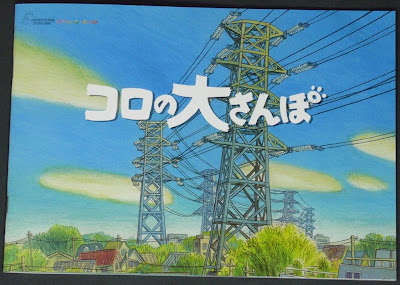
Hayao Miyazaki Short Films: Koro's Big Day Out (2003)

Hayao Miyazaki Short Films: Koro's Big Day Out

Let's take a look at one of Hayao Miyazaki's most interesting phases of his long career: the six short films created exclusively for the Ghibli Museum in Mitaka, Japan.

When the Ghibli Museum was created, a small movie theater was designed where children could watch animated short films created by the studio, usually around 15-20 minutes in length. These films would be exclusive to the museum, never to be seen anywhere else, and never to released commercially. These treasures would stay underground, in the charming Saturn Theater, free from the grip of materialism and commercialism.

To date, six short films have been produced by Studio Ghibli; all of them directed by Hayao Miyazaki. The first three were created in 2003: Koro's Big Day Out, The Whale Hunt, and Mei and the Kittenbus. The second three were created in 2006: The Day I Harvested a Star, House Hunting, and Monmon the Water Spider. Let's take a look at the first movie, Koro's Big Day Out.

These photos come from the official movie book, which is on sale in Japan, and can be found on Ebay for about $25 USD. For most of us, this is the closest we will come to seeing these great movies. These are just like the official art books that are released for Ghibli's feature films, with spectacular artwork and illustrations, as well as commentary on the production.

Koro's Big Day Out is a story of a small puppy who runs loose from his owner, a young girl in a Tokyo suburb. Koro explores the city, meets various people who kindly take him in, including a young woman on a bicycle, a neighboring family and their old dog, and delivery driver in his moving van. At the end of the day, Koro reaches his home, and runs into the arms of the little girl who was been searching for him.

This is a marvelous little story, perfect for its format, perfect for its audience. There's a simplicity that Miyazaki is comfortable with. Compare this to his lavish, epic movie spectaculars, and you see a careful restraint. Here is a skilled storyteller who doesn't feel the need to prove anything to himself or to others. He already has his outlet in features like Mononoke, Spirited Away, Howl's Moving Castle.

In a sense, I think Koro's Big Day Out evokes the smaller canvases of Ghibli's earlier films. It's a small story, based on a simple idea from everyday life. It's about experience and discovery and not about plot or exposition. These qualities connect much more with children, I believe. They can relate to the perky puppy in the big city. Compare this to Disney's 2009 feature, Bolt, and you'll spark some insightful discussions.

Judging from the artbook, the look of this movie is spectacular. It fits in perfectly with Ghibli's animated shorts of this decade, which moved further away from the classical style of the earlier features, more towards the style of children's storybook illustrations. Isao Takahata's My Neighbors the Yamadas was the breatkthrough for this movement, and this direction towards a new art style grew and developed among the Ghibli shorts for many years. Today, we finally see this unique, colorful hand-drawn style in Miyazaki's Ponyo.

I don't think many Westerners are aware just how firmly grounded in real life Ghibli's films are. We tend to look upon Miyazaki's films as Disney-esque fantasy, interpreting through the old American paradigms. But Ghibli is all about finding "magic" and mystery in our modern, everyday world. These are works that inspire the imagination; you want to run outside in the sunshine and wander around the city, explore the countryside, and embrace the mystery of the world.

2009-04-22

The Cat Returns - House Foods Ad


I'm not entirely sure the reasons for the collaborations between Studio Ghibli and House Foods. We've seen the studio's commercials for House from Hayao Miyazaki and Yoshiyuki Momose. Now here is an ad that ties in with Ghibli's 2002 film Neko no Ongasehi, The Cat Returns.

My affection for Ghibli leans towards their naturalist side, so it's always a thrill to see more work that follows in that vein. It's strange, isn't it, that in the year 2009, the idea of animation that captures everyday life seems so novel, so unusual?

Visually, this is one of the more ambitious Ghibli shorts, certainly matching the look and style of The Cat Returns, and is one of the highlights on the Short Short DVD. The art direction and animation is superb, as you'd expect, and we are also treated to that wonderfully catchy song from the movie. All in all, a great little showcase for the Ghibli artists.

More Ghibli Blog Posts To Discover