Search
Showing posts with label mononoke. Show all posts
2019-12-10
Artist Spotlight: Gio Gio Art
I found this terrific illustration of San the Princess Mononoke at the Reddit Ghibli thread. It was created by a person named "Gio Gio Art," who also has an Instagram account at "Giorgio.rt."
This piece has a great sense of tension in its pose, a sense of action and motion. I think it defines the character very well, who is defined by action and assertiveness. San is not a "cutesy" anime character but a tough gal who will whomp you six ways from Sunday.
I also enjoy the color palette with its light brown fur and ample use of empty space. The red tones on the mask are especially nice as well, as are the blood splatters. All in all, great work.
2018-03-29
GKIDS Ghibli Fest 2018 Schedule
To purchase tickets online, visit the Fathom Events website.
Here is the official schedule for Ghibli Fest 2018. Be sure to bookmark this post for future references:
Ponyo
March 25, 26 and 28
The Cat Returns
April 22, 23 and 25
Porco Rosso
May 20, 21 and 23
Pom Poko
June 17, 18 and 20
Princess Mononoke
July 22, 23 and 25
Grave of the Fireflies
August 12, 13 and 15
My Neighbor Totoro
September 30, October 1 and 3
Spirited Away
October 28, 29 and 30
Castle in the Sky
November 18, 19 and 20
May 20, 21 and 23
Pom Poko
June 17, 18 and 20
Princess Mononoke
July 22, 23 and 25
Grave of the Fireflies
August 12, 13 and 15
My Neighbor Totoro
September 30, October 1 and 3
Spirited Away
October 28, 29 and 30
Castle in the Sky
November 18, 19 and 20
2018-02-27
"How Princess Mononoke Was Born" on VHS
A decade ago (can hardly believe it's been that long), I posted a series of YouTube video episodes from the DVD documentary How Princess Mononoke Was Born. This television program originally aired on Japanese network NHK, which has had a very long and fruitful relationship with Hayao Miyazaki, going back to his 1978 series Future Boy Conan, which aired on the network.
Here are some cool screenshots from the VHS edition, containing the series on three tapes and encased in a stylish box. These sort of deluxe packages were common in the latter days of VHS, and have always remained prized collectors' items. Even if you can no longer play videotapes, it's nice to have these sitting on your shelf, filling out your prized Ghibli fan collection.
Unfortunately, this documentary has never been released outside of Japan. It's very unfortunate, because this terrific program deserves to be seen by as wide an audience as possible. Thankfully for fans, an English translation of the Japanese language arrived from the fan underground, and video episodes soon appeared on YouTube for all to enjoy. These were the videos that I shared on Ghibli Blog in 2008 (parts one, two, and three).
Just recently, a Ghibli Blog follower sent me an email about this series. He informed me that the woman who was responsible for the English subtitles was stricken by illness, and she was unable to complete her translation project. This is why the YouTube videos were never fully completed.
More tragedy: recently, Studio Ghibl had all of these Mononoke documentary videos removed from YouTube on copyright grounds. I have never understood the reasoning behind this strategy. It's perfectly understandable to protect your rights when your movies are easily available on store shelves and online retailers. It's quite another thing when said programs are unavailable anywhere. We would love to buy this series on DVD or Blu-Ray. We would gladly pay money for a separate release, or a reissue of Princess Mononoke with the documentary as a bonus feature. Simply taking your ball and going home accomplishes nothing.
Let us hope that Studio Ghibli will indeed release this great program on our shores. It goes into the production of their landmark blockbuster movie in exquisite detail, from conception to completion. You follow Miyazaki on the long and difficult journey to create what was, then, his most ambitious film project. Had the movie failed at the box office, he would have been ruined. Instead, it became Japan's all-time box office champion, bring fame, fortune and international acclaim to the director and his studio.
The next time you purchase the latest Blu-Ray from GKIDS, send them a nice letter asking them to release this title as well. Send them a photo of a twenty-dollar bill and scribble the words, "This can all be yours."
Until then, why not add this VHS box set to your collection? I found it on Ebay fairly easily. All true Ghibl Freaks should have at least one or two videotapes to show off.
2018-02-14
Riffs: Princess Mononoke (Movie and Book)
Later in the movie, Ashitaka meets San, the "Princess Mononoke", and falls in love with her. He gives her his crystal dagger as a sign of his devotion to her. Later, during the dramatic climax, San lashes out in anger by striking the same dagger into Ashitaka's chest. In the end, while the two share love for one another, they both realize that they cannot live together, and must stay in their separate worlds (don't kid yourself; when the girl you are dating says "I need my space," you're never seeing her again).
Now here's where things really get interesting. The village girl Kaya is actually a recreation of the heroine from Hayao Miyazaki's original 1980 version of Mononoke Hime, which was radically different from the eventual movie. It's far closer to a traditional fairy tale, Beauty and the Beast meets Feudal Japan. In that story, Mononoke is a large cat who takes on a human wife, the "Mononoke Princess."
Incorporating the storybook princess into the movie is a stroke of sly brilliance. The romantic heart of this movie involves a love triangle, where the heroic prince must choose between two women who carry the same name.
Most Miyazaki fans in the West had never heard of the 1980 version of Mononoke, created as a series of storyboards for a planned animation project which was scuttled, then published in the 1983 book Hayao Miyazaki Image Boards. A standalone storybook was published in Japan in 1997 to coincide with the movie, and was eventually published in North America by Viz Media in 2014.
2017-11-20
Artist Spotlight: Totoro and Friends
You can never have enough Totoro fan art, it seems. I'm always amazed at the level of creativity and inspiration this humble little movie has spawned. Sometimes I have to pinch myself and remember that My Neighbor Totoro was an extremely obscure movie in the West as recently as a decade ago. Yes, it had a measure of success on home video (read: VHS), but the wider public never really discovered Miyazaki. Today, there is a thriving and growing fan community.
I really like this painting, which incorporates several Hayao Miyazaki characters into a Classical Japanese watercolor art style. We even see a cameo by the director himself in the background. Totoro shares the spotlight with No-Face, the Soot Sprites, a Kodama and Catbus, who appears as a kite. The composition is nicely balanced, which is a challenge when there's so many characters in view.
The artist who created this piece did an excellent job. Unfortunately, I was not able to discover the artist's name, so if you know who is responsible for this painting, please pass it along so that we can give proper credit.
2017-11-03
Bocanada: A Journal of Pop Culture and the Arts - The New E-Zine From Ghibli Blog
Have you downloaded your free e-zine yet?
Many years ago (longer than I care to admit), I created zines to nourish my love of writing and popular culture. I wrote about Star Trek and science-fiction, video games, music, art, and the ups and downs of daily life. They were created on simple desktop publishing software, word processors, and an assortment of clip art and marker pens. It was very low-tech, but highly enjoyable. I even managed to score some freelance writing work at GamePro, which was tremendous fun
Ever since then, I wanted to return to zines. I even had recurring dreams about finding an old computer with long-forgotten websites that were still active, and communicating with old friends. 21 years later, while working on my multiple book projects, I thought it would be fun to finally take the plunge again and create a zine that I could share with my readers and fans. And so Bocanada Issue 1 was born.
Bocanada: A Journal of Pop Culture and the Arts. That long-winded title means, simply, that I get to write about whatever the heck I want, but mostly aimed in the same direction as my writings on Ghibli Blog and the new books: Zen Arcade, Pop Life and Greatest Hits.
For Ghibli Freaks, this issue includes essays on Kiki's Delivery Service, Princess Mononoke and My Neighbors the Yamada. For classic and retro video game fans, there are reviews of Altered Beast (Genesis), Sonic the Hedgehog (Genesis), Bonk's Adventure (TG-16), Mega Man (NES), and Street Fighter 2 Turbo (Super NES). For music lovers, we have articles on Miles Davis' 1974 jazz-fusion album Get Up With It and Sony's PS-X75 Biotracer Turntable. Finally, we have an art gallery of zine-worthy graffiti works created by me back in 2002.
The cover image is another one of my artworks, a 2005 digital painting created entirely on computer. The title is an homage to Gustavo Cerati's 1999 album, a glorious mashup of trip-hop (remember that?), Radiohead's Kid-A and The Beatles. The pages are "half-size," meaning that they are standard 8.5" x 11" pages folded in half. The zine is 48 pages in total, which matches the output of my old zines perfectly (they were 245 pages at standard size).
Bocanada was created for both physical and digital formats. I find the half-size format works perfectly for tablets and even smartphones. The pages are very readable and neatly designed without becoming too cluttered or dense. I created everything on Scribus, a freeware tool, which I suppose would disqualify me in the eyes of many zine publishers -- it's not a "real zine" unless everything is created on a typewriter, scissors and markers. Whatever.
Bocanada is available as a "perma-free" download, meaning the digital version will always be free. All you have to do is join my mailing list. In addition to receiving the zine, you will also receive regular email newsletters that feature the latest news and developments from DT Media (my indie publishing label) and Ghibli Blog, including the new books!
When is Bocanada Issue 2 coming? Soon. I'm still very busy with releasing the books, assembling the new DT Media website, and doing the usual promotional work (translation: hassling everyone with review copies and appearance requests). If we can assemble and publish the second issue in time for Thanksgiving, I'd be thrilled.
As always, thank you very much for your continued support of Ghibli Blog.
P.S. I keep mentioning the new books: Zen Arcade, Pop Life and Greatest Hits. Well, the books are finished and ready to roll out! As for release date, availability and price...join my mailing list and I'll share all the answers in my next newsletter.
Update (10/4 8:23pm): Bocanada now has a new cover design! I like it a lot, and hope you will, too.
2017-10-27
Hipster Miyazaki Hated Weinstein Before It Was Popular
Hipster Miyazaki would like you to know that he hated Harvey Weinstein long before it became popular:
In 1997 the director signed a distribution deal with Disney. It was to prove a springboard to global renown, paving the way for a dedicated exhibition at New York's Museum of Modern Art and helping him secure the 2003 Oscar for Spirited Away. Even so, the nature of Miyazaki's films has been tweaked in transit. In Japan his films are blockbusters the whole family can enjoy. In Britain and the US he remains a predominantly adult, art-house phenomenon.
Miyazaki taps a cigarette from a silver case. The Disney deal suits him, he explains, because he has stuck to his guns. His refusal to grant merchandising rights means that there is no chance of any Nausicaa happy meals or Spirited Away video games. Furthermore, Disney wields no creative control. There is a rumour that when Harvey Weinstein was charged with handling the US release of Princess Mononoke, Miyazaki sent him a samurai sword in the post. Attached to the blade was a stark message: "No cuts."
The director chortles. "Actually, my producer did that. Although I did go to New York to meet this man, this Harvey Weinstein, and I was bombarded with this aggressive attack, all these demands for cuts." He smiles. "I defeated him."
2017-10-26
Original Mediallion Used for Princess Mononoke Poster
A Reddit user named "ghiblithroway" shared this very rare item: a medallion used as the model for the US movie poster for Princess Mononoke in 1998. According to the owner, this sculpture was commissioned by Studio Ghibli for the poster design, and stayed with its creator until finally given to him some time later.
The sculpture is made of plastic, and given a nice bronze finish. It is roughly eight inches in diameter.
I wrote about this poster design years ago, and revised the article for inclusion in Bocanada Issue 1. It's a fascinating attempt at branding for the US release of Mononoke, which was later revised to feature the male lead, Ashitaka, instead of San. You are free to debate which poster suits the movie better. Or you can just pile the blame onto Harvey Weinstein, who deliberately tanked the picture as revenge against Hayao Miyazaki's refusal to allow any cuts.
2017-09-22
Artist Spotlight: Mononoke Hime by Michael Tunk
This absolutely fantastic collage piece titled "Mononoke Hime" was created by California-based artist Michael Tunk. His paintings employ classical surrealism with a pop art sensibility that is also reminiscent of underground punk zine culture.
According to his website bio, "Michael Tunk takes photographs and magazines from the 1800's-1980's and re-contextualizes them into something beautiful. He takes refused detritus and spins a yarn of gold. He takes the weight from a hoarders home and fixes it into aesthetic candy. His pieces are never photoshopped, he uses only Xacto blades and what’s left of the bones in his wrists."
I enjoy the way this collage invokes a sense of mystery about this world, and a slight sense of dread as well. We are not walking into another one of Walt Disney's enchanted forests, but a strange and mysterious land where discovery and danger lie around every turn. Everything is wildly colorful, more than a little psychedelic, invoking all its dreamlike implications. Dali and Warhol would be proud.
Please visit Tunk's website to see samples of his work, and send him a note with your thanks.
2017-09-11
8-Bit Cinema: Princess Mononoke
Continuing the "8-Bit Cinema" series from Spirited Away, we find this equally fascinating and compelling mock videogame dedicated to Hayao Miyazaki's 1997 blockbuster hit Princess Mononoke.
I think Mononoke works better as a videogame than Spirited Away. The structure of the movie fits squarely with the conventions of classic action-adventures, you have a hero on a quest and a wide cast of characters, you have a dramatic arc with many twists and turns, you have many lush environments and locales, and you have the potential for a lot of terrific action.
This video does a great job condensing the two-plus hour movie into a 2D side-scrolling game, similar to what you would expect to find on NES, Sega Master System or Turbografx-16.
Hayao Miyazaki is notoriously hostile to most modern technology, and this goes double for electronic games. He would never allow for such a project as this, but he should. Perhaps a small team of indie game developers should just go ahead and make this Mononoke a reality. Heck, somebody send an email to Vanillaware and tell them to use the Muramasa engine.
Here are some screenshots of key moments in the video:
2015-03-26
FLASH SALE: Studio Ghibli T-Shirts
There's only 12 hours left on this sale, so be sure to hurry if you're interested.
2014-11-21
New Miyazaki Book: Princess Mononoke: The First Story
Newly published from Viz Media is Hayao Miyazaki's famous storyboard book, "Princess Mononoke: The First Story." This story consists of watercolor image boards created by Miyazaki in 1980 for an unrealized film project. The artwork was first published in his 1983 artbook, "Hayao Miyazaki Image Boards," and ten years later as a standalone volume.
I've written about the history behind the 1980 Mononoke Hime, going into greater detail, so I won't recount that tale yet again here. I also published the entire story, with fan translations, on Ghibli Blog back in 2008, eventually finding its way across the internet and generating great interest in Hayao Miyazaki's "lost" anime.
I have edited my 2008 Mononoke post to remove all but a small sample of pages. And now I strongly urge all Miyazaki fans to purchase this new book. The quality of the paintings is superb, and the presentation is the same high calibur we expect from Viz. This is an excellent storybook, one that will make wonderful gifts for friends and family this holiday season.
Hayao Miyazaki's manga comics remain largely unknown to Western audiences. I do hope this latest release will begin to turn that around. There should be a whole series of "Hayao Miyazaki Comics" in our libraries and bookstores.
P.S. The 1980 Princess Mononoke share nothing in common with Miyazaki's 1997 blockbuster anime film, apart from the heroine, who reappears in the movie as Ashitaka's love interest. Mononoke, the giant cat, obviously resembes a close cousin to Papa Panda and Totoro. And some of the scene designs would resurface as the bath house in Spirited Away.
2014-11-19
New Studio Ghibli Blu-Ray Movies Released This Week
As all good Ghibli Freaks know, this week sees the release of three new Studio Ghibli Blu-Ray movies in the USA: The Wind Rises, Princess Mononoke, and Kiki's Delivery Service. It's always so rare that we get anything released by Disney at all, having three movies at once is especially grand.
I haven't had a chance to examine these BDs for myself, but reviews have been mostly positive. Picture quality should be excellent, if a step below the Japanese BDs, color tones will be rich, warm and extremely detailed. Studio Ghibli looks so much better on high definition over DVD, it's worth upgrading your home theater system just for these movies. But that's just my opinion.
The only negative is that Mononoke uses dubtitles - what, "dubtitles?" - instead of the literal English translation from earlier releases. That's completely baffling and frustrating, but it wouldn't be the first time this has happened; Disney's US Blu-Ray of Castle in the Sky is also plagued with incorrect subtitles. It's a puzzling oversight, and one that's completely unnecessary. Because of this, I cannot recommend the US release over the Japanese. That's just me. If you prefer Neil Gaiman's US script, then you'll be perfectly happy with this release. It was a fairly good anime dub for its time, more respectful than most. But it still would be nice to enjoy the Japanese soundtrack as well, and using incorrect subtitles detracts from that experience.
Kiki's Delivery Service, similarly, also uses dubtitles instead of a literal translation, but this has always been the case. We have never had proper subtitles of this movie, in any format. Fortunately, the subtitles are taken from the old Streamline Pictures dub, which was very enjoyable. There's one throwaway joke about the Hindenberg that I could do away with, but it's never really bothered me. Kiki is underrated in the Miyazaki canon; for me, it continues the gentle, pastoral pace of My Neighbor Totoro, and its insights on emerging adolescence, and any period of transition in one's life, ring true.
Years ago, I was grappling with long-term unemployment, the kind where you fear that you'll never find work again. When watching Kiki's Delivery Service, the scene where Kiki sat in a park, lost and uncertain, stuck me to my core. I felt that moment, that disorientation, that worry. Where will I go? What will happen to me? That scene has always resonated in my memory, because of my experience. If there's anything I respect about Miyazaki, it's his emotional honesty. This is a great movie.
And The Wind Rises? Still a masterpiece, still controversial, but always destined to spark debates and deep discussions about Miyazaki, World War II, and the movies. It was criminally ignored by the so-called fans when it was released in US theaters early this year. Here is your chance for redemption, kids.
2014-03-09
Viz Media to Release "The Art of Princess Mononoke" - Is a Disney Blu-Ray Coming Soon?
Viz Media announced this week that, in addition to publishing Hayao Miyazaki's 1980 Mononoke Hime (based on a series of image boards for an unrealized animation project), they will be publishing "The Art of Princess Mononoke," as part of the continuing Studio Ghibli art book series. The book will arrive in bookstores this October.
This release will officially replace the long out-of-print edition published by Miramax, "Princess Mononoke: The Art and Making of Japan's Most Popular Film of All Time." That book was also based on Ghibli's official art book. I haven't seen that edition in many years, so I cannot remember if there were any exclusive pages or essays that won't appear in Viz Media's edition. We'll just have to wait and see.
And now for the larger question: Does the publication of two Mononoke Hime-themed books mean Disney is planning to release the Blu-Ray edition of the film? It was released in Japan just in time for Christmas last year (along with The Cat Returns the Favor/Ghiblies Episode 2), and should be arriving around the world in due course. Unfortunately, as we all know, the relationship between Studio Ghibli and Disney over this film was rocky and contentious. It's never a good sign when the studio boss wakes up to find a loaded weapon in his mailbox.
When Miramax split from Disney, they took Princess Mononoke with them, as they were the official distributor in the US. It appeared the rights would be lost in legal limbo; fortunately, Disney quietly reacquired those rights a couple years ago, and reissued the DVD, with the blue-and-gold label. This was done with almost no fanfare, and, probably don't even know this release even exists. Heck, I didn't know about it until I saw a copy at Barnes & Noble's last year.
When Disney signed a distribution deal with Studio Ghibli, they were interested in Hayao Miyazaki's children's movies like My Neighbor Totoro and Kiki's Delivery Service. The last thing they ever expected from the Japanese filmmaker was a bloody and brutally violent Ford-Kurosawa epic. In a society where animation exists almost solely as "the electric babysitter," Princess Mononoke came as a shock, and relations between the two parties were notably damaged, until Pixar's John Lasseter came to the rescue in 2002.
On the Blu-Ray front, Disney in the US has fallen so far behind Japan and the rest of the world, I've all but given up hope. They have little interest in selling movies that don't sell in this country, especially when Disney holds no merchandising or character rights ("where the real money from the movie is made.") And the box office returns for The Wind Rises are absolutely dreadful. And so there is very little demand, or interest, by either Disney or the general public.
The two new Mononoke books give hope that we'll see the Blu-Ray on our shores. On that topic, I'll move the dial from "Never in a Million Years" to "Maybe." For our side, I'll count that as a win.
2014-03-07
Hayao Miyazaki's 1980 Mononoke Hime Book Coming to USA
Good News, Everyone! Viz Media will publish Hayao Miyazaki's Mononoke Hime picture book this October in the USA. Retail price will be $34.95.
The original Mononoke Hime began as a film project in 1980. Miyazaki created a complete set of image boards, rendered in pencil and watercolor, and sought out producers to finance the project. He was unsuccessful in this quest. He eventually published the image boards and story in his 1983 art book, Hayao Miyazaki Image Boards. In 1993, Mononoke Hime was published as a stand-alone picture book, and this is the version that Viz will be publishing in the States.
This period of Miyazaki's career - late 1970s to early 1980s - is very interesting. It's a time of setback and struggle; the glory days of Toei Doga, of Heidi and Marco, his collaborations with Isao Takahata, are fading in the distant past. His own attempts to establish himself as a sole director in his own right - 1978's Future Boy Conan, 1979's Lupin the 3rd: Castle of Cagliostro, 1981's Sherlock Hound (Famous Detective Holmes) - were met with failure on the small screen, the big screen, and behind the scenes. Despite the excellence of his work, the peak of his cliffhanger serial period, the director could not find an audience willing to accept him. And so a number of film projects, including Mononoke Hime and My Neighbor Totoro, languished for lack of interest and lack of funds. By 1982, it appeared that his anime career was all but finished.
One could see his return to manga comics, with the monthly serial Nausicaa of the Valley of Wind in 1982, the graphic novel The Journey of Shuna in 1983, the publication of his Image Boards book the same year, as Hayao Miyazaki's farewell to animation, a return to his earlier passion, comics. Others could see this period as a regrouping, of healing wounds and plotting the comeback, a period of evolution. When Miyazaki was given the chance to direct the Nausicaa anime film in 1983/84, the heroic optimism of his youth had burned away, and what emerged was darker, and more emotionally complex, and with a new sadness underneath the surface. Hayao Miyazaki, the Personal Filmmaker, was .
For our interests, the 1980 Mononoke is a fascinating look into the younger Miyazaki of the 1970s, whose stories were clean and direct. This is a children's fairy tale far removed from the emotionally wrenching 1997 John Ford-Kurosawa epic. It's fun and amusing and entertaining, and it doesn't aim to be anything else. It's fascinating to imagine how Miyazaki and his animators could have realized these image boards. The giant cat, of course, reminds us of Totoro, and I think that's why this storybook is popular with fans. I expect this book to become a hit when it reaches bookstores in October; it's closer to what Miyazaki fans actually want, instead of a confessional melodrama like The Wind Rises.
And now a personal note. I posted the complete set of the 1980 Mononoke image boards, which were translated into English. After a few years, it was finally discovered by the internet and spread like wildfire. To this day, this is the most popular post in the history of Ghibli Blog. I am very humbled and thankful to have played a role in spreading awareness of this, and many other, works from the careers of Hayao Miyazaki and Isao Takahata.
It has always been my dream that these films, comics and books would be released in the US. And now that Mononoke Hime is being published, I will soon delete the comic from that post, so as not to hurt Viz Media's book sales. The role of this website is to preserve history and build a community, not steal or exploit. I urge everyone to purchase this book when it is released, and support those who invest time and money on these projects. Show your support with your dollars and help to build this community.
2014-02-23
Neil Gaiman Discusses Princess Mononoke
I honestly cannot remember if I ever shared this 2005 Neil Gaiman interview, in which he discusses his US dub translation for Princess Mononoke. In any case, it's a worthy piece of history that should be preserved and shared. It's a fascinating glimpse into the sausage-making of movies, of struggling to bring a blockbuster anime film to the United States at a time when "anime" was borderline toxic.
Kids today don't realize just how badly the grownups were scared by Japanese animation. It was all so, well...alien. It's a miracle that these movies were ever released on our shores at all. Thank God for those brave pioneers who carved the trails.
2012-11-27
Minneapolis Studio Ghibli Film Festival - Closing Days
The two-week Studio Ghibli Film Festival in Minneapolis closes out this Thursday, and we are playing the final four films: The Cat Returns and Mimi wo Sumaseba on Monday and Tuesday, Princess Mononoke and Omohide Poro Poro on Wednesday and Thursday. It's a terrific lineup and we wish we could be there every day this week. Sadly, we're down to our final two free passes, and we have to save our money for the move to a new apartment this weekend.
Marcee and I will be there on Thursday for the final showing of Omohide Poro Poro, Isao Takahata's 1991 masterpiece. I thought it would be right for Ghibli Blog to be there at the very end.
Of the final four movies, The Cat Returns is the weakest of the bunch, and it's a good example of Ghibli's struggles to find new directors to follow Hayao Miyazaki and Isao Takahata. It does have its charms, but when you can also watch Yoshifumi Kondo's Mimi, why bother? One is a decent movie best served by home video (and best paired with the short film, Ghiblies Episode 2); the other is an animation masterpiece by a skilled veteran who built a long career with the Miya-san and Paku-san. I really wish I had money hidden under my couch cushions!
Princess Mononoke was Miyazaki's blockbuster smash that toppled E.T. from the Japanese all-time box office and brought international acclaim to Studio Ghibli. It also sparked a notorious battle between Miya-san and Disney, and especially the Weinsteins at Miramax. Now Lionsgate owns the home video rights, and it's questionable that we'll see Mononoke on US home video again. If you get a chance to see this movie in a theater...run. Don't walk, run. You may not get another chance for a long time.
Omohide Poro Poro is the perfect closer, a style and genre of filmmaking that literally does not exist in the West. Feature animation in the service of a weepy character melodrama? With a pop culture nostalgia that rivals Quentin Tarantino? And one that addresses contemporary Japan (ca.1991) as its vaunted bubble economy burst? Somewhere in the mix lies a popular Japanese manga about a woman's childhood in the 1960s, and a modern quasi-documentary about organic farming and cultivation of safflowers for dyes and cosmetics. Yes, this is a very deep movie. Yasujiro Ozu would have been amazed.
Much thanks to everyone who attended GKids' Studio Ghibli Film Festival here in Minneapolis. It's been terrific, and I really do wish it could have lasted longer. I needed more time to save up more money! Please come back!
2011-04-06
Mononoke Hime (1980) - Here's a Hi-Res Poster
Some of you have been asking for higher-resolution scans of Hayao Miyazaki's 1980 Mononoke Hime storyboards. So I dug around the pages of Hayao Miyazaki Image Boards, his 1983 art book, and decided to pull out this little gem. This watercolor illustration is probably the iconic image from the 1980 Mononoke.
If you're wondering, Image Boards (the book) can be easily found on Ebay. A quick search should yield some results. Good luck!
2011-03-30
The History on Miyazaki's Mononoke Book
We've been getting a ton of traffic lately because somebody discovered Hayao Miyazaki's Mononoke Hime image boards from 1980 (thanks, everybody!), and there has been a bit of confusion about this story and what it has to do with the 1997 Studio Ghibli movie of the same name. So I'd like to explain it all as best I can.
The period of 1979-1983 marks the bleakest days of Hayao Miyazaki's career. Future Boy Conan, his 1978 TV series at Nippon Animation, is today considered a classic, but at the time was not a great success. In 1979, he directed his first feature film, Lupin III: Castle of Cagliostro, at TMS, or Telecom. Like Conan, Cagliostro is today widely regarded as a classic, but the movie was a failure at the box office. With Yasuo Otsuka, Miyazaki-san oversaw the final dozen or so episodes of the second Lupin television series, and directed two episodes himself, but under a pen name - very telling. In 1981, he worked on the Meitantai Holmes (Famous Detective Holmes, which is what Arthur Conan Doyle's stories are called in Japan), series at Telecom. Sherlock Hound, as it's known in the west, was scrubbed with only six episodes in the can. This would be Miyazaki-san's last work in animation for three years.
2011-03-28
The 1980 Mononoke Hime Book Meets Spirited Away
Well, thanks to io9, for sending a boatload of traffic to this site to read Hayao Miyazaki's 1980 Mononoke Hime book. Now that I've got your attention - well, the few of you who chose to stick around - I'd like to show you something you may have noticed.
First, the quick backstory on Mononoke. In 1980, Miyazaki published a book of image boards he drew for a story project that never got off the ground. Titled Mononoke Hime, it told the story of a giant cat, named Mononoke, who kidnaps a girl and demands that she become his wife. The girl's father is possessed by the spirit of a demon who turns him into a bloodthirsty warrior and a brutal tyrant. She convinces Mononoke to take her home and save her father. By the end of the story, the girl discovers that Mononoke was actually a young boy who was wild and greedy. He behaved like an animal and was cursed to live like one - echoes of Beauty and the Beast.
This unfinished Mononoke Hime bears no real relation to Studio Ghibli's 1997 movie of the same name (the title was Toshio Suzuki's idea). But the story's climactic sequence is echoed again, interestingly, in 2001's The Spiriting Away of Sen and Chihiro. I'll assume that you've seen Spirited Away a few times, so you'll spot these shots right away.
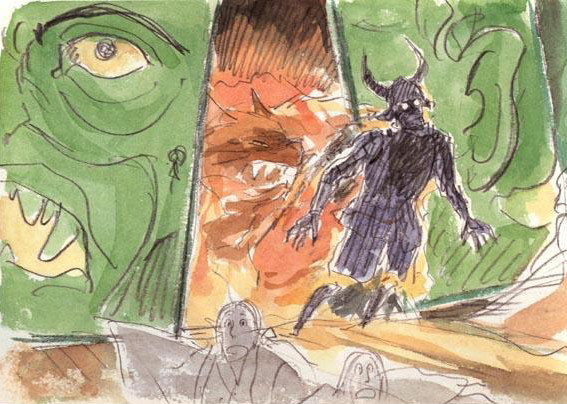
In this scene, the unnamed girl confronts her father in his castle. Notice the patterns on the walls, which is a useful bit of foreshadowing as well as an impressive piece of Japanese art. Alone in the chamber, she succeeds in freeing her father from the demon, who then inhabits a suit of samurai armor. Mononoke (that's the giant Totoro-ish cat) rushes in to block a wall of flame, and charges out of the room and down the hallway at the monster.
This just also happens to be one of my favorite scenes in Spirited Away. It's the sequence where Sen confronts the bloated and greedy No-Face creature. Sen offers something which begins a chain reaction, causing No-Face to regurgitate and bellow and smash down the hallways in a violent rage. It's a smashing bit of directing, perfectly tense, masterfully timed, and climaxes in an explosive rush. It's one of my favorite Miyazaki action scenes.
Take a look at these Mononoke Hime image boards and see for yourself.
First, the quick backstory on Mononoke. In 1980, Miyazaki published a book of image boards he drew for a story project that never got off the ground. Titled Mononoke Hime, it told the story of a giant cat, named Mononoke, who kidnaps a girl and demands that she become his wife. The girl's father is possessed by the spirit of a demon who turns him into a bloodthirsty warrior and a brutal tyrant. She convinces Mononoke to take her home and save her father. By the end of the story, the girl discovers that Mononoke was actually a young boy who was wild and greedy. He behaved like an animal and was cursed to live like one - echoes of Beauty and the Beast.
This unfinished Mononoke Hime bears no real relation to Studio Ghibli's 1997 movie of the same name (the title was Toshio Suzuki's idea). But the story's climactic sequence is echoed again, interestingly, in 2001's The Spiriting Away of Sen and Chihiro. I'll assume that you've seen Spirited Away a few times, so you'll spot these shots right away.
In this scene, the unnamed girl confronts her father in his castle. Notice the patterns on the walls, which is a useful bit of foreshadowing as well as an impressive piece of Japanese art. Alone in the chamber, she succeeds in freeing her father from the demon, who then inhabits a suit of samurai armor. Mononoke (that's the giant Totoro-ish cat) rushes in to block a wall of flame, and charges out of the room and down the hallway at the monster.
This just also happens to be one of my favorite scenes in Spirited Away. It's the sequence where Sen confronts the bloated and greedy No-Face creature. Sen offers something which begins a chain reaction, causing No-Face to regurgitate and bellow and smash down the hallways in a violent rage. It's a smashing bit of directing, perfectly tense, masterfully timed, and climaxes in an explosive rush. It's one of my favorite Miyazaki action scenes.
Take a look at these Mononoke Hime image boards and see for yourself.
Subscribe to:
Posts (Atom)