Search

2006-07-31

Gedo Senki Premiers in Japan


Studio Ghibli's newest feature, Gedo Senki (Tales From Earthsea), was released in theatres in Japan this weekend. Understandably, there has been great interest in Goro Miyazaki's film debut. If nothing else, people will want to see what the fuss is all about, to see if the son of Japan's most successful filmmaker can pass muster. Thankfully, the reviews have been very positive.

The Daily Yomiuri has a pair of reviews praising the film, one in English and the other in Japanese. The English review by Andrez Bergen describes it as "a bit like Sword in the Stone meets Zatoichi," and has only kind words for the 38-year-old director:

"Still, away from comparisons with anime's uncontested international contemporary success story, and examined in the softer hue of what it actually is--an outstanding debut, and a rousing animation romp in its own right--Gedo Senki augurs well in terms of setting sail toward Goro's very own signature style, Miyazaki moniker or not."

The second Yomirui review, in Japanese, can be read here.

2006-07-30

Movie Night - Omohide Poro Poro

(Update: This video has since been removed from Youtube.  Sorry.)

Welcome, one and all! This week's Movie Night will be Isao Takahata's Omohide Poro Poro, the Studio Ghibli film from 1991. The title translates as "Memories of Falling Teardrops," which betrays its strong Yasujiro Ozu influence. It tells the story of a young career woman who feels disaffected, and quietly begins to question her life during a vacation on an organic farm. Haunted by her childhood days from 1966, the movie shifts from the present-day to the childhood memories that shaped the direction of the woman's life.

This film is deeply affecting, and connects to your emotions on a degree never seen in animation. Certainly never seen outside of Takahata's oveure. Grave of the Fireflies, Takahata's best known work in the West, feels almost monochromatic by comparison. You're about to discover Technicolor, Dorothy. Welcome to Oz.

Omohide Poro Poro


Omohide Poro Poro is, with all due reverence to the great Yuri Norstein, the greatest animation film I have ever seen. It represents the peak of everything Isao Takahata hoped to achieve, in terms of content, in terms of form and structure, in terms of sheer beauty and naturalism.

Isao Takahata's films, as a whole, are a complete repudiation of the American animation codified by the Walt Disney studio, introducing psychological complexity, documentary neo-realism and naturalism, elements of tragedy, drama and comedy, a wide variety of visual styles, and strong influences from masters of world cinema. His movies display a wide variety of visual styles, and his free-roaming camera predates the age of CGI by decades.

Most of all, his stories are deeply human. Omohide Poro Poro is one of the great stories about a person's life, about quietly disenchanted woman who begins to reexamine herself, her place in life, all while being relentlessly shadowed by the ghosts of her childhood. It is a story of the inner child that speaks to us.

I don't think most Americans, or most Westerners for that matter, are aware that animation is even capable of dealing with such themes. Many of you probably won't believe until you see with your own eyes, until you're moved to tears by its graceful beauty. Good Lord, I know this person. I know this woman. This is me.

Omohide Poro Poro translates as "memories of falling teardrops," which is a wonderfully poetic title reminiscent of Ozu. Ozu, painted in watercolor. The scenes in 1982, when the movie is set, is painted with astonishing detail; Taeko-chan's childhood scenes, set in the 1960's, are contrasted with warm colors and faded details. No other picture captures so perfectly the idea of memories. Some events in our lives are sketchy, and we remember only the essence. Other moments sear in our minds with perfect detail; we remember everything.

Takahata adapted this film from a comic of the same name, in which the author recounted events from her childhood. Most of the flashback scenes are brought to the screen, and they run parallel to the adult Taeko as she takes a vacation in the Japanese countryside, working on an organic farm with in-laws. The film is at once tremendously funny, deeply insightful, poignant, tragic, always moving. Bring the Kleenex. You will cry or you have no soul.

There are so many things I could point out, from Yoshifumi Kondo's character design, to the musical score which spans from 60's pop to Hungarian folk music. I'll simply highlight my favorite scene, the sunrise in the safflower fields. It is a sunrise that arises slowly, steadily, over the endless hills, the yellow flowers, the bees, glowing with the Romanian choral music that sweels. The light breaks over the mountains, and we pause, reflect, give thanks. It is one of the greatest treasures of the cinema.

2006-07-29

Today's Screenshots - Umi Ga Kikoeru


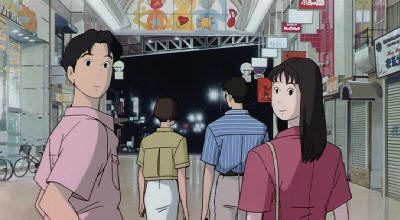
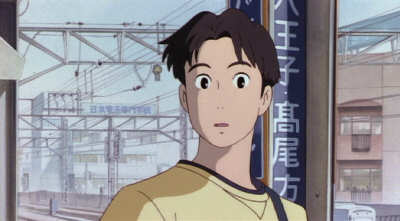
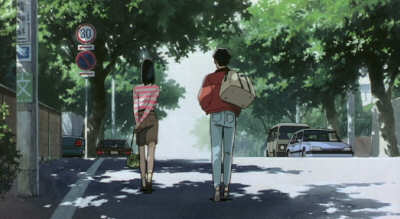
Today's the last day before we move on to the next Movie Night feature, so I thought I'd add a couple screenshots from Umi Ga Kikoeru. There are a lot of terrific shots to choose from, but I'm always a sucker for good composition, so here's one from the airport scene. The other shot comes from the class reunion; note the attention to detail in the shopping mall in the background. Like many Ghibli films, this is based on an actual location, and the accuracy in the detail is striking.

Also, it must be said. I miss the good ol' days of hand-painted animation. Today's computers have many advantages, but they still cannot match that unique quality that only comes from using a paintbrush. Poor Michiyo Yasuda must have cried buckets when they took all the paints away from the Ink & Paint Dept. and replaced them with computers.

A Primer on the Disney Deal, or Fat Chance

So now that you've seen Umi and read a little about it, you want to pick up a copy and watch it on your new big-screen TV. Will there be any chance of it being released here in the US? Hmm. To be honest, I can't say, but if I were a betting man, I'd say our current chances range somewhere between "not likely anytime soon" and "fat chance." To understand, we'll have to look at the distribution deal between Ghibli and Disney.

In 1996, Disney signed a distribution deal with Tokuma Shoten, the publishing company that financed Studio Ghibli. According to the deal, Disney would sell the Ghibli catalog on video and DVD, and distribute theatrical films around the world. For Ghibli, this was a very profitable deal. They retained creative control over the DVD's, and released their entire catalog in excellent condition, and to great success. Disney's involvement also meant global exposure, which obviously is a very good thing (otherwise I'd be fast asleep instead of writing this).

There were some conditions to the deal, however. Rule Number One: no cuts. Rule Number Two: see Rule Number One. This was the deal-breaker. A number of Hollywood studios came courting, but wouldn't accept Ghibli's terms. Disney, however, agreed to the terms, and walked down the aisle.

Rule Number Two: Disney has to release all of the studio's movies in the American market (with the exception of Grave of the Fireflies, which was taken by Central Park Media), and they would get distribution of later theatrical films. And while they could not remove a single frame from any movie, they could rescore and re-dub the soundtracks for the US versions.

Despite signing on the dotted line, the Disney suits were never very happy with these terms. In all liklihood, they just wanted to get the rights to some of Miyazaki's more kid-friendly movies, like My Neighbor Totoro and Kiki's Delivery Service (these were the first movies to appear here on VHS, and they remained the only Ghibli movies on video for a number of years). It's also just as likely that Disney signed with Ghibli to prevent the other studios from getting their hands on the catalog of a rival animation studio - a studio that had cranked out one masterpiece after another, something that the Disney corporation hadn't done since Walt's glory days of the 1930s and '40s.

Disney was hoping Miyazaki would churn out another Totoro. Instead, his next film turned out to be Princess Mononoke - a dark, bloody violent meditation on conflict and the human condition, a grand opera on par with Kurosawa's Rashomon and Ran. Not exactly Mickey Mouse. The suits didn't like the picture one bit, but they were bound by the contract, and were later suckered by a second movie trailer, assembled by Ghibli president Toshio Suzuki, that sold it as a romantic damsel-in-distress adventure.

Mononoke was handed to Miramax, where Harvey Weinstein tried to chop the picture apart, as he often has with foreign movies. Miyazaki and Suzuki's response was almost like something out of The Sopranos. Suzuki greeted Weinstein with a samurai sword. On the sword was the incription: no cuts.

Miramax's response was the standard response of every Hollywood boss who doesn't like the movie the director handed him - they buried the picture. Despite spending over a million dollars on the Mononoke dub, employing Hollywood stars, and the writing talents of Neil Gaiman (whose original translated script was chopped to ribbons almost immediately after he handed it in), Mononoke played in a handful of major markets and was then shelved.

In the intervening years, there have been two major efforts by Pixar's John Lasseter to give Miyazaki's films a wider theatrical release. It's no bit of exaggeration to say that Lasseter is the one responsible for Miyazaki's Academy Award. Both Pixar and Ghibli have become remarkably close over time; Ghibli regularly helps to promote Pixar's movies in Japan (particularly with prized exhibits in the Ghibli Museum), and even released a DVD, "Lassater-San, Arigatou," as a thank-you for the Oscar.

Still, despite all the hard work, despite the stellar results (easily the two best American dubs of any foreign film), Disney buried Spirited Away, and then buried Howl's Castle. The two highest-grossing Japanese films of all time were never shown on more than a few hundred screens. Most high-profile releases are shown on several thousand screens.

The DVD front has been more successful, but it largely depends on where you happen to live. Buena Vista's Japanese DVD's are magnificent, wonderfully packaged, with superb picture quality and extras that include making-of videos, interviews, extensive trailers (the Mononoke DVD includes 26 minutes of movie trailers around the world), the e-konte storyboards, and English subtitles.

In America, Disney has finally released the bulk of Ghibli's films, but they've only done so kicking and dragging their heels every step of the way. The DVD's for Castle in the Sky and Kiki's Delivery Service were literally shelved for years, only to be brought out after Spirited Away won the Oscar for Best Animated Feature. These first DVD's are generally terrible. Nearly all of the extras, save the storyboards, were excised (the Mononoke disc doesn't even include that), the packaging is terrible, and the Disney-dubbed soundtracks were just awful.

To Disney's credit, the later DVD releases have improved somewhat, coming closer to the Region 2 originals (and in the case of Totoro, matching them). At least the packaging includes a cardboard slipcase, at least when you can find a store that stocks them. The cynics among us may complain that Disney has steadily swept the Ghibli movies under the rug, but at least they're improving. Well, sometimes. It's best not to go into detail just now. Unless you want to read another 10 or 20 paragraphs without blinking.

I'll come back to Disney's American Ghibli DVDs, but chew on this one for a minute: they don't put the movie's title on the main menu screen.

So now we're back to the beginning of this never-ending essay, and the main question at hand: will Umi Ga Kikoeru be released in the US? The answers, again: "not likely anytime soon," "fat chance." Choose your poison.

2006-07-28

Gedo Senki Trailer

Since Goro Miyazaki's movie is about to be released, I thought this would be a good time to take a look at the movie trailer for Gedo Senki. The title translates as "Gedo War Story," but the official Western title is "Tales From Earthsea." The film is adapted from the series of Earthsea fantasy novels.

If nothing else, this looks to be a well-crafted movie. However, am I the only one who notices the heavy influence of Miyazaki Senior? The imagery seems to be jumbled from parts of Horus, Prince of the Sun, Heidi, Girl of the Alps, and Nausicaa. At the very least, it raises a few questions. Does the hero represent Goro, struggling to find his own identity within his famous father's shadow? Does Goro have a creative vision of his own? And why did he wait so long to get into the family business?

Oh, and will the movie be any good? It remains to be seen whether the son will be accepted by the moviegoing public, but there's no doubt everyone will want to buy a ticket and see for themselves. I don't think we should expect the next Mind Game, or even the second coming of Hayao Miyazaki. In any case, this will be the movie to watch this season.

Today's Screenshots - Heidi, Girl of the Alps


For Friday's screenshots, I wanted to share some images from Heidi, Girl of the Alps. I'm having a wonderful time watching the series, drinking in all the magnificent artwork, sumptous color, and remarkable naturalist detail. It easy to see why Heidi remains among the most beloved anime series in Japan.

While the DVD box set doesn't include English subtitles, the story seems to be faithful to the Johanna Spyri's original novel, with a heady mix of romanticism and documentary realism. It's a landmark anime in many ways, and remains one of the great triumphs for Yasuji Mori (Animation Director), Yoichi Kotabe (Animation Director, Character Design), Hayao Miyazaki (layout, continuity), and Isao Takahata (director).

YouTube Temporarily Down For Maintainence

Just a quick heads-up in case you hadn't already noticed earlier. YouTube is doing some routine maintainence, which means that all the videos are down. This should only last a little while, I hope. I really hope I won't have to re-enter the links to get them working again. For now, we'll all just assume that everything will be working again soon.

On a related note, I wanted to clarify something about the movies and video clips. I've mentioned earlier that a number of Studio Ghibli films have been uploaded to the YouTube site, including Cagliostro, Nausicaa and Totoro. It's been suggested that I was the one responsible for uploading them, and that isn't the case. I had nothing to do with any of them. This week's movie, Umi Ga Kikoeru, was uploaded by somebody else, and I'm just linking to it. To date, I've only uplosded two movies: Horus, Prince of the Sun, and...well, the second one's a surprise. You'll just have to wait until Sunday for our next Movie Night screening.

(Edit: Yay! We're back in business! The videos are working again, as of 10:30 am cdt.)

2006-07-27

Gedo Senki Screening at Venice Film Festival


It's just been announced that Studio Ghibli's Gedo Senki (Tales From Earthsea) will be screened at this year's Venice Film Festival. It seems that Venice has become the home for Ghibli's international premiers, having shown both Spirited Away and Howl's Moving Castle in past festivals.

Gedo Senki is the directoral debut for 39-year-old Goro Miyazaki, the elder son of some totally obscure filmmaker I've never heard of. The movie will be released in theatres in Japan this Saturday, July 29.

As always, my thanks to Peter van der Lugt, whose excellent Ghibli World should be on your rolodex (check the blogroll to the right). He's written extensively on Gedo Senki's production, which means he's the main go-to guy for Western fans.

Kaze no Tori Michi

Reader Konan points me to this music video I've seen recently (but subsequently have forgotten about). This is a video for a 2005 song titled, "Kaze no Tori Michi," sung by 26-year-old pop singer Sayuri Horishita.

This video was directed by Tomomi Mochiyuki, and three artists from Studio Ghibli, Katsuya Kondo (animator), Takahito Nakazawa (animator), and Naoki Tanaka (backgrounds). Ms. Horishita was a great fan of Spirited Away, and was thrilled at the chance to work with Ghibli's famed artists.

It's a great little song, isn't it? I'm not especially experienced with Japanese pop music (apart from garage band Guitar Vader), but this is a nice, sparse tune. It's so nice to hear a pop song that's, well, real music, instead of the corporate-jingle driven, computer-manufactured drivel that passes for pop in America today. Ugh. It hasn't been this bad since the dark days of Hair Metal (could even be worse - at least Stryper didn't lip-sync).

Anyway, this video aired on an NHK program called Minna no Uta, or "Everybody's Music." It's a long-running show, usually running five minutes at a time (at the end of television programs), and serves as a vehicle to introduce new pop songs and showcase animators. A Wikipedia page (the real one, not the Mad Magazine version) on Minna no Uta can be read here.

Miyazaki Riffs #3


I haven't written anything about Puss in Boots in a little while, even though I'm still not through endlessly praising it to the heavens. But since the new Castle of Cagliostro DVD is coming in a few weeks, this is a great opportunity to spot another patented Miyazaki Riff.

Cagliostro contains one of the more famous parodies of the castle chase from Puss in Boots. We've already seen one example, and here's another one. At top, the bit where Lucifer takes a couple ballet leaps across the air; and at bottom, the Lupin version, with similarly funny results. I'm a sucker for these goofy little gags. Blame it on sugary breakfast cereals and Saturday morning cartoons.

A Short Blurb About Pixar's Cars (2006)

I have mixed feelings about Cars. I've found that a certain charm still lingers days after, and goodness knows everything looks terrific. On the other hand, the script is weak, very cliched and formulaic. I wasn't as enamored with Finding Nemo as many other people are (I made the mistake of watching Studio Ghibli's Whisper of the Heart on the same day I watched Nemo), but I don't remember that movie relying so heavily on sitcom routines and '80s movies like Doc Hollywood.

On a deeper level, Cars serves as a metaphor for the Pixar studio. The film was made while the studio was ending their contract with Disney, and wondering what direction they should take. Could they break away, plow their own independent path, and cut a distribution deal with one of the other major studios? Or should they stay with Disney, embrace the corporate behemoth with all its status and money and opportunity.

So we can forgive Cars for offering an ending that's a bit of a copout. It wants to thread the needle, to have it both ways. I don't know if that's possible, and I'm unsure just how much freedom Pixar had in choosing to walk down the aisle with Disney (the other studios balked at a deal). But Lasseter and his crew have their optimistic hopes, and they've made their choice.

To his own credit, Lasseter received the thumbs-up from Miyazaki. Is there any other person, aside from family, whose opinion matters more to him? Likely not.

(Note: I wrote these comments on Sergio Leone and the Infield Fly Rule, a great little movie blog that highlighted Conversations on Ghibli in a recent post. So I decided to reprint my Cars thoughts here. Cough, shameless padding, cough. Oh, and for the record, don't change the name!)

Two Degrees Removed From Ozu


"And it was then that I realized...I had always been crazy for her."

Umi Ga Kikoeru finishes with a climax that's truly moving, a dramatic punch-line after a long, engaging story. More likely than not, it's the scene that will linger in your mind the longest. At least, that's been the case with me; it's a grand, sweeping romantic gesture, literally sweeping.

It's a great construction. The whole film is building, building, building to the climax. Anyone who knows drama or comedy, truly knows it in their bones, will tell you how important it is for the punch-line to contrast against the set-up. This is a crucial lesson for anyone who wants to write novels or make movies. Something like this just isn't possible from today's brain-sucking Hollywood blockbusters. There's never any contrast, any proper build-up; no, it's all punch-line. It's all endless explosions and rapid-fire cuts. BoomBoomBoomBoomBoomBoomBoom!!!!!

Kids, this is why Master of Puppets is vastly superior to Kill 'Em All. It's all in the contrasts, the tempo shifts.

The climax to I Can Hear the Sea is a textbook lesson, taken straight from Yasujiro Ozu. Ozu became the master of zen filmmaking, of stripping away every excess, every concept, every notion. All that's left is the pure, unnamed experience.

Notice how scenes are assembled, with its casual pace, its long shots, its endless pillow shots. This brings us not only closer to the characters, by moving everything in a real-time tempo, it also allows us to contemplate, to meditate, to reflect. Umi is mostly told via flashback.

Notice how every shot is a static shot. The camera never moves once. And then we return to the train station, right where we began. Taku had once spied a girl he believed to be Rikako; now, having come to terms with himself, he spies her again. He won't let her get away this time. He sprints down the stairs, across the subway, and then up the stairs to the other side. Running out, he looks around, but cannot see her.

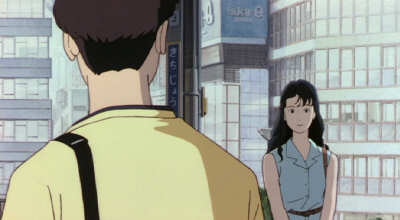
And then Taku turns his head. His eyes are fixed, the sounds of the train station melt away, and the camera swings around, sweeping in a circle to meet Rikako, who waits, smiling. Punch-line. Checkmate.

After an hour of stationary cameras, we have a circular rotation, 180 degrees in two cuts. It's an emotionally-charged climax, and it's about as satisfying a payoff as one can ask for. It's only possible when in concert with the rest of the film, and its long, slow buildup. A remarkable lesson learned from the young Ghibli staff - two degrees removed from Ozu.

2006-07-26

I Can Hear the Sea


Studio Ghibli's 1993 production, Umi Ga Kikoeru, is a superb example of animation in the service of naturalism and neo-realism. The teenage drama, which veers from anxious romance to open-eyed nostalgia, provides another excellent example of what animation can achieve in the service of drama. It's a lesser-known work in the studio's canon, mostly because the DVD has yet to be released outside of Japan, but it deserves equal billing with its older siblings, Grave of the Fireflies, Omohide Poro Poro, and Mimi o Sumaseba.

In a sense, I Can Hear the Sea represents everything that Miyazaki and Takahata sought to achieved when they founded Ghibli in 1985. Allow me to explain.

When Studio Ghibli was founded, one of the things Miyazaki and Takahata wanted to change was the working conditions within Japan's animation community. Traditionally, an animation team would be assembled for a specific project, but would be dissolved after its completion. For many people, there was little job security, moving from one project to the next in an almost temp-like fashion.

The old masters wanted to change this. They wanted an environment which could nurture and raise the next generation of animators. Ghibli ushered in a new wave of reforms. Employees would be paid a living wage. They would be hired permamently, not merely hired for one gig and then let go. This committment to share the wealth was a generous move for Ghibli, especially when you consider that the studio's first three films - Laputa: Castle in the Sky, Grave of the Fireflies, My Neighbor Totoro - were not box-office hits. The first movie to pull in a profit was Kiki's Delivery Service in 1989.

Perhaps most importantly, Ghibli also established a school for training the younger employees. Both Miyazaki and Takahata taught classes, imparting their wisdom and sharing the techiques in filmmaking and animation that made them world-famous. Soon, the kids would be set loose upon the world.

I Can Hear the Sea was the fruit of those labors. The project was handed to the newer kids, and the television format guaranteed that there would be less pressure upon them. Perhaps it's also a nod to their teachers' own experience; they began their careers on Toei TV shows like Hustle Punch and Wolf Boy Ken, and became masters of the form on Heidi, Girl of the Alps, and other television dramas of the '70s.

In any case, Umi is an accomplished work, and doesn't feel at all like a student work. It's focused, firmly paced; the many characters are given a considerable depth and avoid all the typical teenage romance cliches. Clearly, it's heavily infused with Takahata's naturalist style, with its objectivist portrayal of the main characters, and the many pillow shots which point back to Ozu. The animators had worked on Omohide Poro Poro two years before, and they absorbed that film like a sponge.

The director's chair for Umi Ga Kikoeru was filled by Tomomi Mochizuki, an outside director best known for his work on Here is Greenwood and Kimagure Orange Road: I Want to Return to That Day. Like the staff, he was a young up-and-comer, and his sensibilities fit perfectly with what the story requires. He was already committed to the Here is Greenwood TV series, and the resulting stress of directing two productions simultaneously took its toll on him. Fortunately, he succeeded on all fronts.

This was the first Ghibli production with an outside director, and it presages later director work by Yoshifumi Kondo, Yoshiyuki Momose, Hiroyuki Morita, and others. It's also the beginning of the great crisis for the studio, namely, Who Will Be in Charge When the Old Masters Retire? We'll be coming back to that one again sometime.

Letters...We Get Lots and Lots of Letters #3


Hi Daniel! My name is Nancy & I'm a fan of your site. I got Animal Treasure Island & Puss n' Boots through your recommends and also enjoyed reading your insight from a Westerner's point of view. Very nice.

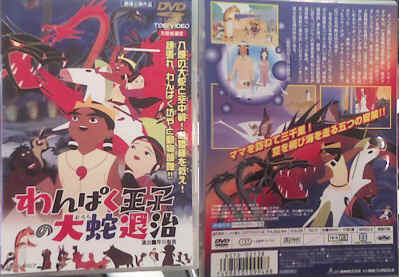
I'm writing because of something you mentioned in today's entry--"The Little Prince & the 8-Headed Dragon". I bought this R2 DVD in Tokyo 2 years ago while on holiday. They had the most amazing Japanese animation show at the Museum of Contemporary Arts.
They displayed a ton of amazing sketches and watercolor illustrations from some of the great early animation in the 60s, right down to the entire Studio Ghibli/Miyazaki catalog. It was so good and yet you weren't allowed to take photos, or anything. This weblink is the closest I've seen to any visual documentation of this show.

It was at the museum gift store that I was able to find a nice selection of the Studio Ghibli stuff (already available at HMV Japan, etc.) and many early selections by Toei Animation. (I heard about this show through the Nausicaa mail list when one of the Japanese fans shared the info.) Before arriving I had only known about the work after Panda Go Panda--had NO clue about the early works or Toei. I found their work so stylized, retro (in a good way) and quite refined for it's time. When I saw clips of "Little Prince" projected on the wall throughout the showing, I was blown away and had to get the DVD. I had never heard of Yasuji Mori but immediately became a fan. Anyway, there were at least 6-10 old Toei titles to choose from and they weren't cheap. I only bought the one I really wanted (it was 4,500 Yen--you do the math) and looked forward to watching it when I got home to Canada.

There are no English subtitles so my husband did his best to translate (he knows only basic level through immersion) but it's in very formal old Japanese. It's very quiet with little music so it has a really slow pace compared to the Miyazaki-directed pieces. The quality of the film and sound is impressive and very clean. I would imagine that if you contacted the gallery store directly, you might be able to purchase it directly or find it through other means online.

Anyway, just thought I'd share the info with you and some cellphone pics I took of the case so you know what to look for.

Nancy

More Ghibli Blog Posts To Discover