
Showing posts with label little prince and the eight headed dragon. Show all posts
Showing posts with label little prince and the eight headed dragon. Show all posts
2009-05-10
Video - Wanpaku Ouji no Orochi Taiji Movie Trailers
The Japanese movie trailers for Toei Doga's 1963 classic, Wanpaku Ouji no Orochi Taiji, or as its known in the West, Little Prince and the Eight Headed Dragon.
I really do wish Toei comes to its senses and releases these movies on Blu-Ray. I can only imagine how fantastic this would look in high definition.


Photos - Little Prince and the Eight Headed Dragon (Wanpaku Ouji no Orochi Taiji) (1963)


I've been wrestling with the dilemma of whether to refer to Toei Animation's 1963 film by its Japanese title, Wanpaku Ouji no Orochi Taiji, or the common Western title, Little Prince and the Eight-Headed Dragon. I certainly want to make things as easy as possible for you to discover and appreciate these classic movies. And I certainly don't wish to be a foreign movie or anime snob.
In the end, I've decided to use the original name, since, after all, it's their movie. And one of the goals of this blog is to understand these Japanese animations on their terms. We're here to learn, and I think I'll do everyone a better service if I try to teach with the correct names. Western hacking of anime classics is a real sore point with many fans, including me. It's a mistake that must be ended.
According to Wikipedia, "Wanpaku Ouji no Orochi Taiji" translates as "The Naughty Prince Slays the Giant Serpent." It's a bit of a mouthful, but oftentimes Japanese movies have long title.
I'm a great fan of this movie, and I wanted to share a number of screenshots for you. I'm afraid my only copy was downloaded from YouTube a few years ago, so that's why the pictures are smaller than I'd like them to be. It doesn't help matters that Toei's DVD's of all their classic anime films are old, single-layer releases, circa 2000. It's astonishing that Toei doesn't respect their own history, or that they fail to recognize the value of these great movies. This was their golden age, when they aspired to create feature-length animation comparable to Walt Disney. In the process, their young artists nurtured and developed their skills, eventually giving birth to modern anime as a unique and wholly Japanese artform.
Fans of Studio Ghibli are missing out on the Toei Animation classics, and not just the ones Isao Takahata and Hayao Miyazaki created. In many ways, Ghibli is the torch-bearer for Toei, and it's the key to their uniqueness. Nobody in the world makes movies like Ghibli, and if you truly want to know why, your journey leads to Toei.
I've done a little work on Paint Shop Pro to pretty these photos up. Hope you enjoy them! This is a spectacular movie, one of the true animation classics.
Riffs - Horus, Prince of the Sun


I haven't done any "riffs" in a long while, so we're long overdue for some new examples. For those of you who are new to this blog, "riffs" are quick visual quotes of one film in another. Usually these are very short shots or cuts, a blink-and-you'll-miss-it event. Very often there's a direct connection, either with the animators or directors, or some thematic link. For example, a number of shots in Panda Kopanda are riffed in My Neighbor Totoro (here's one example).
It seems this tradition dates way back to the Toei Doga era. Here is one excellent example. The first screenshot is from Horus, Prince of the Sun, in 1968. This is the opening battle between Horus and the wolves. This dramatic shot shows one of the silver wolves stalking to the left side of the screen.
This is a riff on one of Toei Animation's most famous movies, the 1963 masterpiece Wanpaku Ouji no Orochi Taiji (Little Prince & the Eight Headed Dragon). It's best known in the West under the title, "Little Prince and the Eight-Headed Dragon." In this second screenshot, we see a similar fight between the hero, Susanoo, and a fierce tiger. The tiger is in the same position, and makes the same movement to the left of the frame.
Wanpaku was a breakthrough film for Yasuo Otsuka, who served as a key animator. The thrilling climactic battle against the giant eight-headed dragon was his masterwork. Isao Takahata, likewise, was one of two Assistant Directors on this film. His swift ascention up the ranks impressed the Toei studio, and in 1965, he was given the honor of directing a Toei feature. He chose Otsuka as his right-hand man, and then, with Hayao Miyazaki, Yoichi Kotabe, Reiko Okuyama, Akemi Ota, and Yasuji Mori, set to work on Horus.
There are a number of Wanpaku riffs in Horus, and this is but one example. We'll take a look at the others in future posts.
2008-12-03
Yasuji Mori Gallery #1
As promised, here are some samples of Yasuji Mori's artwork. First is this watercolor sketch of Hilda, the tragic heroine from Horus, Prince of the Sun. Hilda was Mori's creation, and he personally animated most of her scenes. The rest were handled by Reiko Okuyama. Together, they helped to create a deeply complex, complicated character unlike anything seen before in anime. And she blazed the trail for everything that followed. Heidi, Marco, Nausicaa, Akira, Evangelion, Paprika, Mind Game - all sprout from this one iconic heroine.

Now here is a sketch from Toei Doga's first color feature film, Hakujaden. The story is based on a Chinese folk tale. This was done in the spirit of reconciliation between China and Japan. This is the first anime movie under the Animation Director system. Sadly, this movie remains almost completely unknown to the outside world. We should work on that.

And here is a collection of character sheets from Toei's 1963 anime classic, Little Prince and the Eight Headed Dragon. This is an animation showcase, endlessly thrilling to watch, and to this day remains among the handful of anime classics. This should prove especially useful to American animators and artists. Mori's skills as an animator just shine. Go ahead, animators - share, share!


Now here is a sketch from Toei Doga's first color feature film, Hakujaden. The story is based on a Chinese folk tale. This was done in the spirit of reconciliation between China and Japan. This is the first anime movie under the Animation Director system. Sadly, this movie remains almost completely unknown to the outside world. We should work on that.

And here is a collection of character sheets from Toei's 1963 anime classic, Little Prince and the Eight Headed Dragon. This is an animation showcase, endlessly thrilling to watch, and to this day remains among the handful of anime classics. This should prove especially useful to American animators and artists. Mori's skills as an animator just shine. Go ahead, animators - share, share!


2008-01-01
New Year's Day Movies - Little Prince and the 8-Headed Dragon
(Update: This video has since been removed from Youtube. Sorry.)
Let's give a round of applause to YouTube user Extraordinaire, who has sent me a number of animation clips during 2007. Then, just in time for Christmas, I was sent the links to a full-length movie - the 1963 Toei Doga feature, Little Prince and the 8-Headed Dragon.
Excellent work! Pass the popcorn! Sure wish I had a computer that could play this.
This film was the sixth full-length animated picture from the Toei studio, and is universally regarded as a Japanese masterpiece. Little by little, the young animators and artists and writers are learning their craft, building from their understanding of American cartoons, calling upon their own vast cultural heritage. If Horus, Prince of the Sun can be called the Sgt. Pepper of anime, then Little Prince and the 8-Headed Dragon is their Rubber Soul.
I'll let Ben Ettinger, the expert scholar of anime history, describe the movie in his own words:
Let's give a round of applause to YouTube user Extraordinaire, who has sent me a number of animation clips during 2007. Then, just in time for Christmas, I was sent the links to a full-length movie - the 1963 Toei Doga feature, Little Prince and the 8-Headed Dragon.
Excellent work! Pass the popcorn! Sure wish I had a computer that could play this.
This film was the sixth full-length animated picture from the Toei studio, and is universally regarded as a Japanese masterpiece. Little by little, the young animators and artists and writers are learning their craft, building from their understanding of American cartoons, calling upon their own vast cultural heritage. If Horus, Prince of the Sun can be called the Sgt. Pepper of anime, then Little Prince and the 8-Headed Dragon is their Rubber Soul.
I'll let Ben Ettinger, the expert scholar of anime history, describe the movie in his own words:
Now we come to one of the all-time anime masterpieces, a film that holds the
distinction of being the film that introduced the animation director system into
anime (whereby one person corrects all the drawings by the key animators in
order to eliminate minor differences and keep the characters looking the same
throughout the film). But that's not necessarily what's great about it to anybody who watches it. The designs are great. The color is great. The music is great. The story is great. The animation is great. The finale is incredible. It's probably the first Toei Film film that comes together as a totally satisfying and integral whole.
The animation hilight of this film is the final scene of the hydra, animated by Yasuo Otsuka together with Sadao Tsukioka. Otsuka had pursued realism since he began as an animator, basing his animation on close observation of the reality around him -- for example, observing and drawing actual catfish in preparation for animating the scene with the giant fish in Magic Boy. But there are no 8-headed dragons in the real world to study, so how to draw one? Reality in this scene is evoked by the tension produced by careful timing and framing of the action unfolding on the screen in one
continuous flow over the course of several minutes.
There are many other great scenes -- the fight with the tiger early on, the dance scene. This is the first film in which most of the film is totally satisfying in terms of the animation, with interesting movement and appealing and original designs.
2006-07-26
Letters...We Get Lots and Lots of Letters #3
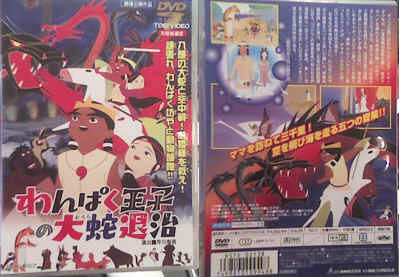
Hi Daniel! My name is Nancy & I'm a fan of your site. I got Animal Treasure Island & Puss n' Boots through your recommends and also enjoyed reading your insight from a Westerner's point of view. Very nice.
I'm writing because of something you mentioned in today's entry--"The Little Prince & the 8-Headed Dragon". I bought this R2 DVD in Tokyo 2 years ago while on holiday. They had the most amazing Japanese animation show at the Museum of Contemporary Arts.
They displayed a ton of amazing sketches and watercolor illustrations from some of the great early animation in the 60s, right down to the entire Studio Ghibli/Miyazaki catalog. It was so good and yet you weren't allowed to take photos, or anything. This weblink is the closest I've seen to any visual documentation of this show.
It was at the museum gift store that I was able to find a nice selection of the Studio Ghibli stuff (already available at HMV Japan, etc.) and many early selections by Toei Animation. (I heard about this show through the Nausicaa mail list when one of the Japanese fans shared the info.) Before arriving I had only known about the work after Panda Go Panda--had NO clue about the early works or Toei. I found their work so stylized, retro (in a good way) and quite refined for it's time. When I saw clips of "Little Prince" projected on the wall throughout the showing, I was blown away and had to get the DVD. I had never heard of Yasuji Mori but immediately became a fan. Anyway, there were at least 6-10 old Toei titles to choose from and they weren't cheap. I only bought the one I really wanted (it was 4,500 Yen--you do the math) and looked forward to watching it when I got home to Canada.
There are no English subtitles so my husband did his best to translate (he knows only basic level through immersion) but it's in very formal old Japanese. It's very quiet with little music so it has a really slow pace compared to the Miyazaki-directed pieces. The quality of the film and sound is impressive and very clean. I would imagine that if you contacted the gallery store directly, you might be able to purchase it directly or find it through other means online.
Anyway, just thought I'd share the info with you and some cellphone pics I took of the case so you know what to look for.
Nancy
Subscribe to:
Posts (Atom)