(Update: This video has since been removed from Youtube. Sorry.)
Here is the first episode of Future Boy Conan. Conan is Hayao Miyazaki's 1978 television series, spanning 26 episodes. It remains one of his signature works; it may, in fact, be his definitive work in animation, if only in that it captures all the different moods of his personality. There's the heavy slapstick comedy, the masterfully timed action scenes, the compelling characters, and the darker, more serious commentary. It's a classic cliffhanger serial, like most of his work in the 1970s, and has such a vibrant energy, such a fast pace to everything. All these elements mix together perfectly.
For followers of Serious Miyazaki, Conan is Act II, following Horus, Prince of the Sun, and presaging Nausicaa, Princess Mononoke, and finally Howl's Moving Castle. It's probably the anime that he quotes most often, at least as much as Heidi. It's something of a game to spot the "Conan Riff" in every Studio Ghibli movie.
So if you consider yourself a Miyazaki fan, Future Boy Conan is absolutely required viewing. It sits alongside Isao Takahata's World Masterpiece Theatre trilogy, Heidi, Marco, and Anne, as the definitive works of Japanese animation for television. These are the long-form masterpieces that really define their careers.
Anyway, here is episode 1 of Future Boy Conan, presented in three parts. Hopefully, I'll be able to show more episodes. Don't forget to download the fansub copy so you can watch on a larger screen.

2006-10-17


2006-10-16
Today's Screenshots - Nausicaa of the Valley of Wind


 I'm really getting tired of using a camera with such a tiny lens. It's impossible to get decent shots of closeup objects like books.
All of thse panels are from the third book of Nausicaa of the Valley of Wind, presented in order. This details the end and aftermath of the epic battle scene that spans 40 pages, and ends on the greatest emotional climax Miyazaki has ever conjured.
I remember the first time I read Nausicaa, I stayed up all night plowing through the old four-book set (since replaced by the proper seven-book set) without any sleep. I hopped on the bus and headed over to Al's Breakfast in Dinkytown, the greatest breakfast shack in the known multiverse. On the bus, I read through the 40-page setup to Miyazaki's greatest battle scene, and then to the battle itself.
By the time I get a seat at Al's (and this means standing in line for your turn for a while), I get to that ending. Kai just drops to the ground. And at that point, I just about lose it. I slam the book down, and shout out, "That's it! I'm not reading any more!" To this day, I still get upset when thinking or discussing it.
Perhaps now it has become the metaphor, the icon, for the traumas in my life.
In any case, it was at this point that I realized that I was reading the greatest graphic novel ever written. Art Spiegelman and Scott McCloud had finally met their match.
If you haven't read the Nausicaa books, then get your ass out of here, and don't come back until you do.
On the Account of My Aunt's Death
 If you're wondering what I've been up to, take a look at that screenshot from Mimi. Change the collar for a maroon longsleeve shirt, and you've got a good portrait of me.
Several weeks ago, my aunt, Barbara MacInnes, died suddenly. I've had a rough go of it, struggling to come to terms with her death and learning to live in the aftermath. Needless to say, I've been hit very hard. I'm reminded of a phrase I conjured up when describing one's first experience with Grave of the Fireflies, and it rings true again: I feel like I've been hit in the chest with a cinder block.
This is the first time I've sat down to write about it, and I'm only just getting past the shock and emotional upheavals. I don't know how you deal with death when it comes to your door. In that regard, I've been extremely lucky so far in life. Spoiled, even. I lost my best friend five years ago, just before Thanksgiving; David Grimm was only 30 years old, a couple years older than me. I'm still upset about that, and I still feel the pain, but I'm also aware that much of that pain has faded. Time will impose itself upon you in however way it chooses.
I've also had the benefit of closure with Dave, mostly due to a dream encounter, one that to this day I cannot determine was a dream conjured by my mind, or a visitation into the afterlife. Well, the waiting room for the afterlife, to be specific. I've pondered this greatly, in search of an answer. The only interesting thing to note is that he's never been in any of my dreams since; I feel, in my bones, that he's gone. Wherever his soul resides, if it has survived death, then Dave Grimm is in a place far, far away.
Now I've lost my beloved aunt. I've lost Barbara. This is far, far worse.
I'm reminded again of Miyazaki's Nausicaa books. I know, sounds like I'm trying to shoehorn this in because of the weblog, but that novel had a deeply profound impact upon me. There's a great line that comes back to me, one of the most personal lines Miyazaki's ever written. I've always loved it, but it's only now that I truly understand its meaning:
"If I stop moving, I'll drown in grief. I have to go foreward..."
The curse of death is how it affects the living. You must go on with your life, continue your normal schedule, and carry on as if nothing else has happened. You must. There is no choice in the matter. Your every step must be in defiance of this entity, this reality, that has taken away one of your own. It stalks you ever closer with every breath, every step.
I try to take every day as it comes. I attempt to drown my mind into other things, be it writing or painting or music, listening to your favorite albums, reading, watching the latest batch of Criterion DVDs. There are good days. And there are bad days. A dark void hangs over my head, just inches away from my mind. A simple melody, a thought, or a gesture brings it all rushing back, and again I struggle not to swallowed whole.
If I stop moving, I'll drown in grief.
I've treaded through every bad emotion in the book. Anger, fear, shock, sorrow, resentment. This whole damned thing is unfair. But so what? No one ever promised a fair universe, aside from the pollyannas and the crooked puppetmasters, buried alive among the Crypts of Shuwa, who claim to speak for the Supreme Being. Like it or not, God never made such a promise. Everything struggles, everything suffers.
"The greatness of a mind is determined by the depths of suffering." I remember reading that somewhere. I try to repeat them in my mind as I carry on. I've been dealt the hardest blow of my life. Yet I know that harder blows await me. The deaths of my grandparents. The deaths of my parents.
Barbara MacInnes was the baby of the family. She was the youngest, with four older brothers. I remember her when I was, I don't know, maybe six. She was living on her own for the first time, driving her first car, this magnificent, beat-up monster with no muffler and growling so loud it made the front seat shake. Life was just beginning for both of us, and the future was limitless. But, oh, that magic feeling....nowhere to go....
She married soon after, and at that point life decided that magic feeling would end. And so the suffering began. Her husband was a decent guy, not too bright and perhaps a little too confrontational, but a good soul and full of promise. Over the years that followed, time took its toll upon him as well, and he slowly lost his mind.
Barbara suffered this, and continued along as a single parent in Washington. Then illness decended, and she was forced to suffer some more. Her health was taken from her forever. And yet, she still soldiered on, with her daughter who has now graduated high school and will be starting college.
Then she suffered one final blow. Her days of struggle and suffering had ended at last. But what a cost. What justice is this? Why was she taken from us? Why now?
You can choose to shake your fist at the night sky, and scream at the injustice of this fate, but what is there to shout at? Who is going to listen, anyway? If you don't believe in God, then you're pretty much on your own. If you do believe in God, then if you listen closely, He will probably tell you that we're now living in the Galactic Year 14 Billion, and it's a bit late to start complaining now about the cycle of birth and death. If you wished to lodge a complaint, you should have done so at the proper time, before the Big Bang.
As for me, I feel fortunate that I do believe in God. You can decide for yourselves whether that's a blessing or a curse. I'd like to think that life is the light that shines in the darkness, that both purity and corruption are the very essence of life, that our God inhabits even a single leaf and the smallest of insects. That what I get for reading so much.
The world goes on. The leaves turn, and the wind continues to blow. I'm still moving forward.
An Update About "Movie Night"
It was brought to my attention recently, thanks to our friends at Online Ghibli, that some of the movie files from YouTube have been taken down. This sparked my attention, so I quickly went through this weblog to see what's still available.
The bottom line is that most of the video clips are gone. Most have been removed due to YouTube's "terms and services" which are violated when you upload videos of movies you already own, or TV shows you're watched or paid for (DVD box sets, cable bill). Yes, I'm a little cross about all of this. I'm also aware of how mass media corporations are trying to gouge more and more money from our ever-thinning wallets, with iPods and next-generation DVD formats and the coming of video-on-demand.
Still, friends, we knew this from the beginning. As I've explained before, YT reserves the right to remove any video files at any time. Is it fair? Probably not, but that's merely my opinion. Them's the rules. And those rulese aren't about to change anytime in the future.
So here's a rundown of where everything stands in regards to Movie Nights:
Porco Rosso - Shut Down.
My Neighbor Totoro - Shut Down.
Umi ga Kikoeru/I Can Hear the Sea - Shut Down, only available via private request.
Ghiblies Episode 2 - Shut Down.
Nemo Pilot Film (1984) - Still Available, thanks to Google Video.
Omohide Poro Poro - Still Available
Horus, Prince of the Sun - Still Available
It seems the only Miyazaki and Takahata videos still available on YouTube are the ones I've uploaded myself. Perhaps this is due to their relative obscurity, and the fact that Poro Poro and Horus are still unavailable on DVD in North America.
I pretty much expected the movies that are available here on DVD to be deleted eventually. There's no reason why you shouldn't have bought them already. What more are you waiting for? I'm more cross at films that have not been released here, such as Ghiblies or I Can Hear the Sea. Surely, this isn't cutting into anybody's bottom line. As if anyone would prefer to watch a movie on a tiny 400-pixel window, instead of their brand-new widescreen TV.
I'm still uploading movies to YouTube, including Future Boy Conan, Anne of Green Gables, The Flying Ghost Ship, and Like the Clouds, Like the Wind. There's no promise that any of them will stay for any length of time, so we'll just have to enjoy them while we can.
Don't forget your two best options for watching these classic films and shows: import, and fansubs. You should have no trouble with either. Pass along, share, and enjoy.
Omohide Poro Poro Reaches 13,000 Viewings

Some time ago - late July, in fact - I added Isao Takahata's 1991 Studio Ghibli film, Omohide Poro Poro, to YouTube. It's become popular on the site, dribbling through word-of-mouth and heartfelt curiosity at one of the two remaining Studio Ghibli movies to appear in North America.
Well, readers, I'm happy to report that Omohide Poro Poro has reached 13,000 views on YT. To be fair, this is the first segment (the film had to be cut into 13 segments, as per YouTube's "10-minute rule"). I'm currently scouring through the website to see how that compares to other Ghibli films's traffic.
So pat yourselves on the back for helping to make Takahata's cinema masterpiece a success. My hope is that this added exposure will influence Disney to release the DVD in the States.
That said, here is your homework assignment: first, bring along all of your friends and show them Omohide Poro Poro (you can watch the movie here at Conversations on Ghibli, ovbiously); second, send a polite letter to Disney expressing your love of the film and your desire to see the DVD finally released. Remember, kids, be polite.
2006-09-24
Movie Night - Porco Rosso
The Movie Nights are back! It seemed for a while that there was nothing left for me to show you via YouTube. There were a number of Ghibli films available, but many of them were removed. It seemed as though we were left with nothing left beyond small clips here and there. So I'm happy to see some of these movies return, if only for a little while. This week, we'll be watching Hayao Miyazaki's 1992 Studio Ghibli film, Porco Rosso.
Porco Rosso made a remarkable impression on me when I first watched it. Here is a movie about air pilots that is less interested in endless dogfights than in the pilots themselves. It's about the men who risk their lives in the air, and the women who love them. It's a bittersweet poem to a lost age of chivalry and rivalry. An age of romanticism, lost in the rise of fascism and the march towards the Second World War.
An American counterpart would merely settle with action, action, action! It would be, basically, a loud summer blockbuster ala Star Wars. There would probably be some preachy moral lessons that have little bearing on the real world. Marco, certainly, would discover his feminine side and become a sensitive changed man by the end of the picture. And there would be lots of generic pop songs to pad out the running time.
In other words, such a movie would be terrible and instantly forgettable. Thank goodness for the Porco Rosso that we have.
This movie is shown with the original Japanese soundtrack and English subtitles, starring Shuichiro Moriyama as Marco. It is broken into 9 parts, and assembled here in order. Enjoy the movie, and be sure to get the DVD, so you can watch on a nice big-screen TV.
EDIT UPDATE: I'm sorry to report that this movie has been deleted from YouTube, due to copyright infringement. Sorry, kids, them's the brakes.
Porco Rosso
 I bought a copy of Porco Rosso for my three sisters, aged 10 to 14, and was surprised to discover that it was sold out nearly everywhere. I'm glad to see this great movie slowly find an audience in America. It deserves one.
Doesn't this movie remind you of Casablanca? It carries a very similar tone, with a cynical, middle-aged hero who has given up on humanity, his comedic romantic rival, the emotionally-conflicted woman, and the rise of fascism across Europe. For Miyazaki, this is among his most personal films. His love of aviation is fully indulged, and he shows off his knowledge of airplanes with great glee. And Marco is his self-portrait; the youthful idealist who was become disillusioned with the world of men, but still maintains his faith in romance and love.
And what's so funny about peace, love, and understanding?
Porco Rosso is loaded with slapstick comedy, and the use of large groups of people reminds you of Blake Edwards comedies. It's all fused brilliantly with the excellent action scenes, which are wisely kept to a minimum. The real conflict is between these characters, and inside themselves. Cynical Marco, boastful Curtis (doesn't he remind you of Errol Flynn?), faithful-yet-sad Gina, and young firebrand Fiola. It's all about them, and their own search for freedom in a world steadily closing in.
This is more of an adult film than, say, My Neighbor Totoro, but since all of Miyazaki's movies carry a more mature sense than our cheesy American cartoons, I can't see why the whole family couldn't enjoy this. Then again, I think kids should be shown Bicycle Thieves and Casablanca.
2006-09-22
Will Sherlock Hound Soon Go OOP?
 I've been informed that Geneon will soon take their Sherlock Hound DVD's off the market. I send an email to the company asking for confirmation, but have yet to receive a response. Considering that the series was released in February, 2002, it wouldn't be surprising.
I would suggest that until we learn otherwise, we should assume that Sherlock Hound will soon go out-of-print at the end of this month. As I wrote in an earlier post, the Telecom, Miyazaki-directed episodes appear on Sherlock Hound Case Files 1-3, so be sure to purchase those DVD's via your local retailer or Amazon. When I bought mine, I paid about $20 for each.
Videogames of the Damned - My New Games Blog

Videogames of the Damned
If you're wondering what I've been up to lately, to the detriment of this wonderful Ghibli blog, I've been moving and setting up a new videogames weblog. I used to have a blog at Digital Press named V - The Next Generation (the name was based on my old fanzine from a decade ago). Unfortunately, the DP crew needed to tear apart and rebuild a new forum system, and that meant closing down the blogs.
So I moved most of the best content out, and started up a brand-new games blog. It's called Videogames of the Damned. A nice, catchy name, don't you think? It's a mix of irreverence and classic monster movies, with a terrific Pac-Man template I found on one of the many "Blogger template" sites.
Please take out a few minutes and pay a visit to the new blog. There's already a lot to read about many topics, and I think the quality of the writing is very good. Even if you have no desire to play videogames (or if you simply grew up), you'll enjoy the writing. I'm including a number of games-related essays on my upcoming book, "No War 4 Empire," which I hope can finally gel together before too long.
2006-09-20
Today's Screenshots - Lupin III: Castle of Cagliostro

 For today's screenshots, I thought I would share with you some of the storyboard drawings Miyazaki used for the film. The first is that terrific shot from the car chase (we see a little of how the scene is paced out for the animators); and the second comes from Lupin's dramatic entrance into Clarisse's tower prison.
It's always interesting to note the amount of detail in these illustrations. They're really not necessary, since we're only using storyboards to establish or highlight motion and/or composition, but it's reflective of Miyazaki's great, obsessive skill as an artist. He's able to effectively communicate action and movement with still drawings, and I think this is an essential skill for an animator. A different artistic approach than the standard, Westernized style (read: Disney), but closer to comic books or graphic novels. But, for me, these feel more cinematic, more compelling. They have a greater sense of gravity to them.
Lupin, La Dolce Vita, and the Title Sequence

When I write or talk about Manga cutting the title sequence from Castle of Cagliostro, I'm coming from two different areas. One, is disrespect, not only to the film itself, but also to the medium of animation. What it says is that this really isn't legitimate, or acceptable. It's an insult.
The other reason is artistic, and I'd like to discuss that a little more in this post. While many movies treat a title and credit sequence as an afterthought, or perhaps a necessary distraction from the film, a good filmmaker knows how to integrate it into the film, so that it has a dramatic power.
By placing a sequence of events on-screen while the credits roll, you are placing an emphasis on them. You are highlighting them, focusing attenion upon them. This can prove highly effective for the story you want to tell, and it's underlying themes.
Miyazaki does just this in Castle of Cagliostro. It's important to understand that with this film, he and Animation Director Yasuo Otsuka are portraying an older Lupin, one who is at the twilight of his career. He and his cohorts are older and wiser than their counterparts on the original 1971 Lupin television show, and the film shows this in their actions and motivations.
Observe how the film opens with an action sequence, a dramatic casino robbery and escape. It's a very dynamic sequence, fast movements, panning, and a it ends with a bit of slapstick. We don't see any buildup; we only witness the payoff.
Scene two is a little slower, but it's still very visually active, between the compositions, the movement of Lupin's car, and the great comic payoff of Lupin and Jigen dumping a carload of counterfeit money. This scene proposes the heist that will drive the picture, like many episodes of the old show. This sequence, and much of the plot, come from the TV episode "Target the Counterfeit Money Maker."
While Miyazaki often reuses or quotes from his earlier work, I think there's a deeper agenda at play here. Much like comparing Panda Kopanda in 1973 to My Neighbor Totoro in 1988, the framework of Cagliostro allows us to examine Lupin as an older character, with the weight of experience. There's something notably different about him this time.
 This is where scene three - the title-and-credit sequence - comes into play. The tempo is completely changed; instead of delivering a fast-paced, quick-witted caper, Miyazaki shows us a peaceful, quiet sequence. In this scene, not much happens. Lupin is sometimes driving, mostly parked. He is planning, but is also waiting, watching. This is a scene of contemplation, of meditation.
While the audience may think this is simply a travelogue for the benefit of the credits, it's really establishing the underlying mood of the picture. This is Lupin the Third at a crossroads. He has seen and conquered; what more is left, beyond one more monstrous heist at a legendary castle. Where does he go after this?
Miyazaki is employing his slower, meditative side that he acquired from Takahata after working on Heidi and 3000 Leagues in Search of Mother, and it will become a trademark quality with Nausicaa and then Studio Ghibli. He's a filmmaker who raises questions and gives you time to contemplate the answers.
One notable thing about Castle of Cagliostro, apart from the series (the original 1971 series remains the definitive Lupin, really), is that you see the machinations of everything. You see everyone assembling and planning and putting things together. Television only gives you enough time to cut straight to the action.
This mood continues like a silent undercurrent. It's notable that Clarisse (voiced by Sumi Shimamoto in her terrific debut) isn't seen by Lupin as the latest sexual conquest. And it's not merely Miyazaki's own romantisicm, or the appearance of his eponymous Heroine, that drives this. I think that Clarisse represents something for Lupin; she represents not only a possible way out, a final escape from the nomad life, but also a lost opportunity, a different path. She's the girl who stares at Marcello at the end of La Dolce Vita, the great possibility of what his life could have been.
To some degree, you have to wonder if Lupin has become trapped by his life and his identity, and if he is able to finally escape it. He's clearly torn at the end, when Clarisse openly declares her devotion to him. "You know, you could always go back," Jigen quietly offers. Lupin says nothing, but continues to silently think. He has to rouse up the energy to continue the game, with that big silly grin. He's looking for a way out. He's looking for a way to escape.
Am I putting too much thought into this? This comes back, I suppose, to that other pet peeve of mine, the notion that animation isn't really legitimate cinema. It's just "pretend movies" for children, and nothing more. Americans consume this message, and accept it without question; then we wonder aloud why we're drowning in so many terrible animation features. The dreadful deluge of Monster House, Over the Hedge, The Ant Bully, The Wild, Everybody's Hero, Hoodwinked and Barnyard is never going to end until we change our attitudes towards the medium. We get what we believe we deserve.
Miyazaki has demonstrated the alternative throughout his career, and he does so again in Castle of Cagliostro. This mood serves as an undercurrent to the entire picture, and it's first revealed in that title sequence. That credit sequence brings us into that mood; its presence is vital to the whole story.
And now, dear friends, you see just why I object so strongly to Manga making cuts on the new DVD.

New Cagliostro DVD: A Review (of Sorts)

Alright, everyone. I've been procrastinating long enough, and wasting enough time on my videogames blog (which had to be moved to a new home...that was fun) and intermittant writings for the upcoming No War 4 Empire book. It's time to delve into Manga Entertainment's new DVD release of Lupin III: Castle of Cagliostro.
For ease, I will assume everyone visiting Conversations on Ghibli is already familiar with Miyazaki's 1979 directoral film debut. You shouldn't need to be told that this is a magnificent movie, a heady mix of slapstick, spy intrigue, and quiet introspection that grows with repeated viewings. You already know that.
The best thing about the new DVD is the picture quality. It's fantastic. I can't imagine what possesses the movie industry to attempt to sucker the public with a new DVD format war when the current discs continue to improve so dramatically. Oh, wait, that's right - they're greedy bastards who take us all for suckers and chumps. It's the same reasoning that leads Sony to sell its Playstation 3 for $600.
Anyway, I'm getting away here. The important point is that the new Cagliostro looks far superior to the old Manga release. I'm assuming this is the same source as the Japanese Region 2 disc, which is lauded for its vibrant picture quality. The resolution is higher, supporting widescreen televisions, and offers a far sharper, richer, more luminous palette. The above screenshot is a perfect example.
I think one reason Westerners thought of Cagliostro, somewhat dismissively, as an "old" movie was because the old DVD was so washed out and worn. Manga's old release used a 35mm film print which had clearly seen some mileage, and there was extensive color tweaking in order to cram it into a single-layer disc. Even the cigarette burns (which announce the next reel change for the theatre projector) are left in. That wasn't something that bothered me, since I prefer to see movies on the big screen, where they belong.
This new version looks as sharp as any of the recent Studio Ghibli DVD's. It really is a dramatic improvement, and it really only becomes evident in motion. I've tried my best with screenshots, but you have to watch the film to see how much cleaner and brighter it all is.
Thankfully, the excellent subtitles, the hallmark of the earlier release, is still here. That was the plague of the R2 DVD - the subtitles were taken from the English dub, which, as usual, took considerable liberties with the script and made a complete mess. Now, it seems we're finally getting the best of both worlds.
Moving onto to the DVD features, we see an impressive, if over-indulgent, animated main menu. It's better than the old one, although I'm still wondering why no one follows Criterion's lead of DVD menu design. Keep it simple, stupid - that's the rule. The other menu screens are impressive, include musical samples, and are fairly responsive.
On the flip side of the disc (yes, you have to flip the disc over), you will find the complete storyboards to the movie. The e-konte was drawn by Hayao Miyazaki, and this is our first opportunity to see his artwork, how it contrasts with Yasuo Otsuka's visual style, and how the scenes were assembled. This is a feature that's included with all the Ghibli DVD's in Japan and the US, so I'm glad that Manga included them here.
The final extra is an extensive interview with the great Otsuka, in Japanese with subtitles. It runs for about twenty minutes, and Otsuka discusses a number of topics. It's always a thrill to hear words of wisdom from the old master, and if you've been fortunate enough to see his documentary DVD, you'll feel right at home. In addition to serving as Animation Director, Otsuka was one of the key figures in Lupin animation, going back to the original pilot film and subsequent 1971-72 TV series (on which Miyazaki and Isao Takahata also worked).
There are two problems I have with the new Cagliostro; one minor and one major. The minor complaint is simple. I'm not very fond of the box design. I'm glad that a cardboard overlay is included, much like Disney's later Ghibli DVD's, but the artwork is somewhat lacking, especially on the back side. I would have much preferred the original movie poster, which is pretty dynamic and sure to grab attention. I know, I know, this is minor stuff. Still, it looks a little amateurish - three different fonts for the title and whatnot.
 Now onto my major complaint, and this is something that left me hopping mad upon first viewing. Maybe it won't affect you as much, but it does for me, and here it is: the movie's title sequence has been cut out.
The title sequence, the film's third scene, shows the credits over a montage of Lupin and Jigen travelling through the countryside by car. It's a terrific sequence, a memorable one, and one that subtlely sets the tone for the entire movie. Manga completely chopped it out, and in its place, gave us a collection of still shots from the scene, with english credits overlayed.
I'm sure this was the reason why they made the edit. That is no excuse. There is no excuse whatsoever for cutting this movie, or any movie. This was once a common crime of American anime distributers. They felt it was their duty to cut, edit, and otherwise make changes to the original works as they saw fit. It was an attitude steeped in the notion that animation, and especially Japanese anime, was not really respectable cinema. These are just silly kiddie cartoons, anyhow. It's not different from editing Bugs Bunny cartoons for broadcast on Saturday-morning TV.
I thought we were past this. I thought we had finally accepted anime, and certainly the works of Miyazaki, that we would no longer tolerate cuts. We all remember the Disney-Tokuma deal, right, kids? What is Rule Number One? No cuts.
Again, I cannot say if this will prove as serious an issue for you as it has for me. Everyone is entitled to their own viewpoint. I'm also aware that I'm quite stubborn on the subject. But, dammit, Manga, you chopped up one of the best scenes in Cagliostro. It was a scene that was left perfectly intact in the previous DVD release, and there's no reason why you needed to tamper with anything. There's no excuse. Put simply, it is not your damned movie, and you don't have the right.
So, finally, where does that leave us? How does everything stand? I cannot in good conscience reject the new Calgiostro DVD because of the credits, especially when everything else is so excellent. But I'm obviously angered and disappointed by this move, which prevents this release from true greatness. It's an unnecessary mark. So here's what I recommend for you: buy the new Cagliostro DVD, but make sure you also own the older DVD release. I'm assuming it will go out of print, so buy it if you haven't yet done so. Keep both versions.
Yes, I know. It's indulgent, but it's just as I've said. I'm stubborn. I'm an artist.
Castle of Cagliostro - Audio Commentary Track
Chris Meadows will probably be kicking me for being so late on this, but I think this is a perfect opportunity to bring attention to his hard work. Chris, you see, is a Miyazaki fan, and particularly his 1979 movie Lupin III: Castle of Cagliostro. Two years ago, he compiled and recorded an audio commentary .mp3 for the film.
The idea originally sprang from Roger Ebert, who suggested in a magazine column several years ago that people should begin recording their own DVD commentary tracks. They would offer their own unique points of view as cinephiles and experts in their own fields, and would help build the greater film community across the internet. This was an idea that began before the rise of weblogs or podcasts, so it was a little ahead of its time. Perhaps now (wouldn't it be cool to have a Conversations podcast?), we will finally see homebrew commentary tracks flourish.
Thanks to the recent Cagliostro DVD reissue by Manga, Chris has gone back and made numerous additions and edits to his audio commentary, keeping it as fresh and current as ever. His weblog details his creative process and how he compiled the information he imparts to his listeners.
Please pay Chris a visit and download his Cagliostro commentary, and be sure to send him a letter expressing your thanks. I've found it to be an enjoyable listen, and I'm looking forward to hearing the newest version.
Lupin III: Castle of Cagliostro - Audio Commentary
Chris Meadows weblog - That's All I've Got to Say
2006-09-19
Yaarrgh!!!

Yaarrgh!! Today be International Talk Like a Pirate Day! I'm sure all of you have been living it up pirate-style all day long, and annoying any squares in sight. Now that the evening is winding down, sit back, grab your hearty mug of root beer, and watch the greatest pirate movie of all time:
Animal Treasure Island! Aye!
(There's supposed to be a screenshot from the movie up there. Anytime Blogger wants to join the party...anytime they want to show up and do their damn job....yaarrgh.)
2006-09-01
Screenshot Comparisons - Castle of Cagliostro
Manga's new DVD for Lupin III: Castle of Cagliostro was released in the US this week, so I wanted to take a look at how the picture quality compares with the older release. We all expected this to be a real improvement, since the old DVD used a well-worn movie print (complete with reel-change burns); thankfully, our hopes have been realized. This new DVD looks absolutely brilliant.
The most significant improvement with the new version is that it is optimised for 16X9 widescreen. The picture is slightly larger; I don' t know if you can tell from these photos I've taken. I watch on my computer with a 21" widescreen Gateway monitor, and the difference is notable. Let's take a look at some specific examples.

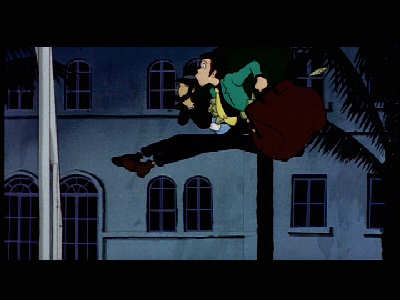
Our first example is from the movie's opening scene, where Lupin and Jigen rob a casino and make their escape. If I remember correctly, this sequence was used in a laserdisk videogame sometime in the early 1980's. I think I saw it once when I was a kid, but, like all laserdisk games, I could never figure out what the heck was going on. Too bad I was never shown the full movie back then.
Anyway, excuse the rambling. This first shot is from the new DVD; the second shot from the older release. The difference between the two is striking. The colors and contrast was clearly tampered with on the original DVD, enough so that it's difficult to properly make out details on most of the darker scenes. This was often a problem for early single-layer DVD's, and they've thankfully become a thing of the past.
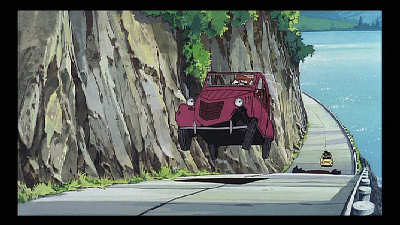

Our second example comes from the classic car chase. Here we can see the degree of clarity on the new release, the sharpness of the picture. It appears that the colors have been saturated a little on the older version, and blurred up somewhat. The higher contrast tends to flatten the image, dull out the light saturation. It's really not something you notice when watching the older version (which, to be perfectly fair, looks pretty good), but the crispness of the new DVD is immediately visible.

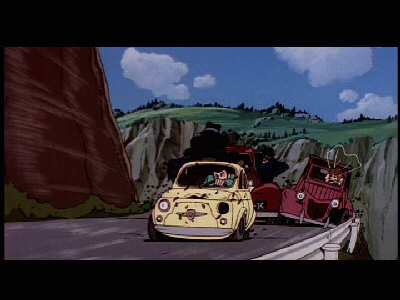
The third and final example is at the end of the car chase. It's a perfect example of the difference in color between the two versions. The older release bleeds extra color unnecesarily, and this makes the picture muddier, more "cartoonish." To be fair, this is the combination of the older DVD 1) using an older film print, and 2) being single-layer. The difference between that and today's dual-layer discs are striking - enough so that you have to be scratching your heads at the so-called "next generation" DVD format war. If that isn't a collosal scam to vaccuum more money our of your pockets, I don't know what is. Bush and Cheney would be proud.
Anyway, rambling again. Bear with me. The essential point I'm aiming to convey is that the new Cagliostro DVD looks far superior to the older Manga release. In, fact. I would say it's the definitive version, if not for one egregious, unforgivable error that left me furious. I'll discuss that in my next post; for now, I'm afraid I need some sleep.
The most significant improvement with the new version is that it is optimised for 16X9 widescreen. The picture is slightly larger; I don' t know if you can tell from these photos I've taken. I watch on my computer with a 21" widescreen Gateway monitor, and the difference is notable. Let's take a look at some specific examples.


Our first example is from the movie's opening scene, where Lupin and Jigen rob a casino and make their escape. If I remember correctly, this sequence was used in a laserdisk videogame sometime in the early 1980's. I think I saw it once when I was a kid, but, like all laserdisk games, I could never figure out what the heck was going on. Too bad I was never shown the full movie back then.
Anyway, excuse the rambling. This first shot is from the new DVD; the second shot from the older release. The difference between the two is striking. The colors and contrast was clearly tampered with on the original DVD, enough so that it's difficult to properly make out details on most of the darker scenes. This was often a problem for early single-layer DVD's, and they've thankfully become a thing of the past.


Our second example comes from the classic car chase. Here we can see the degree of clarity on the new release, the sharpness of the picture. It appears that the colors have been saturated a little on the older version, and blurred up somewhat. The higher contrast tends to flatten the image, dull out the light saturation. It's really not something you notice when watching the older version (which, to be perfectly fair, looks pretty good), but the crispness of the new DVD is immediately visible.


The third and final example is at the end of the car chase. It's a perfect example of the difference in color between the two versions. The older release bleeds extra color unnecesarily, and this makes the picture muddier, more "cartoonish." To be fair, this is the combination of the older DVD 1) using an older film print, and 2) being single-layer. The difference between that and today's dual-layer discs are striking - enough so that you have to be scratching your heads at the so-called "next generation" DVD format war. If that isn't a collosal scam to vaccuum more money our of your pockets, I don't know what is. Bush and Cheney would be proud.
Anyway, rambling again. Bear with me. The essential point I'm aiming to convey is that the new Cagliostro DVD looks far superior to the older Manga release. In, fact. I would say it's the definitive version, if not for one egregious, unforgivable error that left me furious. I'll discuss that in my next post; for now, I'm afraid I need some sleep.
Subscribe to:
Posts (Atom)