
2011-01-07


2011-01-06
What's the Deal With the Disney Princesses?

I saw this online some time ago, and I just had to post it on the blog. Sorry, I couldn't help myself. But I honestly don't see the point to these Disney fairy tale princesses. Doesn't it strike you as a bit parochial and, well...a bit creepy? These were thinly disguised male sexual fantasies from the Flintstones era. Weird.
Hayao Miyazaki Short Films: Mr. Dough and the Egg Princess (2010)

Ladies and gentlemen, the newest animated film by Hayao Miyazaki, Mr. Dough and the Egg Princess (Pan-Dane to Tamago-Hime). This short film was released to the Ghibli Museum on November 20, 2010, and is also paired with an accompanying exhibit.
What we are looking at is the official art book that serves as a companion piece to the film. It all looks so spectacular; of course, we already expect this. It's Miyazaki. I'm thrilled to see him continue his surrealist streak; you can see how happily he has settled into his grandfather role.
At its core, Mr. Dough and the Egg Princess asks the question, "How is bread made?" The idea is examined through the wild, imaginitive eyes of a small child. Cooking becomes magic. Ingredients become alchemy. Leavened bread becomes alive. The miracle of creation is on display, weaving through waking eyes and the imagination. Miyazaki has a way of making the natural world seem magical that is wholly unique. Perhaps it's because I hail from Minnesota that I can identify with this quality so much. American animators should aspire to this.
Little details are to be found everywhere in these photographs. I'm sure the animation is a joy to watch. The shot of the breadman crawling out of the oven is a riff from the giant robot in Castle in the Sky. The animal farmers remind me a lot of Richard Scarry's animals, which I loved as a small child. On the final photo, you can spot Miyazaki-the-Pig, and is that Heidi seated at a table with some bread? Yes, it is! And I marvel at the brilliant contrast between the large witch - a surreal, messy cousin to the witchy women in Spirited Away and Howl's Moving Castle - and the Egg Princess, who is a textbook example of simplicity in action. This 10-minute cartoon is amazing in its diversity. Am I right to suspect that some of Miyazaki's greatest anime resides in these Ghibli Museum short films?
You'll have to click on the photos to seem them in the proper size. The color and detail is exquisite; our thanks go out to the forums at Buta Connection in France. No doubt copies of the art book will be sold on Ebay; like every dedicated Miyazaki fan, I am determined to collect all of them. What an amazing movie.


Critic After Dark Examines Horus, Prince of the Sun

The always excellent movie blog Critic After Dark has a number of brilliant, thoughtful essays on Studio Ghibli's movies, with a sense of understanding and knowledge I rarely find these days. Case in point - joy! - film critic Noel Vera wrote a masterful essay on Horus, Prince of the Sun.
I'm highly tempted to just quote the entire review, but I'll hold back a little. The entire piece is excellent is worth considering. My only gripe...cranky Grampa Simpson alert...that damned title! Widdle Pwince Baby Schnookums, my eye. And, yes, I know how fortunate we are to even find other Westerners who've even heard of Horus, much less seen it. I complain with a grin on my face.
Anyway, read Critic After Dark's essay on Horus, Prince of the Sun. Then download the fansub and watch the movie again.
...Little touches of psychological realism, distinguish Takahata's storytelling. The colors may be bright, the characters round-eyed and faintly Disney-ish, the sidekicks cute small animals, but their words, actions, thoughts, feelings, are not all adorable. Hols has a complicated relationship with these villagers--the trust they give him is provisional, on the apparent death of the fish, but his success has also won him enemies among the villagers, enemies that conspire to turn the people against him, force him back into exile.
Arguably the most striking sequence in the picture is when Hols discovers an empty village, eerie with silence. Among the deserted huts he encounters the mysterious Hilda, an apparent survivor of whatever devastation has emptied the little town. Hols takes her back with him, and her singing enchants the townspeople, who find themselves stopping work to listen.
If Hols relationship with the village is knotty, Hilda's is well nigh hopeless--she often finds herself looking upon the villagers as grotesque in their simplicity, despite their kindness. Hilda's character actually makes more sense if you see her as the traumatized survivor of some unknown holocaust--the inability to open up to people, the tendency to be willful and perverse, the obsession with death and destruction (she suffers from survivor's guilt and exhibits suicidal tendencies). Likewise the villagers' response to her--an uneasy mix of incomprehension and mute fascination--is more understandable if you keep in mind the chasm in experience between them and the girl, how strange yet alluring it can be. Yes they have suffered (the pike's recent reign of terror comes to mind), but they simply cannot understand the effects total destruction can have on a young mind, the kind of nihilistic philosophy it can create, even in a lovely girl with a beautiful voice.
Perhaps Takahata's finest and least appreciated effect would be the sense of roundedness, of solid familiarity, he gives the villagers. Viewers looking for easy entertainment might find the scenes of singing and festival-dancing and everyday living dull, but the scenes go hand-in-hand with Takahata's idea that the real protagonist of the film isn't Hols, but the community as a whole--this in turn going hand-in-hand with Takahata's view of the complex relationship between individuals and the various communities that inhabit his films.
Thus: in Only Yesterday, the heroine Taeko's easy efforts to immerse herself in a small farming community is contrasted with her childhood struggles to integrate herself into her own family; in My Neighbor the Yamadas the focus is on one family and, to some extent, the neighborhood they live in. Pom Poko is possibly the fullest and most complex expression of this idea of community-as-protagonist--yes they are raccoon dogs, yes they are mythological figures, but the way these dogs debate, squabble, compromise, celebrate, and make love reminds one of the interactions and struggles found in any community, particularly one faced with the possibility of extinction. And tragic Pom Poko may ultimately be (a conflict between animals and men can only end one way), it is relatively optimistic in its view of community relations compared to what may be Takahata's finest film, the great Grave of the Fireflies. There a young boy and his little sister struggling to survive the waning years of World War Two begin a gradual and complete rejection of their community--a rejection that will result in consequences the film shows us with simple, unflinching honesty.
Portrait of the Artist as a Young Man - Takahata, Miyazaki, Otsuka


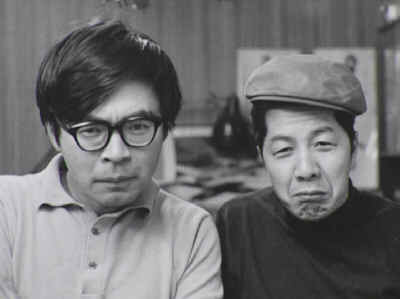
In celebration of Hayao Miyazaki's 70th birthday on Wednesday, I wanted to finally contribute the one thing the internets are so sorely lacking: photos of Miyazaki as a young man. So I popped in Yasuo Otsuka's Joy in Motion, Studio Ghibli's excellent, must-see documentary DVD from 2004, grabbed the digital camera, and took some photos.
The photos are of Isao Takahata, Hayao Miyazaki, and Yasuo Otsuka, taken sometime during the production of Horus, Prince of the Sun (1965-68). The fouth photo shows their ages in 1967: Otsuka, the elder brother anime pioneer; Takahata, the revolutionary director; Miyazaki, the hotshot and ambitious upstart. For those series of photos, they were filming themselves swinging an axe, as research for what would become the opening fight scene in Horus. How shocking that scene must have felt to audiences four decades ago!
It's easy to look at the old men Otsuka, Takahata and Miyazaki have become, and think of kindly grandfather figures, Japan's answer to Uncle Walt. But they were young once, and they were '60s radicals and revolutionaries in every sense of the word. It feels like a thousand years ago.
2011-01-05
"At First, I Wanted to be a Manga-ka": Analysing the Nausicaa Manga

In honor of Hayao Miyazaki's 70th birthday, I tracked down this excellent and highly detailed discussion on Nausicaa of the Valley of Wind, the iconic graphic novel that I consider his crowning masterpiece. These lectures by Japanese anime scholar Kentaro Takekuma were translated into English by author Kumi Kaoru (who himself wrote a book about Miyazaki), and then published online at Datacomp.
This is a brilliant and highly intelligent analysis on the structure of the Nausicaa manga, and how Miyazaki struggled to bring his filmmaking expertise to comics, resulting in an epic that is very different from typical manga. Compositions, panel arrangements, and editing are all used to create a cinematic experience, and Takekuma goes into depth to explain how it all works. Fans of Scott McCloud will appreciate his descriptions of comics panel editing.
The translations of Takekuma-san's lectures are available here: part one -- part two.
Poster - Gulliver's Space Travels


Here are a pair of movie posters for Toei Doga's 1965 animated feature, Gulliver's Space Travels. This movie is probably best remembered as the one where young Hayao Miyazaki, working on his second picture as an in-betweener, successfully lobbied the director to change the ending, where the princess robot is revealed to contain a human princess underneath the shell. It's a fiendishly clever move, one that alters the tone of the entire story. The climactic scene has also been riffed, many years later, in My Neighbor Totoro.
I always love the style of Toei Animation's movie posters, and the official Gulliver poster fits nicely into that groove. But it's the second poster that really makes my eyes jump out. Now this is an anime movie poster! I'm stunned - we've never seen a futuristic design quite like this one. If I were in charge of bringing the Toei classics to DVD and Blu-Ray, not only would I use this poster for the cover design, I'd use this same abstract style for all the films. How very Criterion-ish.
I honestly can't comprehend why Toei isn't selling prints of their classic movie posters. Tell me the second Gulliver poster wouldn't find its way onto the walls of every animator's studio in the West. You know you want it. And you'd be willing to pay a pretty penny to own one.
Poster - Horus, Prince of the Sun

Yeah! I found another movie poster for Horus, Prince of the Sun. One of these days, I'll finally track down one of these vintage posters for real. This one strikes a nice action pose, and the larger, wide format is a welcome change of pace. This is an exciting composition. It's too bad that crummy bear is in the boat; as everybody knows, those cartoony characters were forced in by the Toei bosses, over the objections of Isao Takahata and company.
One of the great running jokes in Horus is the way Koro (annoying bear) and Flip (annoying child) are endlessly bullied and beaten down. By the end of the movie, Takahata has literally buried them in a snowstorm. He probably would have fed 'em to the wolves if he had the chance.
Hayao Miyazaki's 70th Birthday
So the young hotshot comic animator and manga artist is now 70 years old. Happy birthday, Miyazaki-san! Here's hoping that the next ten years are as productive and successful as the last ten. Cake and ice cream for everyone!
Later tonight, I'll grab some photographs of the young Hayao Miyazaki from the excellent Studio Ghibli documentary, Yasuo Otsuka's Joy in Motion. If you haven't seen this movie, take this opportunity and watch it tonight.
Photos - The Great Adventure of Horus, Prince of the Sun


It's great that Hayao Miyazaki is world-famous and movies like My Neighbor Totoro and Spirited Away have become modern classics. I love those movies to pieces. But if you want anime that is stylized, gritty and violent - the anime of Akira and Ghost in the Shell and Metropolis and Evangelion - Horus is the King. No other film defines anime cool like Horus, Prince of the Sun - the pioneer who made all the others possible.
Toei seriously has to get off their lazy hides and remaster their classic films for DVD and Blu-Ray. Horus in high definition would be spectacular. And if they're too damned lazy, then let Ghibli have it. Give it back to Paku-san.
"Little Norse Prince" on Hulu & IMDb

Ugh, I can't tell you how much I hate that lousy title. It's not 'Prince Valiant," ya jerks! You just know whoever finally brings Horus, Prince of the Sun to the States is going to use the wrong name.Jerks.
Anyway, Chris Sobieniak had this old television ad for Widdle Nowse Baby Schnookums, and also pointed out that the old MGM release, dubbed into English by Fred Ladd, is available on the IMDb, courtesy of Lulu. You can watch the movie here.
Watching the dubbed version was an interesting experience. The picture has been cropped into a 4:3 frame, which cuts out a great deal of the action, and that's certainly annoying. And the voice acting is syrupy and childish, which is pretty much what you'd expect for its time....and doesn't it sound like the cast of Rocky & Bullwinkle did the voices? Heck, I'll bet only a couple actors recorded all the voices. To its credit, this film is very colorful, moreso than even the Japanese Horus DVD. The difference is striking, really.
Oh, and according to the American credits, this movie was directed by "Sao Takahata." That's right. Bastards even mangled Paku-san's name. That's always a good sign.
Ah, well. Hollywood used to seriously mangle great anime films. And the sun rises in the East. Check out Widdle Pwince Baby Schnookums and see what this does for ya.
2011-01-04
Photos - Grave of the Fireflies


To my complete shock and amazement, Grave of the Fireflies is, once again, out-of-print in the US. The film was held by Central Park Media for many years until they went backrupt a few years ago. Then ADV bought their catalog and reissued Fireflies with the same content and a new cover design. Then they, too, went out of business in the latter half of 2009.
If you dig around, you may find a CPM or ADV copy of Fireflies. Personally, I'd rather hold my own with the most recent fansub copy, or import the Ghibli ga Ippai DVD from Japan. I've noticed that the picture quality on the Japanese disc is much better, more honest on the colors. CPM made some "remastering" adjustments to the picture for their Special Edition release some years ago; I'll leave it to you to decide which version works best.
I'm holding out high hopes Ghibli will bring Fireflies to Blu-Ray in 2011. If you'll notice, you'll see that the Miyazaki movies are being released in chronological order - does this mean My Neighbor Totoro is next? If so, I think it's only fitting that Takahata's searing war drama appear alongside, like it's 1988 all over again.
I am still amazed that Grave of the Fireflies and My Neighbor Totoro appeared on a double bill in Japanese theaters. And I remain astonished that a single animation studio could create two masterpieces simultaneously.
2011-01-02
Poster - The Borrower Arrietty

Here is the official movie poster for Arrietty in France. It is scheduled for release in theaters this January, with DVD and Blu-Ray to follow in the summer. The poster is identical to the Japanese poster, which is very good. It's an excellent illustration; no doubt this same illustration will be used around the world.
Cecile Corbel, Arreitty's Composer

Animated Views has an excellent interview with French Celtic singer Cecile Corbel, who wrote the music for The Borrower Arrietty. As it turns out, she is a devoted fan of Studio Ghibli, and quickly opened a dialog with Toshio Suzuki after sending a copy of her latest CD, Songbook Volume 2.
The interview is short but to the point, and it's an enlightening read. Here's the obligatory blog clip:
AV: How do you explain their coming back to you?
CB: Everything happened pretty quickly. Less than ten days after I had sent the CD, I received an email about it. A series of coincidences led to the fact that Ghibli producer Suzuki-san received that envelope and opened. He later told me that it was because it was hand-written, which is really rare. Another thing he rarely does is put the CD into the player, since he’s used to receiving dozen of CDs. Anyway, he did it at a time when the production of Arrietty was at its very beginning and he was wondering about the score.
He knew he wanted something with a Celtic flavor since the original story by Mary Norton is slightly connected to that culture, but he had no more idea about it. He said he was seduced from the very first notes at the harp and by the sound of my voice. Then, he showed it to the director, then to their partners such as Yamaha, which is always involved in their soundtracks. So, I received an email ten days later, and one month after that I was receiving the first elements of the movie. It went pretty quickly, that was so amazing. I wasn’t even expecting a feedback!
AV: What kind of elements did you receive?
CB: That was the early steps of the production. I just received Miyazaki-san’s script, Mary Norton’s original book and early concept art regarding the characters and the settings.
AV: Then, what did you write first?
CB: At first, my only assignment was writing the main title, Arrietty’s Song. Yonebayashi-san, the director had sent me some poems he had written and that were translated for me in English to help me find inspiration. That song had to focus on the character of Arrietty and introduce her in a way. Then, I sent my demo with a certain anxiety via internet, and they asked for a second one, then a third one and up to ten songs! And by 2009, I was on for composing the whole score of the movie!
AV: How did you approach that score?
CB: It was very thematic. One theme can be devoted to one character, but also one environment like the garden (which is very important in the film) or the house. All these themes were derived from the songs I wrote first.
AV: That’s an interesting way of creating a score!
CB: Studio Ghibli always proceeds that way. They always start with songs. With those songs, they produce what they call an “image album” that is released months before the film’s released and that is used as inspiration for the artists working on the film. For Arrietty, I wrote many songs, and we kept 14 of them. And the instrumental themes are derived from them. Anyway, there are quite many songs in that film!
AV: That’s quite unusual for a Studio Ghibli film!
CB: We thought a lot about that aspect. The fact is that the film is no musical comedy like the Disney animated films. No character is actually singing. But as they made some tests with my songs, they realized it was interesting to use my voice as an instrument like any other, the lyrics being secondary.
AV: The color of your voice leads us through the film, just like the harp, I guess.
CB: Yes, the harp is the main color of the score. It represents the sparkling and magical aspect of the film, and is strongly connected to the character of Arrietty.
2011-01-01
Happy New Year 2011

Happy New Year and best wishes to everyone. Here's hoping the food is warm, the football is fun, and the hangovers are manageable. Here is Hayao Miyazaki's annual New Years Day card, and posted on Studio Ghibli's website. Has a nice Richard Scarry quality, doesn't it?
In this coming year, Father Miyazaki will finish his latest movie, a short film for the Ghibli Museum, while he assists son Goro on his sophmore feature, Kokuriko Zaka Kara. The Borrower Arrietty will arrive around the world on the big screen and on video, to great anticipation. On Blu-Ray, Castle in the Sky and My Neighbors the Yamadas are available in Japan, Nausicaa is coming to the US in March, and Arrietty will land in Japan and France this summer. Oh, and don't forget that Tales From Earthsea will arrive on DVD this March.
In the coming weeks, the long-awaited Heidi fansub project (!!) will see its completion, and we will finally be able to experience what is arguably Isao Takahata and Hayao Miyazaki's masterpiece. Hopefully, more of the classic Toei Animation films will become available. Hey, maybe 2011 will finally be the year that Toei reissues their "Golden Age" movies (1958-72) on DVD and Blu-Ray! Those existing discs were released over a decade ago, and it shows. I want Horus on Blu-Ray..and with good subtitles!
By the end of this year, Ghibli will have announced their next feature film (for summer 2012), and hopefully announcements of Miyazaki and Takahata's next feature film. I suspect this will be the transitional year for the studio, as plans for the post-Miyazaki age are laid out. At this point, I do believe Studio Ghibli will continue; Arrietty's spectacular success was the home run that was so desperately needed. How will that future play out? In what manner will Ghibli evolve? Will the new directors have greater freedom to create outside of the established Heidi paradigm?
One personal request: Please give us another Yoshiyuki Momose anime! I'm such a great fan of his work; I just thew on the Ghibli Short Short DVD a couple nights ago, and Momose's three Capsule videos are as stunning and imaginative as ever. His 2009 film Piece was also excellent, and I'm always eager for more. I am curious to learn why he hasn't made the jump to feature-length movies, but perhaps he feels the short-form is more to his style. In this realm, he's brilliant, a true peer to Miyazaki and Takahata.
Overall, 2010 was an excellent year for Ghibli Freaks, and 2011 promises to be even more eventful and exciting. Oh, and by the way, Conversations on Ghibli/The Ghibli Blog turns five years old this spring. We'll definitely have to do something to mark the occasion. Enjoy the holiday!
Subscribe to:
Posts (Atom)