Search

Showing posts with label winter days. Show all posts

2015-03-27

Isao Takahata Discusses Winter Days and Princess Kaguya

Isao Takahata

Wired.uk spoke to Isao Takahata recently, touching upon his insights gained from a revolutionary 50-year career. The interviewer, Matt Kamen,, to my pleasant surprise, knew his subject's work, and brought up the 2003 anthology movie, Winter Days, in which Paku-San contributed a scene. That was very nice; Winter Days is one of those animated movies championed by animators and artists, playing in museums and festivals on a regular basis. Instead, it remains almost completely unknown outside of Japan. I guess it doesn't fit within the established genres of "Anime," "Disney," or "Pixar." That needs to change.

Takahata also comments on the freewheeling, impressionist art style of Princess Kaguya, which first emerged in his 1999 feature My Neighbors the Yamadas (and a number of Studio Ghibli short films), and was very strongly influenced by the films of the late, great Frederic Back.

Kamen speaks of Kaguya as Takahata's "final" movie, and this is a common mistake, probably owing to Hayao Miyazaki's retirement from feature films. Paku-san has never announced any retirement; indeed, he has recently spoke about future film projects he might pursue. Will those plans come to fruition? It's hard to say. The clock's ticking, in any event, a fact that Paku-san will happily point out.

Here are the key segments from the Wired.uk interview:


Between My Neighbors the Yamadas in 1999 and The Tale of the Princess Kaguya, you were involved with Kihachirō Kawamoto's Winter Days anthology. It's probably your least known work in the west, so could you discuss how you became involved on the project?

 Winter Days is a collection of collaborative linked poems hosted by BashōMatsuo, the renowned seventeenth century haiku poet. Creating renku, collaborative linked poems, is a highly cultured amusement in which several people take turns composing extemporaneous short, linked poems to jointly create a long poem. Humour was an essential aspect of this form of haiku, or the playful form known as haikai.

Kihachirō Kawamoto, to whom I owe much, came up with the idea of creating a film of Winter Days by assigning each poem to a different animation director to realise this project. He asked me to participate in this effort. I thought this was a rash attempt, but I wanted to applaud Mr Kawamoto's foolhardiness as he knowingly took this on. I first cooperated with Mr Kawamoto in turning the old and difficult language of the linked verse collection into modern Japanese. This was distributed to the participating animation directors. While we were working on this, from the expectations I had and respect I felt for mutual friends of ours, the Russian Yuri Norstein and the Canadian Frédéric Back, I decided to take on one of Bashō's haiku. Unfortunately, Mr. Back was unable to participate as his schedule was too busy.

The result was a unique and interesting film. But, unless one understands the meaning of each poem, it might be hard to comprehend. I was especially impressed by Mr. Norstein's segment in which he showed such a Japanese poetic sentiment and humour, far beyond what Japanese people can express.

Visually, The Tale of the Princess Kaguya is closer to Yamadas than your earlier movies. What appeals to you about this more impressionistic style?

 It is interesting that you describe the style as impressionistic! I have been strongly influenced by Back's Crac!and The Man Who Planted Trees. His animation style can truly be called impressionistic.

In order to have people believe in a fantasy world and characters that no one has seen in reality, it may be best to present the space, objects, and characters in a three-dimensional manner. It is as if that world existed right there, in a trompe l'oeil fashion. The current American animation films utilise 3D CG to aim in that direction.

But I wonder about the representation of the world we know well, how to depict very ordinary daily landscapes, nature, and people. I have long thought that it is better to appeal to the viewers' memory and imagination but this was impossible to express through animation. The initial act of sketching has been the best method for carving onto people's minds and memories the true impression of objects and figures.

Convinced that it was unnecessary to draw in scrupulous detail the everyday world that everyone knows, I used this style forMy Neighbours the Yamadas. I thought that the gifted Hisaichi Ishii [creator of the manga Nono-chan, thatYamadas was based on] had captured a distinct reality of Japanese people in his graphic renditions, and I believe I made the characters move with greater reality than in the usual animation films.

How did you apply those techniques and styles to The Tale of the Princess Kaguya?

 With [this film] I went further along this direction to have the audience vicariously experience the instant the artist rapidly sketched what was occurring in front of his eyes. I aimed to have the audience vividly imagine or recall the reality deep within the drawings, rather than thinking the drawings themselves were the real thing. This would allow the viewers to feel moved by the actions and emotions of joy and sorrow of the characters, and sense nature teeming with life, in a more evocative way than through a seemingly real painting.

For this effort to succeed, it was essential to have the collaboration of a brilliant animator and an artist with special talents. Without Osamu Tanabe, who created the character design, animation design, and layout, and Kazuo Oga, who created the artwork, "The Tale of The Princess Kaguya" could not have been made. This work is the crystallization of the efforts of these two and the entire staff who supported our vision.

2006-10-27

Takahata, Kotabe, Okuyama in Winter Days


Here are two excellent segments from the 2003 animation anthology Winter Days. The first one is by Yoichi Kotabe and Reiko Okuyama, a stylized sequence that's somewhat different from what you'd expect from them - it's not at all like Heidi or Marco or Jarinko Chie. And yet, it's very familiar. I think this format allows them the freedom to stretch their wings, and not necessarily follow any of the standard conventions. They're allowed to experiment with the artform.

For those of you who are new to this site, Kotabe and Okuyama belong to that hallowed group of artists, animators, and filmmakers who grew out of Toei Doga in the 1960s. They're part of a loyal gang that includes Yasuo Otsuka, Yasuji Mori, Akemi Ota, Michiyo Yasuda, and of course, Miyazaki and Takahata. They've all stuck together, here and there, at Toei, A-Pro, Nippon Animation, and Telecom, and ending with Takahata and Miyazaki's founding of Ghibli in 1985. I've written many posts about this history, and will write many more, so be sure to use the search bar if you're curious.

Now, on to Takahata. This is especially significant because, as I've recounted earlier, his last feature film was My Neighbors the Yamadas in 1999. There's a bit of dispute over what exactly happened during the production of that movie, which was over schedule and over budget. This is more common at Ghibli than most folks realize, but Yamadas was something of a daring break, not only with its visual style, but because it so directly contrasted with the studio's previous movie, Mononoke Hime.

Mononoke, of course, became monstrously successful, and catapulted Miyazaki into a statosphere of success that he resides today. He became the most successful filmmaker in Japan's history, by a country mile. It was also during this time that the Miyazaki name was finally spreading around the world, and hitting a critical mass.

So Takahata follows up a hugely successful movie with one that is quiet, reflective, and full of the warmth of human drama. It's a sly film, a comic Calvin and Hobbes cousin to his 1981 film Jarinko Chie. For moviegoers who crave the next epic adventure in the vein of Kurosawa, they got its opposite - an Ozu movie.

As a final, cruel insult, Yamada-kun was released to theatres at the same time as 1) the first Pokemon movie (just when that fad is red-hot), and 2) Star Wars Episode 1: The Phantom Menace. A nation of 100 million people looked at the master storyteller they all grew up with, the one who gave them Horus and Heidi and Marco and Anne....and then ran off to go see Jar-Jar Binks.

The entire Japanese nation lost their minds. Yamada-kun was not a success at the box office, and never even recouped its money. For those who kept their senses and actually - gasp! - sat down and watched the movie, they loved it, and tried to bring their friends and family along. But these were few and far between.

Which brings us back to the present. There has been some dispute, particularly here in the West, since we have so little information to go on, as to what truly happened between Isao Takahata and Studio Ghibli. There was talk that he had been yanked from the director's chair, that he had been forced into retirement, or even made to leave the studio altogether.

It seems the truth is much less dire. Takahata had decided on his own accord to step back from filmmaking. He simply didn't want to continue with the old system of trading off pictures with Miyazaki. We have to remember that he was almost 65 when Yamada-kun was finished. Many of his peers had retired or moved on to other things. For Takahata, it was simply time to step back a bit and take a break from making movies.

The 2003 Winter Days project finally sees his return to the screen, once again at Studio Ghibli. This is an extremely short segment, roughly one minute, but we still see that same brilliance in wit and humor, and that same reverence for his history. Takahata's contribution to Winter Days is outstanding, and only heightens his absense even more.

Will there be another Takahata film? We certainly hope so. He openly boasts of having several film projects that he is researching; knowing him, this phase could take forever. It's always worth it. The crucial challenge now is time. At 70. he doesn't have many years left. But for the greatest living filmmaker, after Igmar Bergman, that can hardly be any hindrance. Miyazaki's next movie will be completed in 2008. Give us one more movie! Onegai! Onegaishimasu!

2006-10-26

Yuri Norstein and Winter Days


I've never wanted this weblog to focus purely on the careers of Miyazaki and Takahata. In order to appreciate their work, you also need to learn about and discover other great animators and filmmakers throughout the world. I've written much about their peers and friends back in Japan, each of whom have contributed immensely to animation. And now I'd like to discuss someone who needs no introduction.

Yuri Norstein is seen in the eyes of many as the greatest living animator. I happen to be one of them. It's an astonishing claim to make when you examine his career, only to discover that his entire creative output as animator and director spans less than 90 minutes. Most of his movies run around 10 minutes or so, and Tales of Tales, Norstein's undisputed masterpiece, runs for 30 minutes.

If you haven't yet discovered Yuri Norstein, what awaits you is one of the truly great artists of our lifetimes. His is a style of filmmaking that has nearly completely evaporated, based upon old techniques of animation from the former Soviet Union. Everyone else has moved on to the computer age; yet here sits Norstein, stubbornly resisting time and following his own path.

Most Yuri Norstein fans have been waiting endlessly for his great unfinished project, The Overcoat, which he has been working on for the past quarter-century. But many of you are not aware that he created a brilliant animation short for the 2003 Japanese movie Winter Days.

Winter Days is something of an omnibus film, a massive collection of shorts from many of the finest animators in Japan and around the world. It is based on one of the poems by the great Japanese poet Basho, in which each person (or team) animates one short stanza, and then passes along to the next person. It's a wickedly smart idea, and an immensely varied film. There probably isn't a better example of the sheer breadth of animation techniques and styles in many years, apart from Masaaki Yuasa's Mind Game, which is another genre-buster.

Yuri Norstein is revered immensely in Japan, so he was given the honor of the first stanza. He created a two-minute segment as vivid, as imaginitive, as brilliant as anything in his career. Considering that his last completed film is 1979's Tales of Tales, this is a great achievement. A great relief. Any fears that the master has lost his powers are quietly put aside.

I purchased the Winter Days DVD earlier this year, and it includes seperate interviews with each of the filmmakers involved in the project, as well as considerabe air time for Norstein. Unfortunately, English subtitles are not included, although I have been tempted to throw some of these segments on YouTube and let someone else translate.

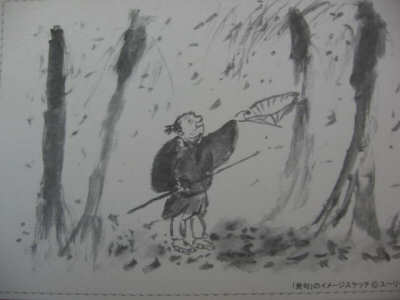
The DVD also includes paper cards of illustrations. I don't know if the same cards are included, or if (like Pearl Jam's No Code album) different cards are mixed around. In any case, my cards include those by Norstein. The above photo shows the first one, a terrific little sketch.

As a final note, I should add that Isao Takahata contributed a stanza for this movie. This was, after all, the reason I bought the DVD in the first place. It remains his only film work after My Neighbors the Yamadas in 1999. The husband-wife team of Yoichi Kotabe and Reiko Okuyama also created a segment; it's no surprise that these shorts are the best of the entire anthology.

More Ghibli Blog Posts To Discover